A detailed book honours India’s 75 years of UN peacekeeping service.
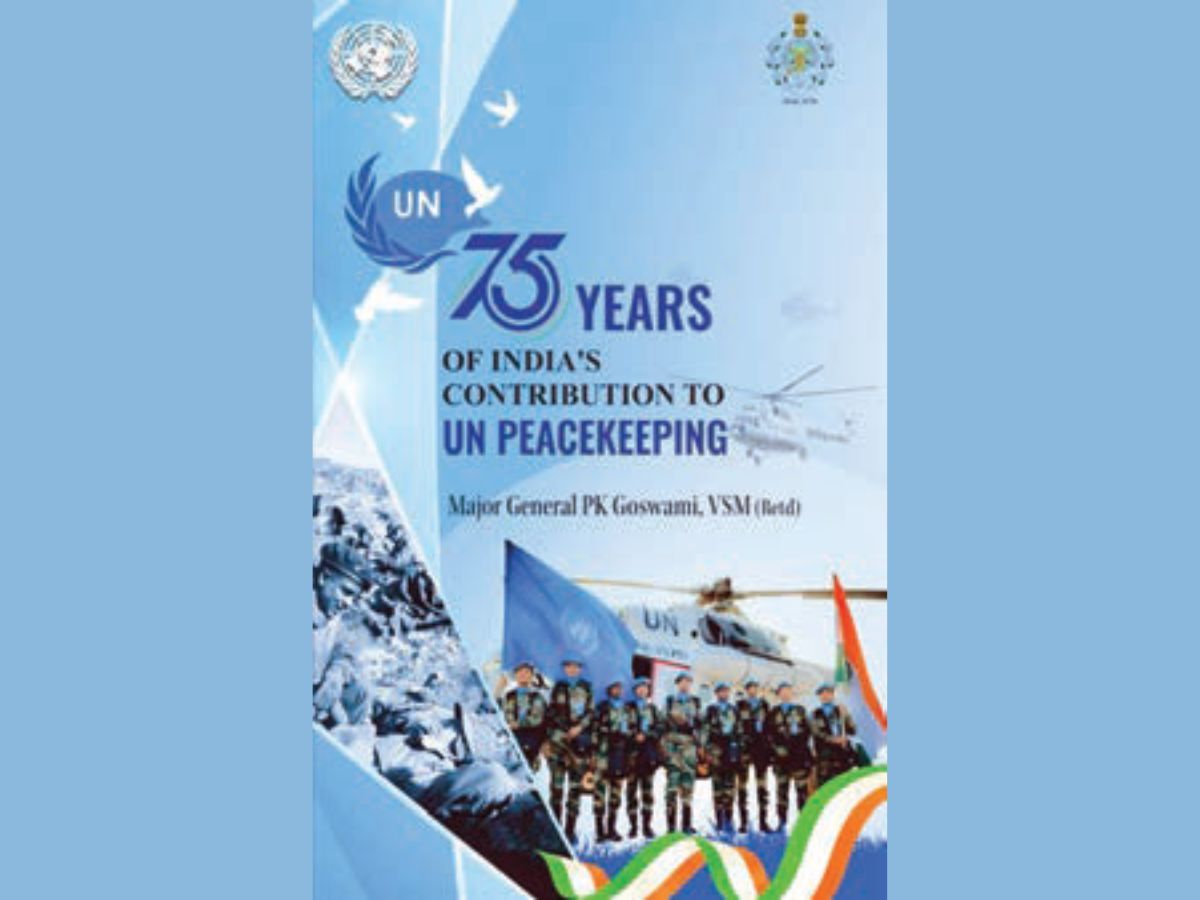
BOOK SHEDS LIGHT ON 75 YEARS OF INDIA’s CONTRIBUTION TO UN PEACEKEEPING
Introduction
75 Years of India’s Contribution to UN Peacekeeping written by Major General PK Goswami and published by Pentagon Press captures the essence of India’s peacekeeping contributions. It rightfully showcases India’s unwavering commitment to the challenges that the peacekeepers face and how they serve distinctively with courage, commitment and compassion.
Over the years, from Korea in 1950 to the last deployment at Abyei in Sudan, India, by far has deployed over 2,90,000 military personnel and nearly 15,500 police personnel across 50 out of 71 Peacekeeping missions which remains one of the largest contributions by any country. The peacekeepers include military personnel, police forces and civilian experts and have played a crucial role in conflict resolution, humanitarian assistance and nation building in regions ravaged by war.
Beyond the mission-areas, India has also played a critical role in shaping the doctrines and policies of UN peacekeeping operations. It has consistently advocated for stronger mandates, better equipped forces and a more representative global security architecture. India also continues to call for a reformed and equitable UN Security Council further reflecting its capacities, capabilities and contributions.
About the Book
The Book which has seven Chapters with seven Appendices is a detailed chronicle of India’s rich and multi-faceted peace- keeping journey which analyses its impact, challenges and evolving role. It does this admirably by its historical and policy analyses, first hand accounts and mission insights which provide a comprehensive understanding of India’s role in UN peacekeeping operations over the last 75 years.
As one of the founding members of the UN, “India has consistently demonstrated strong commitment through its active cooperation and clear understanding of its obligations to UN activities.”
For several decades, India has championed the cause of UN peacekeeping earning global recognition for its focused resolve, impartiality and professionalism of its peacekeepers.
Today roughly 5,500 Indians are deployed in nine active missions. Over the years, India’s peacekeepers have paid a high price as 182 have made the ultimate sacrifice in the line of duty. This blend of valour and sacrifice reflects India’s traditions (often summarized as Vasudhaiva Kutumbakam – “the world is one family”) in action, aligning its nonviolent philosophy with UN values.
Indian women have also been part of the missions since the 1960s, in Congo. India was first country to deploy an all-women contingent for a peacekeeping mission, in 2007 in Liberia. Today women are part of all missions where Indian troops are deployed. More women in peacekeeping means a more effective peacekeeping.
Besides troops, India has regularly contributed senior leadership to include three Special Representatives of the Secretary General and a Deputy Special Representatives of the Secretary General, fifteen Head of Missions and Force Commanders, two Divisional Commanders, and nine Deputy Head of Missions and Deputy Force Commanders so far, along with several Police Commissioners in various UN missions.
In addition, two Military Advisors, two Police Advisers which includes one woman, and two Deputy Military Advisers to the UN Secretary General. There is also an instance where the Secretary General had to write to the Prime Minister J L Nehru for Ambassador Rajeshwar Dayal for Congo.
India has adhered to the principles of non-violence and peaceful dispute resolution through dialogue and mediation which remain the central tenants of its foreign policy. Thus, the author writes that ‘India’s contribution to UN peacekeeping is not merely a calculated engagement but a reflection of its civilisational and cultural values, ethical foreign policy and commitment to global peace and security aimed at fostering harmony, cooperation and a stable international order.’
It is therefore evident that India’s contribution is both sought and valued by the UN, due to its dedication and professionalism of its soldiers. The acceptability of Indian troops, by diverse communities in war-torn countries, lies in its deeply rooted social, cultural, and religious ethos.
This remarkable heritage is deeply ingrained in the Indian character and reflected in Indian troops and police personnel serving in the missions abroad. As a result, Indian peacekeepers quickly understand and respect different cultures, and effectively connect with local populations wherever they are deployed. This helps in building trust, leading to greater acceptance, and maintaining peace in conflict areas, resulting in effective peacekeeping.
Crucial themes in the book include leadership under fire, dedicated diplomacy, and the protection of civilians. For example, Captain Gurbachan Singh Salaria led a small Platoon against Katangese rebels in Congo in 1961 and he was posthumously awarded India’s Param Vir Chakra (the nation’s highest military honour) – the only Indian to earn it in a UN mission.
Presently, Indian units often provide vital humanitarian aid. This year, Indian medical teams ran an outreach clinic in South Sudan that treated over 300 displaced people. Likewise, India operates a Level-III UN hospital in Goma, DR Congo, whose humanitarian outreach “aided FARDC (Congolese army) and civilians” and was praised by the UN’s Special Representative for its professionalism.
In the Chapter on the Way Forward the author has stated that India’s strength lies in its capacity to undertake peacekeeping operations in any terrain, social milieu, or adverse situations, and then sustaining such operations across the globe for prolonged periods. He further states that India’s future peacekeeping approach should enhance its global standing and diplomatic influence by linking peacekeeping activities to its wider foreign policy objectives. For instance, the recently conducted Chiefs Conclave of UN Troop Contributing Countries in Delhi in October this year.
The Appendices given in the book, give out various facts and data related to India’s contribution such as the senior leadership from the Army which includes then Major General (later General) KS Thimayya who was Chairman of the Neutral nations Repatriation Commission, the list of those who laid down their lives and those awarded honours and awards for their service to the UN including the names of Lieutenant Colonel AC Rangaraj and Major NB Banerjee of the Army Medical Corps amongst the five Maha Vir Chakra awardees.
There are also vintage newspaper cuttings of various international publications and a sonnet written by Brian Urqu-hart, the Executive Secretary to the Secretary General in December 1976, on the farewell of Maj General Dewan Prem Chand from Cyprus, encapsulating his contributions.
Conclusion
The book undoubtedly provides a human centric perspective on the rich history of India’s participation in UN peacekeeping over the last 75 years and succinctly conveys the professionalism, valour and sacrifice underpinning India’s contribution.
Written at a time of unprecedented armed conflicts raging worldwide with peacekeeping forces facing multiple challenges – from proxy wars and terrorism to climate-driven crises the book reminds readers that strong multilateral resolve is essential.
The Blue Helmets play a vital role is preserving peace. India’s remarkable and distinguished legacy as one of the largest troop contributors is admirable which not only reflects the growing global stature of India but also its commitment to uphold the values enshrined in the UN Charter. India’s role has gone far beyond providing manpower: it has often led peace-enforcement efforts, protected civilians, and extended humanitarian aid under fire.
The book is undoubtedly a must read for those interested in learning about India’s consistent commitment and principled approach to global peace and its pivotal role in in upholding the vision of a just world order. In an era of evolving security threats India’s continued engagement will be critical in strengthening peace keeping mechanisms, promoting stability and upholding the vision of collective security as it marks 75 years of its peacekeeping legacy.
