A cross-border conversation reveals shared struggles and solidarity among women journalists worldwide.
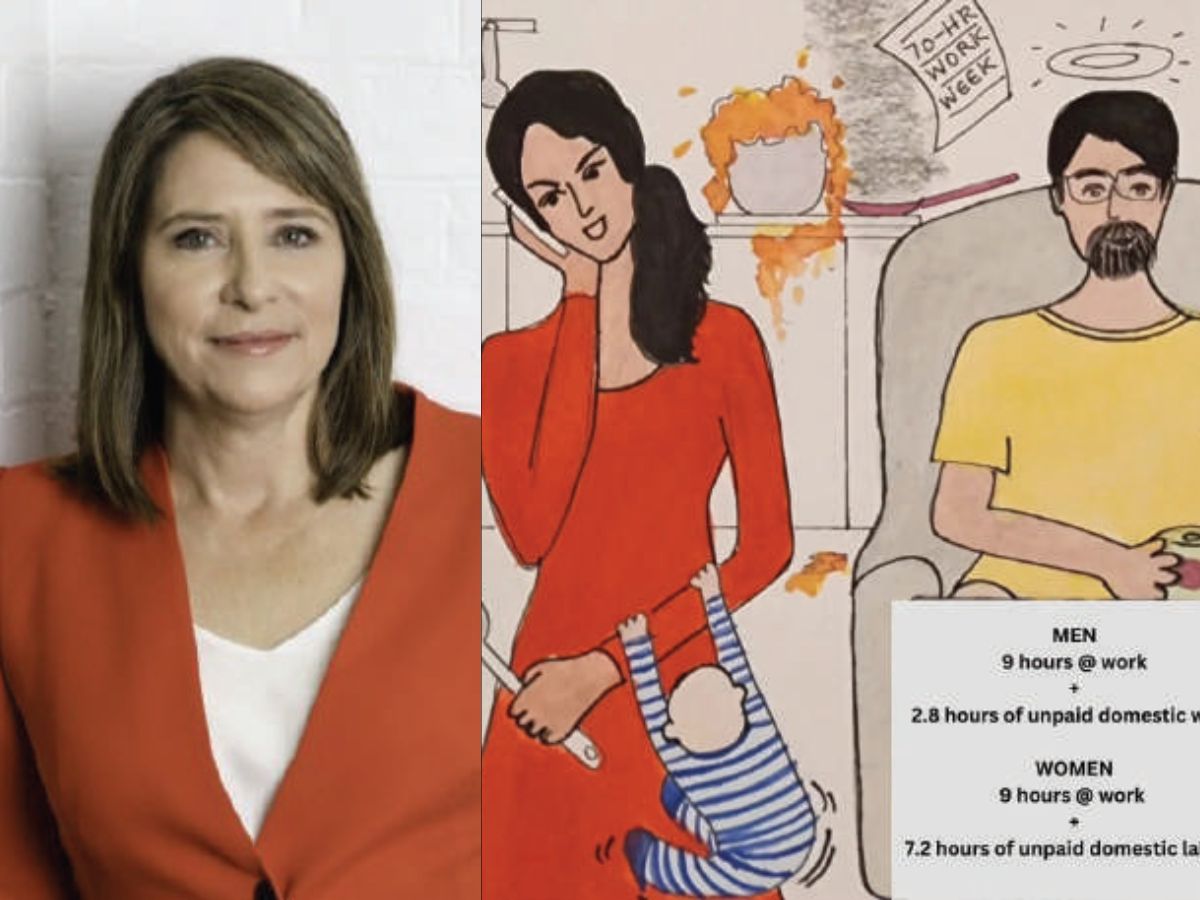
Kathy McLeish | Illustration by Anupama Bijur
I’ve always believed that journalists are outliers. Our profession trains us to be perpetually sceptical. Who really gets us are other journalists. Which is why when I met Kathy McLeish, an Australian journalist I’d never met before, we already had this sense of camaraderie. I was eager to meet her because she was travelling the globe to study initiatives aimed at increasing gender equality for women in the media. Bengaluru was her first stop, and when I heard about her visit through the Network of Women in Media, India, I immediately put out a message that I would like to meet her.
While Kathy was keen to know more about women journalists in India, I wanted to know about our Australian counterparts. Our mutual curiosity led to a frank conversation about the realities of being a woman in the media. We recorded it for a joint podcast which is already up on ‘Spotlight With Sandhya’. Kathy intends to make her recording a part of a series at the end of her findings.
As a senior journalist and producer with the Australian Broadcasting Corporation and Co-Chair of Women in Media Australia, Kathy has spent years watching women “smashing away at their typewriters” while their male counterparts walk around newsrooms “talking about their very important story and their very important voice.” This observation became her catalyst for change.
The first major study commissioned by Women in Media Australia, a not-for-profit initiative, titled ‘Mates Over Merit’, revealed what many women had long suspected: men were hiring people who looked like them, blocking women from senior roles not through deliberate malice, but through ingrained patterns of favouritism.
“The blokes get the jobs because of unconscious bias,” Kathy explains. “It’s not even necessarily intentional, but men are employing people that look like them and women aren’t getting to the top.” This outdated model assumes a primary breadwinner with full domestic support, a reality that no longer exists for most families, regardless of gender. The result? Women are leaving the industry at mid-career levels, unable to see pathways forward in organisations designed, as Kathy puts it, “for men with wives.” With “two income families, people are working together to have a family and a career and the model needs to change”, she says.
Kathy’s involvement with Women in Media began when someone tapped her on the shoulder, promising she “won’t have to do much.” At one point, it felt like two full-time jobs. But the first event she organised delivered an epiphany. Looking around that room at groundbreaking women journalists, she finally saw what had been hidden in plain sight: “We’re pretty amazing. This is quite an amazing group doing amazing work.” Those women “lined up at their computers smashing out the stories, hammering out those really great, important yarns before rushing off to their other full-time job at home” deserved recognition, amplification, and support.
(And quite fittingly, I found an apt sketch by Anupama Bijur, a friend and NWMI member, to illustrate this very point.)
Kathy’s realisation led to an understanding that showing young women journalists “who they belong to and what they’re part of” was crucial. Women in the media needed to connect across networks and organisations, breaking out of their silos to amplify each other’s work, share job opportunities, and simply acknowledge excellence.
Women in Media Australia has evolved beyond networking events to create tangible change. Its initiatives include leadership courses, the Relaunch program for women returning to the industry after redundancy or leave, and advocacy for industry-wide reforms including shadowing, mentoring, and sponsorship programmes.
Kathy emphasises that women often cannot see pathways beyond mid-management. The solution requires industry commitment to flexible work arrangements, and she agrees when I point out that the Covid-19 pandemic proved employees can work effectively from home as anywhere, in most cases.
“Companies are having to come to the party and offer flexible work hours and flexibility,” she notes, observing that organisations resisting this shift are losing talented people to those embracing change.
Kathy’s own career trajectory offers a blueprint for resilience in an industry that demands constant adaptation. From embedded reporting in Afghanistan to producing top-rating television programs, from agricultural reporting to disaster zone coverage, she has deliberately cultivated a broad skill set across radio, television, and digital platforms. “If you’re giving one piece of advice to young journalists, that’s the one I would think,” she reflects on the importance of multi-skilling. But beneath this practical advice lies a deeper truth: women often need to be twice as qualified to secure half the recognition.
The Winston Churchill Trust fellowship has enabled Kathy to travel to India, Germany, the UK, Vancouver, and Los Angeles to meet with NWMI, Deutsche Welle, the BBC’s groundbreaking 50:50 project, UNESCO, and various women-in-media organisations that have formed organically worldwide.
What strikes her most is discovering these sister organisations everywhere, fighting similar battles but rarely connected. The systemic challenges may have different layers in different countries, but the fundamental struggle remains universal.
Her fellowship will culminate in a podcast, ensuring her findings benefit women journalists globally. When women in the media connect internationally, Kathy observes with quiet satisfaction, “we all belong to each other.”
I send her off with a toast to connect with the global sisterhood. Beyond collecting data, I hope her journey will build bridges between women journalists worldwide, recognising that our struggles and strengths transcend borders.
Sandhya Mendonca, author, biographer, podcaster, and publisher at Raintree Media, offers a distinct female gaze of the world in this column.
