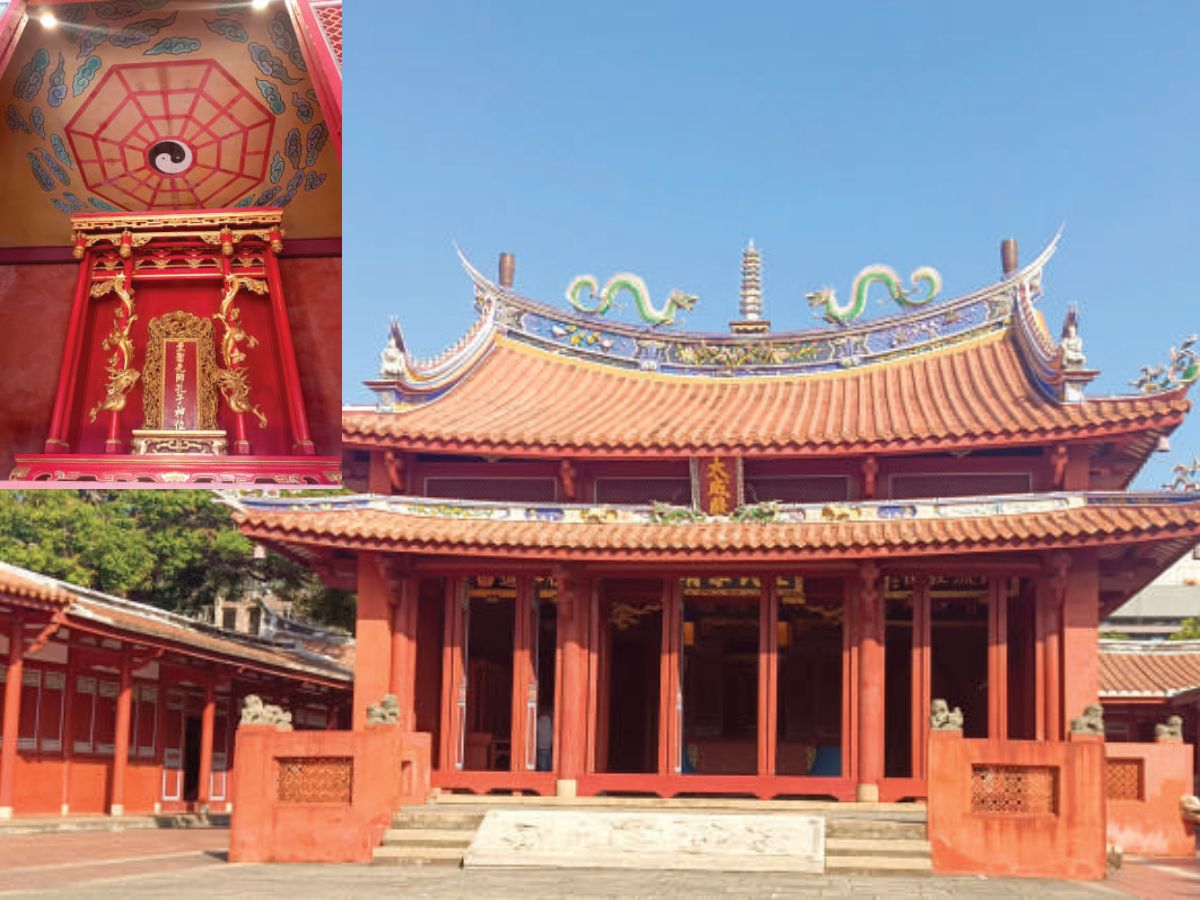
Inside and outside the 400-year-old Confucius temple in Tainan city (first built in 1665) of Taiwan on December 12, 2025. Photo: Venus Upadhayaya
Humanity has ushered into a new year. I have had many and myriad thoughts about world affairs sitting in Taiwan last year. Here I have chosen one out of these many to articulate my first piece of this column.
I have been seriously thinking about politics from the perspective of the human mind which means I have been thinking about some serious topics like leadership, pragmatism, diplomacy, policy making and growth from a psychological perspective. I would add peace to this list but would preferably use harmony as a better synonym, simply because while peace is a delicate balance between war and deterrence, harmony encompasses peace and also requires growth, innovation and well being.
This list isn’t inclusive for that’s what my mind can take on at present and I think that’s serious work. Can harmony replace the peace narrative in 2026?
In Taiwan I pursued this mental engagement further by visiting several Confucius temples in an attempt to understand how the human mind has pursued social order and individual growth in this part of the world. Confucius is one of the greatest contributors to the Chinese mind and the influence of his teachings continues to shape diplomacy, leadership as well national thought in one way or the other across all states influenced by Chinese civilization.
I visited the Confucius temples in Taipei, Taichung, Chaiyi, Tainan and Khaoshuing cities of Taiwan–witnessing architecture, art, religion, rituals, education and worship and drawing for myself a unique sociocultural experience that I termed “Dragon Trails.” But more than all these things that I just listed I also drew important lessons about leadership, organizational psychology, symbolism, soft power and diplomacy.
On my Confucius themed “Dragon trail” in Taiwan I often biked my way to the temples, regularly lost and constantly facing challenges to find my way. And each time the challenge created an opportunity for a new learning and a new path and I gradually realized that the journeys I undertook were more than an attempt to understand Chinese philosophy, religion or culture--it was also leading me to gain new experiences, widen my knowledge and perspective while overcoming many psychological blocks that hindered my personal progress.
What’s leadership perpetually–it’s not only the ability to find solutions to problems impacting oneself and many but it’s also the ability to juggle multiple perspectives, assimilate them, analyse & negotiate them and yet remain rooted in the best interest of one’s mission. The greatest people in the world including Confucius highlight this analogy.
At Confuscius temples I often thought how Confuscius would have led a change in his world. His teachings were so impactful that they have lived beyond his life continuously influencing thinking, leadership, institutional building, and education. They have majorly influenced Chinese cultural diplomacy globally who call their global culture and language centers as Confucius Institutes. Unlike them the Taiwanese didn’t draw their foreign policy on Confucius but have maintained temples as museums, living monuments and cultureeducation centers embedded in society.
I looked for Confuciuslike leaders in Indian history who have in some way created unique learning or educational institutions as well as learning systems for a multifaceted growth of the human mind. I remember at Kaohsiung Confucius Temple while sipping coffee and munching some savories in a cafe called Mango, I became reminiscent of my time working with Sri Aurobindo Society. The philosophy and work of Sri Aurobindo and Mother also focussed on a multifaceted but integral development of the human being and the Ashram school at Pondicherry and other educational institutions linked to the Ashram draw inspiration and methodologies from their approach.
At Taipei Confucius temple I witnessed a music class where many students were learning a Chinese string instrument called the Erhu. And my dabbling into Chinese calligraphy in a Calligraphy school at Taipei helped me understand how the tradition of Calligraphy and its techniques right from the beginning starts with an assessment of the mental ability and its inherent refinery and then progresses to building its skills in a time tested manner.
Any leader who would have pondered over the complexities of society and its existence would have certainly reflected on human psychology in tangible or stereo tones--Confuscius did and so did Sri Aurobindo! And the style of a particular leadership is likely determined by how the complexities are internalized, communicated, negotiated and harmonized. There are many instructors but leaders or the greatest leaders are only few because while many want to be decorated with the leadership crowns, only few cultivate the mind and life that demand sacrifice, commitment and investment in a life-long process of growth, constructivism and service.
Cultivation requires vision of a life that goes far beyond the sense of immediate personal interests.
Now whether it was Confucius or Sri Aurobindo the uniqueness of their paths of life tell us that every individual’s path of cultivation is unique.
If we desire a fine mind, we should have the courage to cultivate it. We should commit to cultivation and harmony rather than just materialism and peace.
