
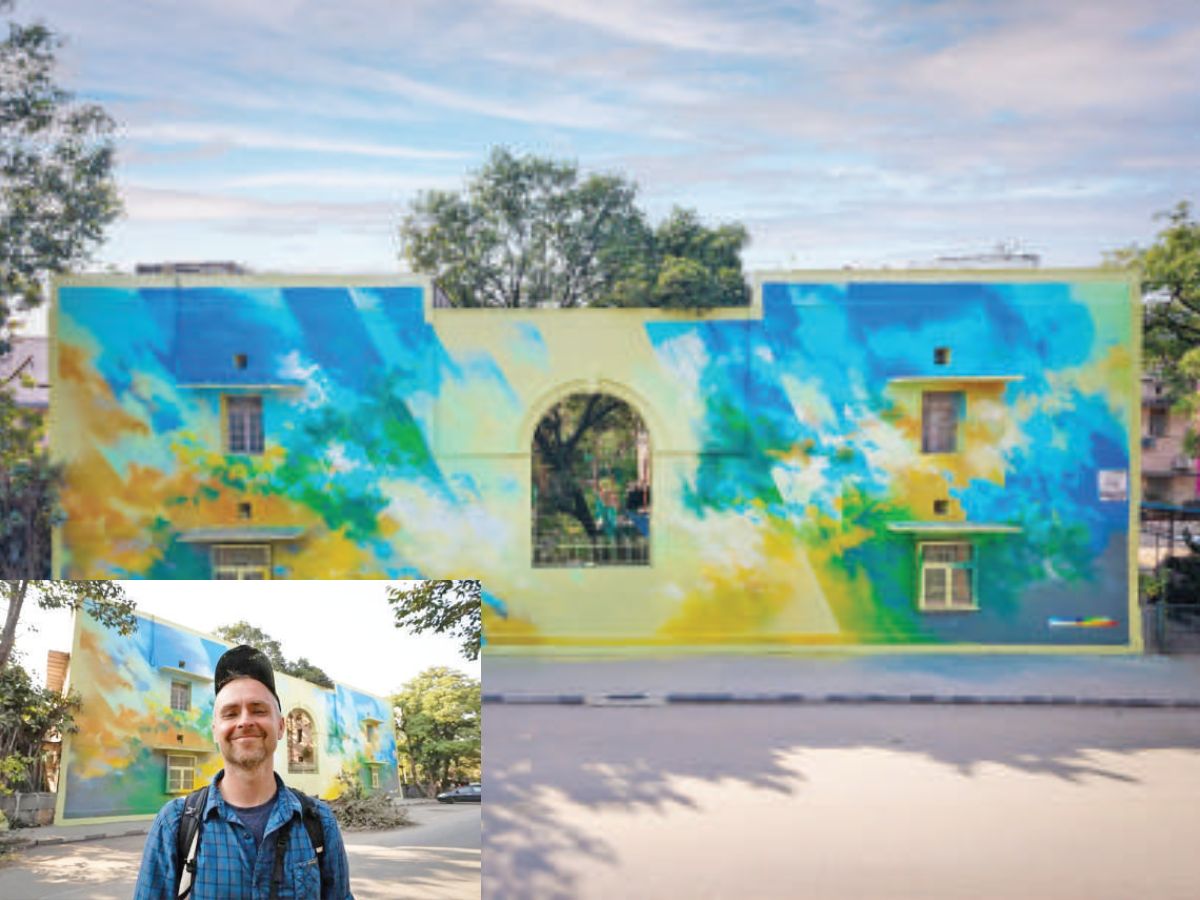
New Delhi wakes gently. Before the traffic begins its daily argument with time, before the markets stretch open their shutters, there is a suspended hour when the city seems to breathe in silence. It is this fleeting, fragile interval that Polish artist Bartek Swiatecki chose to immortalise on a towering wall at the Lodhi Art District during the Lodhi Art Festival 2026, presented by the St+art India Foundation. Marking a decade of the Lodhi Art District as India’s first public art district, this year’s festival—curated around the theme Dilate All Art Spaces—brings together Indian and international artists in a celebration of dialogue, experimentation and shared urban imagination. Swiatecki’s mural, titled Daybreak, stands as one of its most contemplative contributions. His participation in the festival is supported by the Polish Institute New Delhi, underlining the growing cultural exchange between Poland and India.
“This mural is a story about a moment of transition,” Swiatecki says, standing a few feet away from the vast geometric composition that now bathes a residential façade in luminous tonal gradients. “It is a subtle line between night and day, between what is hidden and what is only beginning to reveal itself.”
Swiatecki’s inspiration came not from monuments or spectacle, but from his quiet morning walks through Delhi. “I took photos at daybreak in New Delhi,” he explains. “That time when light does not simply shine onto the world, but makes it emerge bit by bit. A daybreak is still not a day in its full bloom. It is the time of silence and tension.”
“Colours come to life from darkness,” he reflects. “They become more saturated and start defining space. Contours which have so far been blurry now become clear. The form emerges from the shadows, and the world becomes more tangible. This moment is like magic—the transformation is subtle, yet irreversible.”
For Swiatecki, daybreak in India carries a particular resonance. “The air is soft, the light is warm, and reality seems suspended between dreaming and the energy of a new day,” he says. “This feeling became the foundation of my composition. Colour here is not decoration. It is a carrier of energy and emotion.” He adds with a smile, “But I think the most important thing in this kind of situation is the relationship. Being together.”
Over seven days, he worked nearly 11 hours daily, assisted by a small local team. The preparation, he emphasises, was meticulous. “I was prepared 100 per cent when I arrived. We discussed colour charts, composition, what I need. There were many talks before I came. I felt very safe, very comfortable. The organisation here is amazing—so many people involved.”
Unlike some festivals abroad where artists are handed a wall and left to their own devices, Swiatecki found the Lodhi experience deeply immersive. “In some places, you arrive and they say, ‘This is your wall, this is your paint, this is your hotel.’ And that’s it,” he says. “Here, everything is different. There are people around you. For all seven days, I was talking to people walking by—about what I am doing, about abstract forms. It’s a completely different way of thinking about art in public space.”
Residents embraced him warmly. One neighbour, he recounts, greeted him each morning. “He came early in the morning and always said hello. Today he sent me many photos. They are super happy. That relationship—that is important.”
A defining aspect of Daybreak is its environmental sensitivity. Before finalising his palette, Swiatecki virtually wandered the neighbourhood. “I did a walk on Google Maps around my wall,” he reveals. “I sampled colours from the trees, from the buildings—greens, oranges, everything. All the colours I used on the wall come from this environment.”
The result is a mural that, despite its bold abstraction, feels organically anchored. “It’s a big, dynamic, abstract geometric form,” he says. “But I think it is connected with the whole environment around.”
Technically, the mural pushed him into new territory. Used to working with stronger contrasts and darker tones, Swiatecki chose a fresher, more nuanced palette for Delhi. “Usually I work with big, dark contrasts,” he says. “Here everything is more delicate, fresher. I realised it needed that.”
Although widely recognised within the European urban art scene, Swiatecki resists being boxed into a single category. “I am not very comfortable with the term ‘street artist’,” he says candidly. “First of all, I am an artist. A painter. I make the same shapes on canvases as I do on walls.”
In Poland, he notes, harsh winters mean months spent in studios rather than on scaffolding. Still, he acknowledges the energy of graffiti culture. “Graffiti is still pure,” he muses. “You can’t stop it. You can’t say this is good or bad. It happens. There is a lot of vandalism, yes—but also energy. Sometimes I see things I don’t like, but I think: they have the guts to do it.”
He has witnessed urban art’s complicated relationship with gentrification in cities like Berlin. Yet in Lodhi, he sensed something different. “Here, I had a connection to the environment,” he says. “I saw the smiles of ordinary people. We drank tea in the morning, ate lunch on the street. They could see I am not just a guy from Poland painting abstract forms they don’t understand.”
As Lodhi Art District celebrates its tenth year, that sense of promise feels especially apt. The festival continues to expand conversations across borders, inviting artists like Swiatecki to reinterpret the city’s surfaces as shared canvases.




