
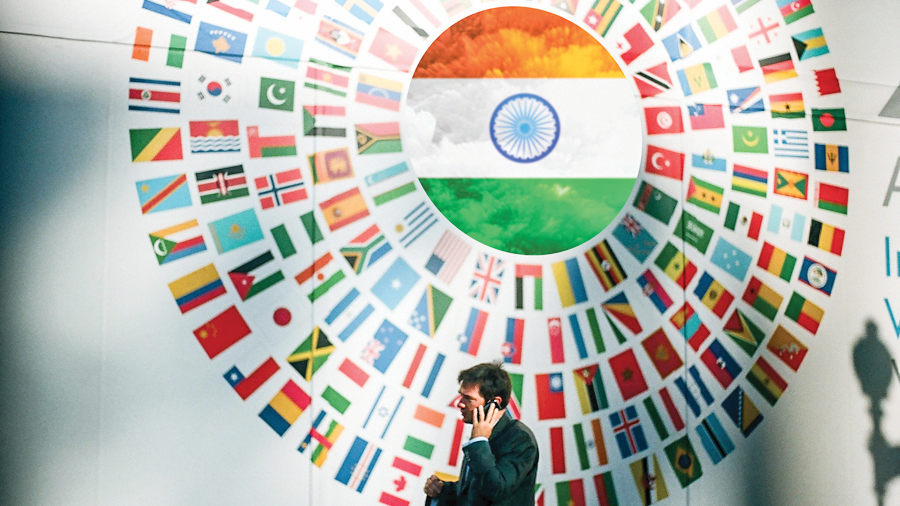
In a deeply religious society like India, conservative thought can be defined by the left comforted dispensation as the one being synonymous with religion led politics. But in today’s geopolitical world threatened by Chinese Communist thought and kindled by an economically rising India– India’s conservatism needs a fresh definition. It’s important to understand and define what would be a conservative, yet progressive Indian thought that’s unique in its construct and doesn’t rely on comparisons with west’s definitions of left vs right.
A burgeoning Global South looking for an alternate to Chinese Communist IQ and also an alternate to the American perspectives of global thought should have an India-led option which is futuristic, practically attainable and empowering. This fresh definition of Indian conservatism could include perspectives grounded in following thoughts: Timely scientific and technological aptitudes, approaches and aspirations that are rooted in national development and collective goals. Second: Ethical perspectives that are practical and applicable in society and economy. These will reflect in governance approaches and can be measured. Third: Revival of a lost civilizational genius based on not just a narrative of its history but on the intellectual, applicable power of its culture.
Solution Oriented & Introspective
It’s important for India to start to define its conservative thought from a global perspective–not just from a philosophical viewpoint based on history and heritage but also from the standpoint of societies focused on rapid economic growth, speedily transforming and efficient work ecosystems, and intelligent policy frameworks that provide innovative alternatives to left-bred systems. It demands that India’s conservative thought becomes solution oriented for it to gain the leadership of a vast majority of the world looking for solutions to many problems. These problems include those created by old schools of thought–both by what the west defines as left and right, and by the antagonistic schools led by the communists.
In times where even the left is calling itself democratic and the context of democracy has dramatically become a battle ground between the left and right– a resurgent India needs to think how its conservatism and freshly building global leadership–takes an untrodden path–without getting trapped into the left and right battlefield. An economic position behind this polarity breeding competition between–US and China–demands that India has its own school of thought. One can’t expect the left to disengage itself from its decades of history and its contemporary alliances but one can expect the conservatives in India to define a school of thought that doesn’t fall into domestic and global traps of idiosyncrasies and rhetoric. This is what the Global South demands from India in return for its validation of India as a global leader. Anything else would be merely a narrative forged by storytelling.
What would be sustainable leadership?
Rising to the rank of a nation with “sustainable leadership benchmarks” requires that India nurtures thought frameworks that instill cultural values in institutions guiding them to achieve productivity, efficiency and overall developmental goals. Cultural values are a progressive concept that define operating values of a productive community such as an industry or an organization. For example Google runs on a set of cultural values that are put into place after a lot of thought– they run like an underlying thread through everything that defines Google from its branding to its business goals to its deliverables. “We’re committed to significantly improving the lives of as many people as possible,” says Google on the “About Us” page of its website. It highlights the following values that define it: “Protecting users; Building and deploying AI responsibly; Expanding Opportunity; Helping solve society’s challenges; Responding to crises; and Building for everyone.” Google is nurtured by these values and it is accountable on these sets of perspectives in its overall operations–its planned, time-bound growth is led on these fundamentals. This is just an example to showcase that progress is derived and determined by value systems and how they are implemented and how they evolve. India’s conservative thought leaders need to do the same.
Multilateralism & Conservative Thought
I would again define three core areas to begin with while laying a framework for India’s Conservatism and its global Leadership:
1: Science and Technology
2: Psychology and Global Societies
3: Multilateralism from a Conservative Perspective All these should be built on India specific research and development. Sitting in Taiwan and trying to fathom its development model, I’m constantly reminded of its policy towards science and technology. Very obviously its values weren’t led by what the PRC was fundamentally led by. It derived multiple learning from other developed societies of the world but eventually Taiwan’s model of progress is its own.
Somewhere that’s reflected in the way its ‘left and right schools of thoughts’ don’t align with the generally popular definitions of left and right in the west. Taiwan’s left isn’t defined by the communist thought! When on an untrodden path, one can’t always expect to follow the way of the left or the way of the right– as the west defines. In this complex, practical world defined by a complicated and interconnected set of realities, things often overlap and play out in unexpected ways–a leader is required to respond. The response defines its leadership! So how India’s conservative leaders, thinkers and other contributing minds assert themselves on their way to the mid-century will also shape their school of thought/s and their style of global leadership.
Any school of thought is never a static framework–maybe it’s so for static societies but for an India that’s looking for a dignified space for its leadership in the global arena–this awareness of a practically ethical, solutionoriented conservatism is essential. Evolving this conservative school of thought isn’t the responsibility of one political party or the other. On its march to mid-century crown, this is the responsibility of every Indian who cares for an innovative, rational India. Venus Upadhayaya is a senior journalist and a MOFA 2025 Taiwan fellow.




