The ceremony marked the birth anniversary of Pandit Goswami, the renowned Assamese writer, historian and linguist.
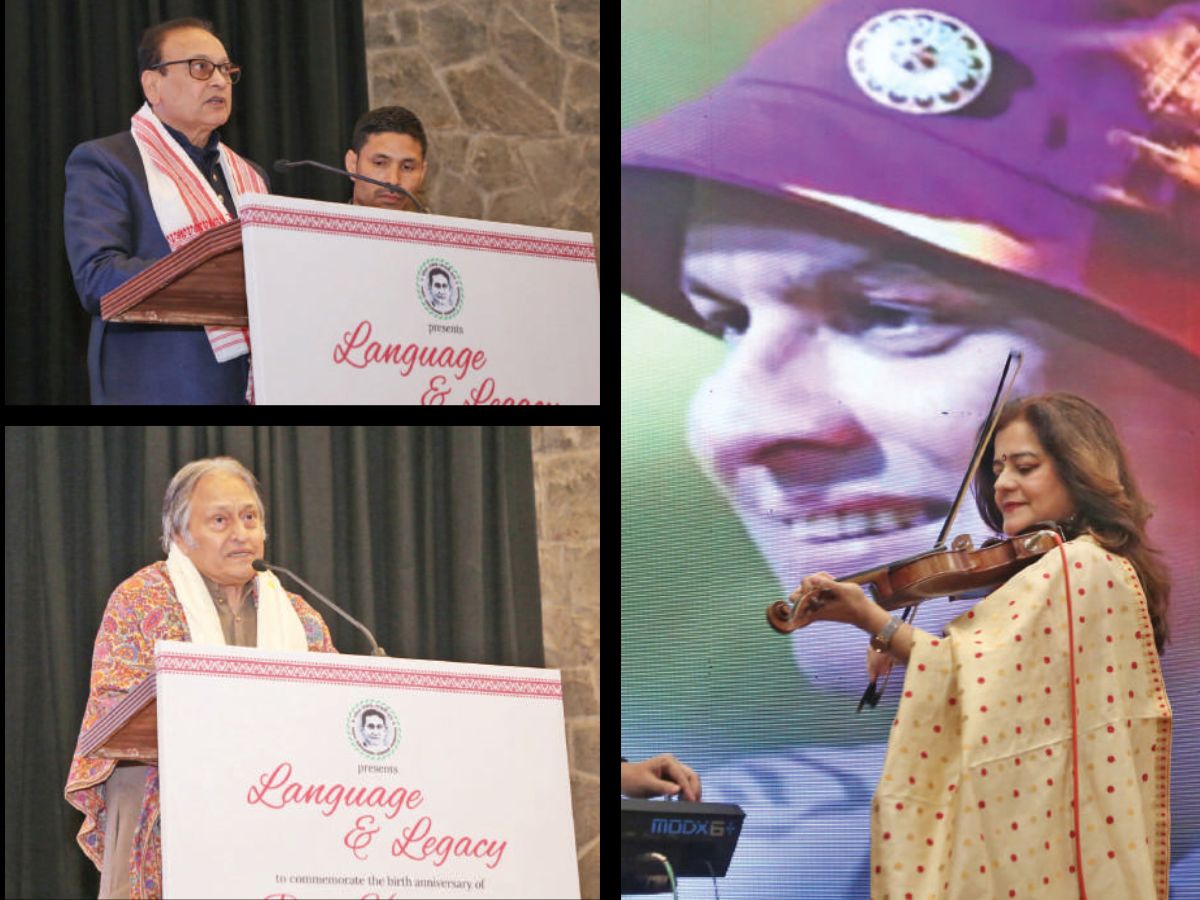
Ustad Amjad Ali Khan | Dr Naba Goswami | Sunita Bhuyan
The length and breadth of India has such a variety of cultural traditions to offer that it might take many lifetimes to absorb it all. Over the years, however, a few cultural ambassadors have become the bridge for people to have a glimpse of the traditions, languages and legacies from cultures other than their own. One such is Assamese polymath Pandit Hemchandra Goswami. On January 9 this year, Delhi celebrated this legendary person’s legacy with a specially curated program at the Deshmukh Hall of the India International Centre (IIC), which was graced by the presence of sarod maestro Ustad Amjad Ali Khan. Organised by the Pandit Hemchandra Goswami (PHCG) Foundation, set up by his grandson, Dr Naba Goswami, in collaboration with Suraj Foundation, ‘Language & Legacy’ proved to be a memorable commemorative event.
Established in 2022, the PHCG Foundation’s core vision is to promote science and Assamese culture. Through a strategic partnership with IIT Guwahati, the foundation organises educational outreach for students from remote corners of Assam, ensuring that the cumulative body of traditional practice and belief is preserved and passed down through the generations. The ceremony marked the birth anniversary of Pandit Goswami, the renowned Assamese writer, historian and linguist, with a program curated by the acclaimed violinist Sunita Bhuyan, who is known for promoting the rich elements of Assamese culture through collaborative projects across the world. She is also the principal curator of Suraj Foundation.
Speaking about the occasion, Bhuyan shares, “This initiative was driven by the tireless vision of Dr Naba Goswami, the illustrious grandson of Pandit Hemchandra Goswami, who has worked relentlessly to conserve and promote his grandfather’s monumental contributions and Indian culture at large.” Expanding on the role of the foundation, Dr Goswami adds, “A cornerstone of our mission is the current collaboration between the PHCG Foundation and the Centre for Indian Knowledge Systems at the Indian Institute of Technology (IIT), Guwahati. Established following a request by the Honourable Prime Minister Narendra Modi in 2020, the Centre performs yeoman service in educating the youth through a multidisciplinary approach that bridges traditional Indian knowledge with modern scientific understanding.”
Pandit Hemchandra Goswami (1872–1928), who is known as the architect of Assamese identity, has long been somewhat of a defining figure in the Assamese intellectual landscape. He dedicated his life to the preservation of the Assamese language, leaving behind him an invaluable legacy. A significant linguistic contribution of his was facilitating the publication of the first edition of Hemkosh, which is the definitive Assamese dictionary compiled by Hemchandra Barua. Pandit Goswami is also credited with composing the first-ever Assamese sonnet titled ‘Priyatamar Sithi’ and serving as a primary resource for Sir Edward Gait’s book ‘History of Assam’. He also compiled Axomiya Sahityar Saneki, which documented 1,500 years of the region’s culture. Further, he systematically catalogued and edited 233 historical chronicles to establish the antiquity of the language. This culminated in the work known as ‘A Descriptive Catalogue of Assamese Manuscripts.’ Pandit Goswami also served as the fourth president of the esteemed Asom Sahitya Sabha.
The commemorative event in Delhi was attended by an esteemed gathering of scholars, cultural icons and performing artists, with Ustaad Amjad Ali Khan being the cherry on the cake. A keynote address offered a scholarly discussion on the crucial role played by narratives in advancing the idea of nationhood. This was followed by the screening of a documentary movie produced by Dr. Naba Goswami. Titled ‘The Greatest Legendary Scholar from Assam: Pandit Hemchandra Goswami’, the occasion marked the premiere of this film highlighting the life of Pandit Goswami, with narration by actor Adil Hussain. A thought-provoking panel discussion explored the journey of the Assamese language and heritage. Its speakers were Dr Uday Dixit, Dr Jayanta Biswa Sarma, Partha Sarathi Mahanta, Sangeeta Barooah Pisharoty, Surjya Kanta Hazarika and Mayur Bora – all luminaries in the Assamese cultural sphere. The event also saw the official release of the commemorative book ‘Legendary Scholar Pandit Hemchandra Goswami’.
The evening ended on a memorable note with a special musical tribute by Sunita Bhuyan. Dedicating her performance to celebrating the cultural leadership of the late Zubeen Garg and late Dr Bhupen Hazarika, she sang and performed songs by both these luminaries. Bhuyan ended with a violin performance of her own composition, ‘Stringing notes to words’. The afternoon concluded with a high tea and enriching conversations among guests.
Noor Anand Chawla pens lifestyle articles for various publications and her blog www.nooranandchawla.com.
