
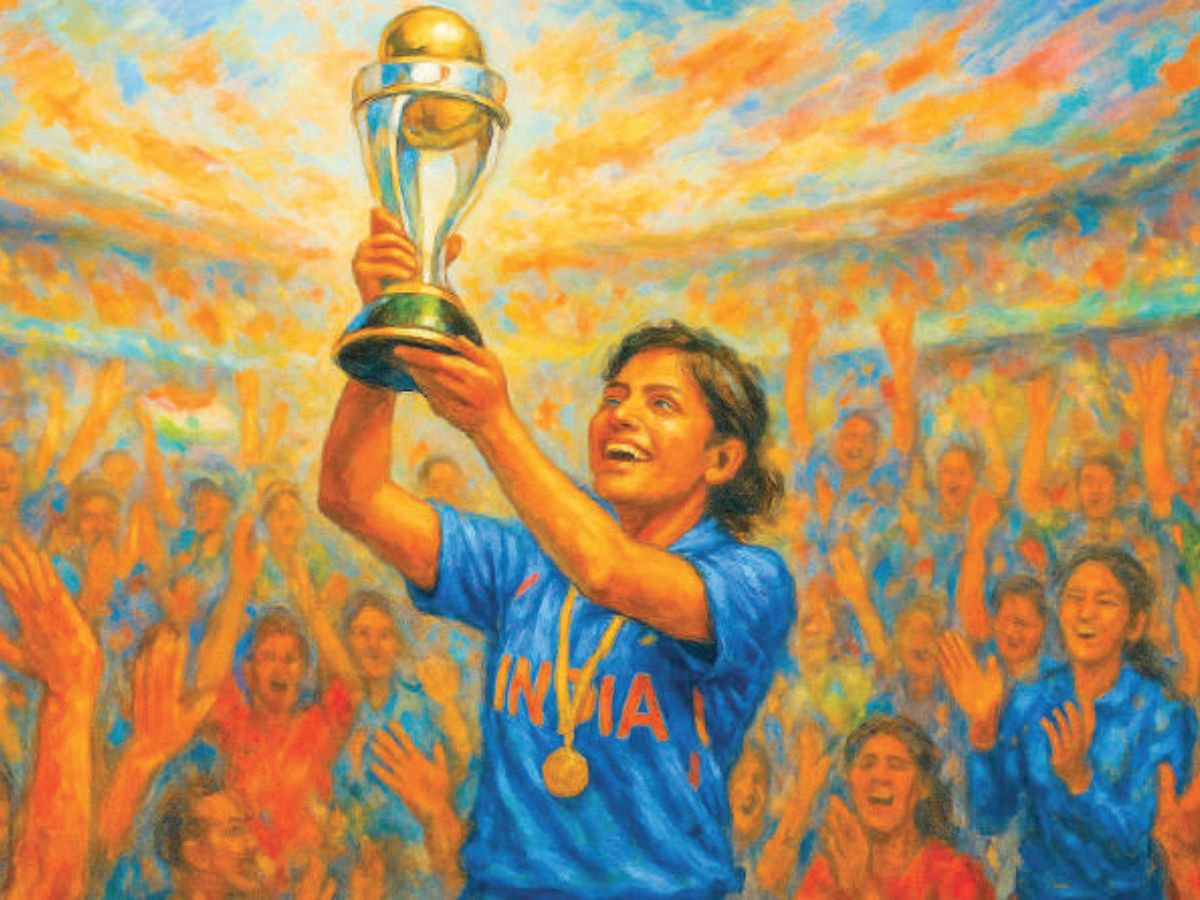
The country is cheering. We are justifiably happy: our women have lifted the cricket World Cup. Behind genuine applause, jingoism, chauvinism, and cricket worship, too, have found an alibi. It’s opportune to ask the noise: what exactly are we celebrating?
On screen, we won a contest between women from two countries. Behind the screen, for one country, it is more of a contest between the woman and the walls within her. What we saw was misleading, suggesting the woman struggles against foreign forces, is supported by her folk, and fights principally external battles. Yes, there is indeed a battle, but the TV screens fail to show the real battlefield.
Will this victory help, in its small way, transform the ordinary woman’s life, or end as another forgotten moment of pride? Or will it rather lull us deeper into complacency?
The win matters. It represents women occupying spaces once denied to them. The girl who fights on the field learns how to fight the world outside and within. Let’s explore the real fight and the battlefield.
Neither Puppet Nor Goddess, But Player
For ages, Indian women have remained trapped between two false pedestals. Either puppets: obedient, strings pulled by custom. Or goddesses: worshipped in poetry, yet denied the dignity of being human, flawed, striving.
Sung about but kept from fields. Celebrated in verse but suppressed in practice. Today, we glimpse what happens when women refuse both scripts: standing neither as decorative dolls nor divine symbols, but as players, warriors, conquerors. Claiming not worship but their rightful place to sweat, struggle, fail, and rise.
When a living being turns from object to subject, from being gazed upon to taking action, it is quite a transformation.
Unlearning the Myth of Fragility
For centuries, a woman’s weakness was disguised as grace, her silence praised as virtue. She was called chuimui, so fragile that even touch might wither her. Myth and culture built this poetic illusion.
But fragility was manufactured. The world didn’t merely admire her softness; it required it. A fragile woman is convenient. A strong woman compels man to confront his own inner slavery.
When Indian women win against players from countries with stronger infrastructure and freer societies, the old myth crumbles. Their victories are born of discipline, resilience, and clarity. Not emotion. What we see unveiled is strength that was always there, just purposefully kept on a leash.
This win challenges a civilizational assumption: that women must remain delicate and desirable. The chuimui image fades, replaced by the woman composed, capable, quietly fierce.
Redefining the Sacred
For too long, we’ve been told sacredness lives in conformity, that holiness abides in women who stay within lines drawn by tradition, still and silent like temple idols.
But divinity is not a frozen pose. True holiness lies in the full flowering of human potential, in the courage to beat the odds.
The sacred is what transforms, not what remains unchanged. When a woman breaks barriers, claims her complete humanity, the divine reveals itself.
This victory shows that piety is not preserving the past, but unleashing possibility. Reverence belongs not to those who conform, but to those who transcend. The truly sacred is not ritualistic compliance, but the urge to overcome limitation.
A Celebration That Must Not Conceal Reality
Can we claim equality when, at the hour the final was played, unborn girls were still denied the right to live? While one set of Indian women lifted a trophy, countless girls never got to touch the field of life itself, eliminated before their first breath.
Can we call ourselves fair, carrying a gender imbalance of millions? When every celebration must be haunted: how many potential champions were never born?
Maya decorates the surface to hide what festers underneath. Look at where champions come from. Nearly half of India lives in the Hindi heartland, yet how many national players come from UP, MP, Bihar, or Rajasthan? Regions guarding tradition most loudly offer the fewest chances. Meanwhile, the Northeast, South, and states like Haryana produce far greater representation.
This is a mirror showing where opportunity exists and where it’s denied. Every boundary scored must turn into boundaries broken in homes and minds. Every four should remind us of that other chauka, the kitchen space that remains more prison than room.
The Measure of Progress Is Beyond the Scoreboard
After every match, talk shifts to rewards and prize money. But if we want to measure progress, wages aren’t the place to look. The real indicator is participation: in work, decision-making, and public life.
Across India, women’s labor force participation declined for decades, even as household incomes rose. When families become comfortable, women are told to rest. Her effort was valued only as economic help, not freedom. When the need ends, her liberty ends. That’s prosperity turning into bondage.
The question isn’t whether women work, but why they’re allowed to. When work serves comfort, it’s welcomed; when it serves freedom, it’s resisted.
How many women lead companies, shape policy, direct capital? A nation that truly honors its women doesn’t count medals; it counts voices heard without permission.
When Women Breathe, Nations Breathe
A nation cannot be truly free while half its population remains in chains. When women play freely, the nation breathes freely. When women claim their place, the planet finds its peace.
This isn’t just a metaphor. It’s recognition of deeper ecology. The earth cannot heal while half of humanity remains suppressed. Patriarchy wounds not just women or men, but the very consciousness of humanity.
Women’s empowerment is the loosening of humanity’s bondage. When she breaks her chains, he becomes freer too. Both were tied to the same delusion: that power and tenderness must belong to different beings.
When women enter classrooms, offices, and fields freely, the culture itself expands. When the culture breathes, the nation breathes. When the nation breathes, the Earth faces less violence.
Encouraging Courage, Not Compliance
To loft the ball for a six is courage made visible. Girls must be taught early: take risks, fall and rise, lose without collapsing. Failure is rehearsal for strength.
A boy who errs is told to try again; a girl who succeeds is told to be careful. This must change. Daughters must walk through doubt. Their heads have been bent for generations; time to look straight.
But courage without clarity becomes another mask of fear. To rebel without awakening is to repeat the oppressor’s mind in a different costume. The goal is not to prove women stronger than men, but to make gender irrelevant.
When strength loses balance, feminism becomes a reaction instead of a revolution. Real empowerment is steady, not noisy. It’s the grace to persist without hatred, to rise after defeat without bitterness. True victory begins when the self ceases to measure itself against another.
The Triumph Over Limitation
This win reveals what becomes possible when women stop being ornaments and start being participants. For centuries, India celebrated women as symbols of purity, patience, and sacrifice, but seldom as doers. This reverses that. A woman is not sacred because she endures, but because she acts, strives, transforms.
The true victory is never over another team. It’s over boundaries drawn by customs and fear. Yet the work is not done. How many girls still cannot play, travel, or study freely? How many remain voiceless? And most haunting: how many are denied even the chance to be born?
Every step in sport must become a step in life. Every cheer must be accompanied by a commitment to create more champions. Not just in cricket, but in classrooms, boardrooms, laboratories, and legislatures.
To the Champions
To the Indian women’s cricket team: your composure under pressure, quiet discipline, refusal to be reduced to symbols: all this transcends sport. You showed us that strength need not shout. That grace and grit aren’t opposites. You challenged a millennium of conditioning. Every ball you faced carried the weight of history, saying you don’t belong here. You’ve lifted not just a cup, but countless heads that had been trained to bow.
An Augury, Not an Endpoint
History will remember this day not merely for the trophy, but for what it stands as an omen of. This is a portent, a beginning, a crack in the old order through which light has begun to pour.
May this be the dawn of many more victories in every field denied to women. May this spark transformation where reverence comes not through tradition but through transcendence. The cup will one day lose its shine. But the mirror this victory has held up: showing both progress and failures, cheers and silences. This mirror must never be put away.
The real test is not how loudly we celebrate today, but how seriously we act tomorrow. Not how many times we replay the winning moment, but how many girls we ensure will never have to fight as hard for the right to play.
The triumph is real. The celebration was worth it. But the work has only begun. That work will be complete only when no girl has to be extraordinary just to be treated as an equal. When playing is a right, not a privilege. When freedom is a birthright, not a trophy to be won.
Until then, let every boundary they scored remind us of the boundaries we must break. Let every six they hit remind us of the ceilings we must shatter. And let this cup they lifted remind us of the millions of heads that must be lifted still.
Acharya Prashant is a teacher, founder of PrashantAdvait Foundation, and author on wisdom literature.




