Religion was never about belief or ritual—it began as a deep inner longing to be free from suffering and truly awake.
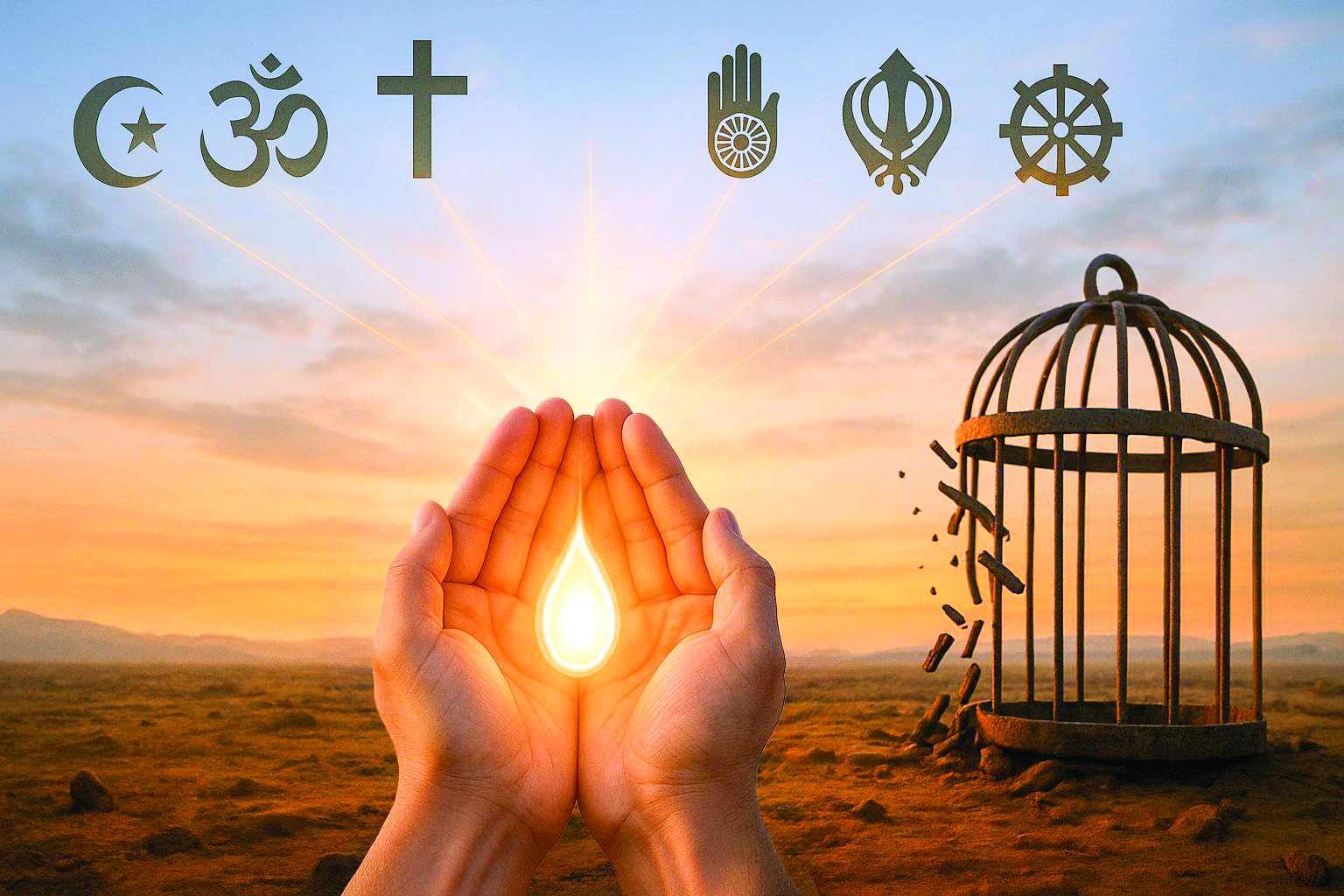
Religion, in its truest essence, began as a stirring within, a call to look deeper than what appears on the surface. It was never meant to be about commandments or ceremonies, belonging to a group, or defending a tradition. It pointed toward something more essential: a different way of seeing, a different way of living.
Yet, as that sacred impulse entered the world of systems and structures, something began to shift. Not out of malice, perhaps, but out of habit. We started clinging to the shell and gradually lost touch with the core. What came as pure compassion and unwavering clarity was often met with fear, greed, and confusion. It came to uplift, to guide, to liberate; not to divide or dominate. But like anything deeply precious, when it passes through our conditioned hands, it risks being shaped by our compulsions. Without inner vigilance, even the sacred can be misunderstood.
The Origins of Religion: A Response to Inner Restlessness
Human life is marked by a deep and continuous unease, a restlessness that doesn’t go away even when all external needs are met. We try to drown it out with work, relationships, travel, and entertainment. But after the noise settles, the restlessness returns. This inner disturbance is not a fault; it is a pointer. Religion begins from here.
True religion does not start with belief. It starts with a question: Why am I not at peace? It begins when a person, tired of running, pauses and looks within. That’s how religion came into being, not as a tradition or community, but as an honest response to the suffering within.
We aren’t born peaceful. We arrive carrying fear, desire, confusion—as if a machine is already running inside us. Unless something intervenes, we live our entire life thinking this is normal. Religion, rightly understood, is not a system; it is a cry for liberation. It is the light by which a person learns to live in the world without being trapped by it.
Lighting a lamp, chanting a name, sitting silently — these acts only have meaning if they come from this urgency to be free. The primary aim of religion isn’t to fix the world—it is to free you from being ruled by it. Until the longing from that freedom arises, no ritual, no temple, no philosophy can help.
Not Religion’s Failure, But Ours
If we turn our gaze to the origins of religion, we find that those who truly saw — whether in the forests of India, the mountains of China, or the sands of Nazareth — were not building institutions or seeking followers. They spoke not to establish systems, but to awaken. Their words were simple, direct, and born of firsthand realization. And it is the nature of such words to unsettle, not to provoke, but to gently shake us out of our sleep.
But when those words reached us, we often didn’t know how to live them. So, in our own way, we tried to preserve what we could: turning living wisdom into tradition, and timeless insight into fixed dates. Perhaps out of reverence, or perhaps out of fear, we held on to the outer form and gradually lost contact with what the form pointed toward. And when the form no longer nourished us, we quietly assumed the fault lay in the teaching. We forgot that the real work was never outward.
Confusing the Remedy with the Disease
In today’s world, it is common to hear that religion is the root of all problems. Many argue that if religion vanished, suffering would lessen. But this conclusion overlooks something deeper: human beings are driven by primal instincts. When those instincts are sharpened by intellect but left untouched by wisdom, they can wreak havoc, with or without religion.
Imagine a child raised with no spiritual exposure, only fed and clothed. Or a society that grows up without any inward guidance. What unfolds isn’t evolution but regression. Primitive instinct, now supercharged by intellect. A perilous cocktail.
Compassion, love, reverence — these are not inborn like hunger or sleep. They were cultivated by those who turned inward, who lived the truth they had realised, and offered it without distortion. It was through them that unadulterated religion reached us.
Misunderstanding the Right Religion
Many today grow distant from religion, not out of rebellion, but because they’ve never encountered its real essence. Take the caste system, often wrongly pinned on Sanatan Dharma. The Upanishads, the very soul of that tradition, speak no such language. They know no hierarchy of birth, only distinctions of inner realization. Once again, the issue lies not in religion but in our unwillingness to examine its roots deeply.
Another misconception is that spirituality is too complex, reserved for monks or scholars. But is it really? The fundamental questions of spiritual inquiry are not abstract. They are immediate and intimate: Who am I? Why do I suffer? Why do I feel incomplete? Why do I chase what never satisfies?
These questions visit every life, in quiet moments, in pain, in the stillness that follows loss. What keeps us from engaging with them is not lack of intelligence, but lack of intention. It’s not that we can’t understand. It’s that we don’t deeply want to.
Religion is Not Belief, It’s a Basic Human Need
Even those who have never read a scripture have known moments of deep restlessness, a sense of incompleteness. Why? Because instinct alone cannot shape a meaningful life. Man has always sensed that mere survival is not enough. Bowing to a tree, singing to a river, lighting a lamp in solitude — these are not superstitions, but signs of a subtle intelligence. One that knows when words fall short, something deeper must speak. That quiet longing to go beyond: that was religion.
Some imagine that as religion retreats, reason will rise. But reason, when cut off from the heart, becomes sterile. Logic can calculate, but not comfort grief. Algorithms can sort data, but not stir awe. And when life becomes governed only by thought, it swings between indulgence and numbness. What then remains of love, beauty, or the sacred?
True religion never asked us to abandon intellect. It asked us to listen with the heart as well. To surrender not our questions, but our restlessness. And in return, it offered no promises, only a quiet invitation to something deeper: a stillness not born of fatigue, a love untouched by demand, a depth that fulfils without asking.
The Mirror We Refused to Look Into
Look around. Where has the gentleness in our gaze gone? Why do our words sound rushed, our gestures feel hollow? The fragrance that religion once left, marked by humility, gratitude, and wonder, is slowly fading. And though this loss won’t show up in climate graphs or GDP charts, it may well be the subtler crisis of our times.
Religion, at its core, was always a mirror inviting us to look within. What we did with that mirror is our doing. Some saw clearly and were transformed. Others painted over it, hung it on the wall, and later claimed it had nothing to offer.
The real question isn’t whether mankind deserves religion, but whether we are ready to meet it with sincerity, with openness, and with love.
The sacred was never lost. It is still here: untouched, uncorrupted, patiently waiting. But it does not reveal itself to the curious or casual. It opens only to the one who comes thirsty, stripped of pretence, and burning with honest longing.
Acharya Prashant, a philosopher and teacher of global wisdom literature, is the founder of the PrashantAdvait Foundation. A bestselling author who brings timeless wisdom to urgent modern questions, he has been recognised for his contributions to thought and ethics—with honours from PETA (‘Most Influential Vegan’), the Green Society of India (‘Environmental Leadership’), and the IIT Delhi Alumni Association (‘National Development’).
