What is it about the Manusmiriti that makes it a lightning rod for the ignorant and the malevolent alike? As is usually the case, the answer lies in little knowledge.
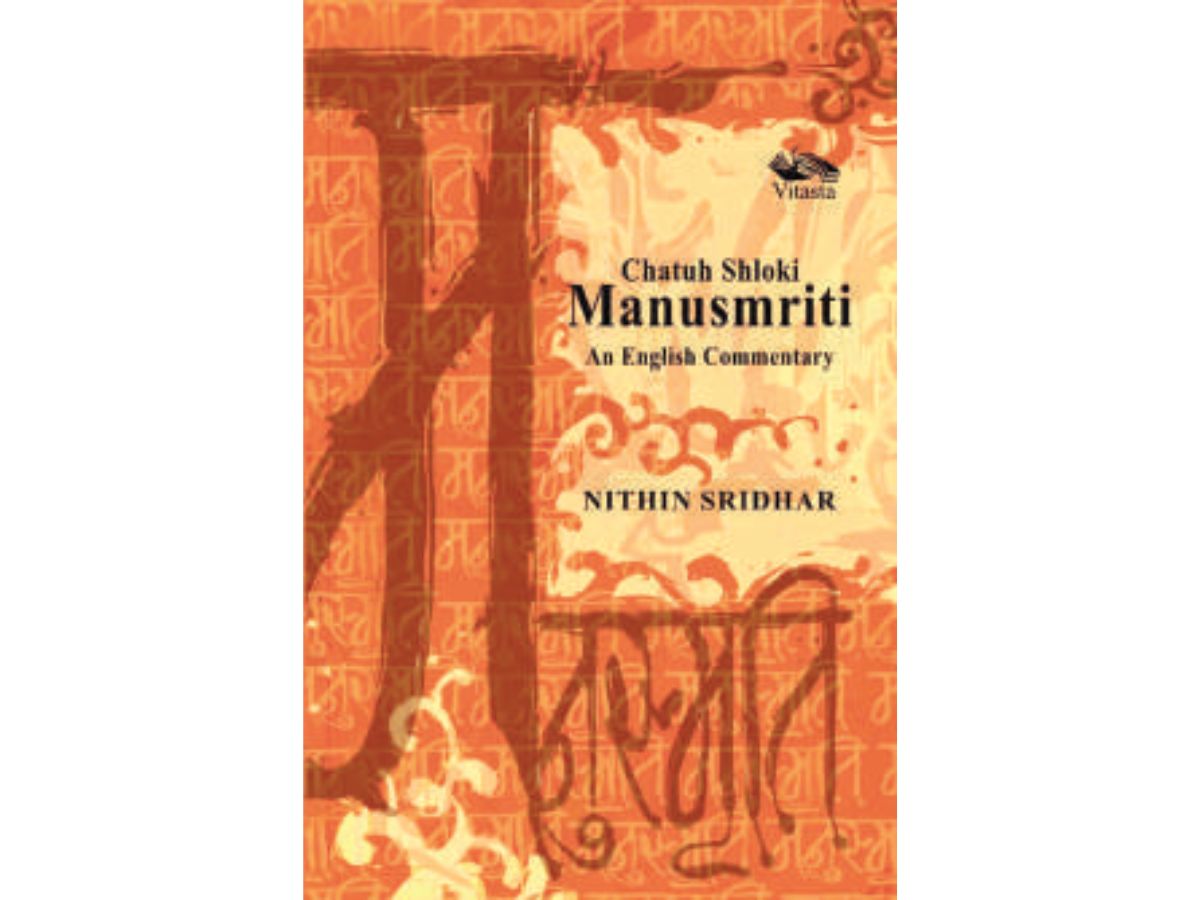
Chatuh Shloki Manusmriti: An English Commentary | Nithin Sridhar Publisher: Vitasta
The Manusmriti is, as the name literally says, a Smriti text in the corpus of Hindu literature—and also one of its most maligned. Nithin Sridhar’s book, “Chatuh Shloki Manusmriti,” dwells on the first four verses of the text as a gateway to understanding it, clears some of the misconceptions around it, and places it in the larger context of dharma.
At a high level of classification, Hindu texts can be divided into Shruti texts—which hold divine truths heard and realized by sages and compiled into the Vedas—and Smriti texts, which are “remembered” texts, secondary in authority to the Shrutis. The Manusmriti falls in this latter category. Verse 2.10 of the Manusmriti—“śrutistu vedo vijñeyo dharmaśāstraṁ tu vai smṛtiḥ”—itself states that the Vedas are Shruti and the Dharmashastra are Smriti.
Which brings us to the question—is the Manusmriti a Dharmashastra? The term Manusmriti for the text is of somewhat later origin, since earlier references call it Mānava-Dharmaśāstra, which therefore classifies it as a Dharmashastra. It is also somewhat inapt to translate it as The Laws of Manu, since neither “dharma” nor “shastra” translates as “law.” But this is how colonial Britishers translated it, and since it was among the first Sanskrit texts translated into English (specifically, by William Jones), they ended up force-fitting the injunctions in the text into equivalent legal categories of English law. Because they translated Dharmashastra as “law,” the term has stuck ever since.
Coming back to the title of the book—this is not a translation of the Manusmriti, nor is it a commentary on the entire text. Why only the first four verses? The author clarifies that Hindu shastras often begin with an enunciation of anubandha chatushtayam, which literally means four connections—adhikari (qualified student), vishaya (subject), sambandha (relation to the other three), and prayojana (the end result or purpose of the endeavour). Hence, it is a tradition to analyze or comment on the first four shlokas of a treatise—in this case, the Manusmriti. Thus, the title “Chatuh Shloki Manusmriti.”
Not that the focus or content is limited only to these four verses (which can be found in Section 2 of the book, from pages 81–164). These opening verses describe how great sages approached Manu, seated in meditation, and told him that he alone was competent to expound on the dharmas of the varnas, and who had knowledge of the essence of the Veda. To this implied question and request, Manu began speaking.
Hindu texts have a long and rich tradition of faithfully capturing the sequence of transmission—usually beginning with one of the gods, then passing through sages. Taking the Kamasutra as an example, Nithin notes that it was Prajapati who composed it in 100,000 chapters (the Mahabharata, by comparison, has nearly 2,000). Nandi then composed the treatise on kama in 1,000 chapters, which was halved by Shwetaketu, then further abridged by Babhravya, and finally compiled and condensed by Vatsyayana into its current form. This chain of transmission is captured in the text itself.
In the case of the Manusmriti, tradition records it as originally containing 4,000 verses, while the extant version has 2,684. Of the two explanations for this discrepancy, foreign scholars tend to argue that it was deliberately abridged, while Nithin Sridhar persuasively suggests that around 1,300 verses were likely lost during centuries of transmission. This seems more plausible given the upheavals, invasions, and loss of manuscripts India endured over the past millennium.
A subtle but important distinction between Shruti and Smriti texts—apart from the hierarchy of authority—is that Smriti texts are contextual to time and place. It is therefore inevitable that Shruti texts will, on occasion, contradict Smriti texts. Nithin writes that this has become a “convenient argument used to discredit Smritis.” Indeed, some teachings may seem anachronistic, but these seeming contradictions are reconcilable—and methods to resolve them were established after centuries of debate within Mimamsa and Nyaya Darshanas (as detailed from page 46 onwards).
What makes the Manusmriti such a lightning rod for criticism—both ignorant and deliberate? As is often the case, the problem lies in shallow reading, distortions, and agenda-driven interpretations. A text dismissed as misogynistic contains verses like:
“Yatra naryastu poojyante ramante tatra devatah: Yatraitaastu na poojyante sarvaastratraphalaaah kriyaah” —
(“Where women are honoured, there the gods rejoice; but where they are not honoured, no sacred rite yields rewards.”)
Ironically, this verse is often quoted by those who simultaneously deride the text.
Nithin examines verses 5.148 and 9.3—frequently cited by critics as evidence of misogyny—and contextualizes them with references to commentaries and supporting scriptures. He explains that while men, in general, are more suited for karma-yoga in its aspects of austerity (tapasya) and ritual performance (karma-anushthana), women, in general, are more suited for karma-yoga emphasizing devotion (bhakti) and service (susrusha). Such nuanced interpretations are often lost on those seeking polemics rather than understanding.
Appendix I is a valuable essay on the concept of varna and how it fits into the larger discourse on division of labour and behavioural traits. Appendix II will appeal to those seeking to understand how to evaluate revisionist interpretations—especially on topics like meat-eating or caste. The book includes 18 pages of bibliography and over 130 pages of endnotes, enough to satisfy the most meticulous readers.
Nithin Sridhar’s book has received glowing praise from several luminaries, including the late Bibek Debroy, whose endorsement aptly summarises the work. “Chatuh Shloki Manusmriti” is a scholarly endeavour that reflects rigorous research and sets the stage for future efforts that may one day cover the entire Manusmriti.
The book deserves a slow, careful reading—the rewards will be manifold.
Disclaimer: Views expressed are personal.
