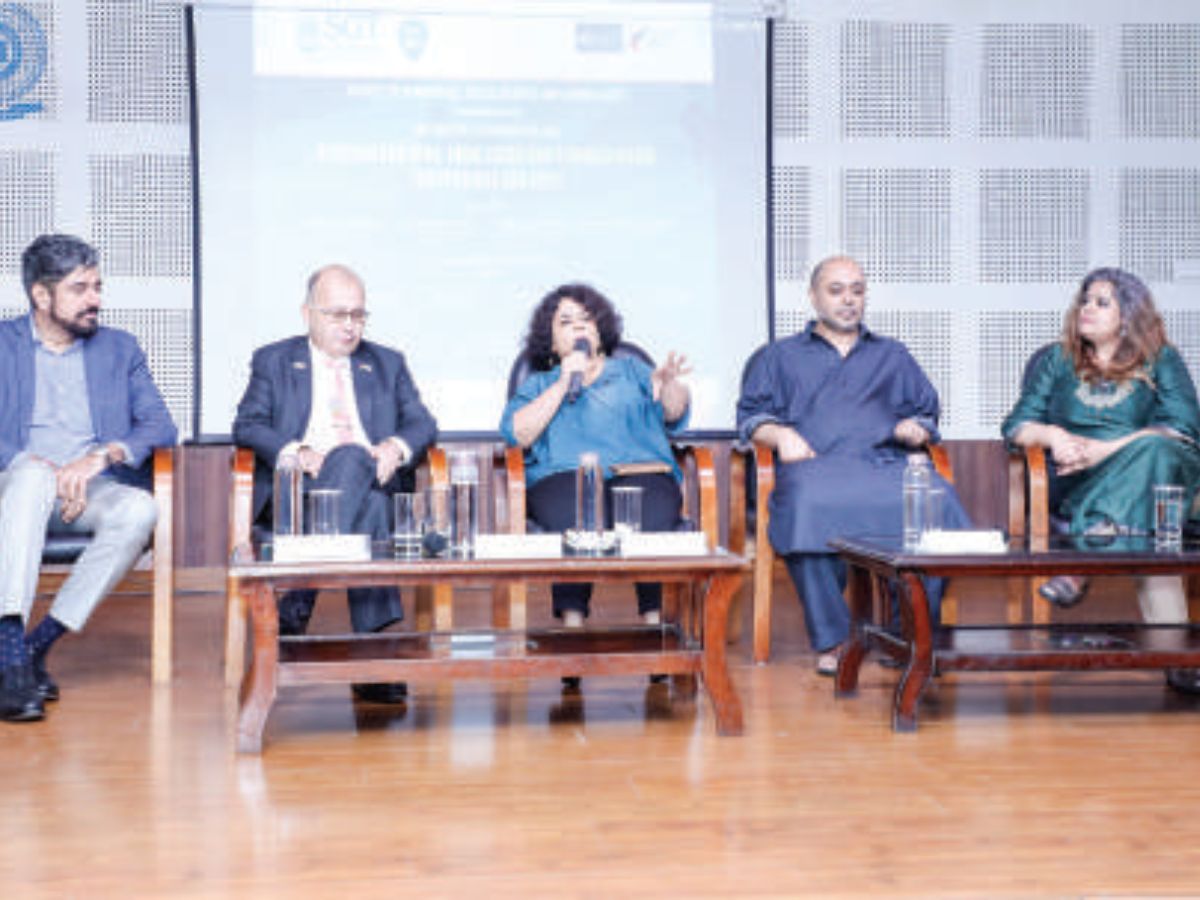
New Delhi: Earlier last week, SGT University, in collaboration with the Central Coordination Cell and the American Jewish Committee (AJC), convened a high-level seminar titled “Bridging Horizons” to examine India–Israel relations in the context of global geopolitics, disinformation, and cultural diplomacy.
The panel brought together Arjun Hardas, India Representative of AJC; Sandeep Unnithan, Editor-in-Chief of Chakra Newz; Manjari Singh of the Centre for Joint Warfare Studies (CENJOWS); and Abhijit Iyer-Mitra of the Institute of Peace and Conflict Studies (IPCS). The discussion, moderated by Joyeeta Basu, Editor of The Sunday Guardian, looked into both the opportunities and vulnerabilities facing Israel at a time of heightened tension in West Asia.
Arjun Hardas set the stage with a sobering reflection on the Jewish community’s demographic fragility. He noted that before the Holocaust the global Jewish population stood at around 18 million, yet nearly eight decades later it remains below that figure, at approximately 16.5 million. Of Israel’s 10.5 million citizens, 8.5 million are Jewish. “The fact that even in 2025 the number has not returned to pre-Holocaust levels reflects the immense devastation caused by that tragedy,” he said, underlining how history continues to shape Jewish consciousness.
Hardas traced the roots of anti-Semitism across centuries, pointing to the scapegoating of Jews during times of war, famine, and plague, and the long-standing role of religious institutions in perpetuating bias. For nearly two millennia, the Catholic Church held Jews collectively responsible for the death of Jesus—a teaching only officially revoked in the 1960s. While anti-Semitism receded briefly in the immediate aftermath of World War II, the reprieve proved short-lived as prejudice soon resurfaced.
Turning to contemporary challenges, Hardas recounted his visit to Gaza, where he observed the deep entrenchment of Hamas in every facet of civilian infrastructure—from hospitals and ambulances to power plants and desalination units. He recalled that Hamas leaders openly admitted their focus on targeting Israeli infrastructure irrespective of humanitarian consequences. More disturbingly, hostage accounts revealed that captives were often hidden in the homes of journalists or UN employees, who continued their professional duties while collaborating with Hamas.
Manjari Singh turned the spotlight on the Boycott, Divestment, Sanctions (BDS) campaign. Launched in 2005 as a Palestinian-led NGO initiative, BDS initially presented itself as a protest against Israeli policies but, she argued, soon revealed its underlying objective of delegitimising Israel altogether. Once this agenda became clear, several European states, including Germany and Spain, began distancing themselves from the movement. Singh argued that what began as political activism was exposed as ideologically driven extremism, stripping it of legitimacy across much of the West.
Abhijit Iyer-Mitra focused on the battle of narratives in Gaza, challenging claims that Israel deliberately starves the population. He argued that international outlets such as BBC, TRT, and Al Jazeera often amplify Hamas-controlled messaging, where civilian casualties—especially those of children—are instrumentalised for propaganda. Acknowledging the presence of poverty, he nonetheless contended that parts of Gaza’s middle class enjoy a standard of living better than often portrayed.
Recalling his own visit to Gaza in 2011, Iyer-Mitra described an atmosphere of suffocating fear, surveillance, and control, likening it to North Korea. He recounted how residents were hesitant to speak freely and how Hamas monopolised control over goods, electricity, and water while diverting critical resources to weapons production. “Contrary to the image of extreme deprivation, I found that some areas of Delhi looked worse. Food and aid do enter Gaza, but Hamas seizes the supplies, sells them on the black market, and exploits its own people,” he remarked, underscoring the ways in which propaganda shapes perceptions of the conflict.
Sandeep Unnithan analysed Israel’s strategic landscape in the wake of Hamas’s 7 October 2023 assault, calling it West Asia’s “Princip moment”—a reference to the 1914 assassination of Archduke Franz Ferdinand that triggered World War I. He traced the roots of the attack to two decades of Iranian expansionism, during which Tehran cultivated a “Shia axis of influence” through proxy networks such as Hezbollah, Hamas, the Houthis, and militias in Iraq and Syria, many built under the direction of the late Qasem Soleimani. According to Unnithan, Israel’s military response has evolved into a prolonged conflict—short of a world war but the most consequential regional upheaval since the Six-Day War of 1967.
Unnithan emphasised Israel’s resilience in the face of existential threats, noting that despite being geographically smaller than Manipur—covering just 21,000 square kilometres—it has survived in a hostile neighbourhood since its establishment in 1948. Sharing a personal anecdote, he recalled a missile siren on 25 September 2024 while staying at a seaside hotel in Israel, when a civilian rushed him to shelter moments before Israeli interceptors destroyed a Hezbollah-fired missile. “What struck me most was how quickly life returned to normal—people went back to swimming, jogging, even yoga. Attacks may be routine, but Israel refuses to let its enemies dictate daily life,” he observed, capturing the defiant normalcy that characterises Israeli society.
