The Indian Army’s SAKSHAM Counter-UAS system secures low-altitude airspace, redefining land warfare doctrine to protect troops, armour, and logistics from drone threats.
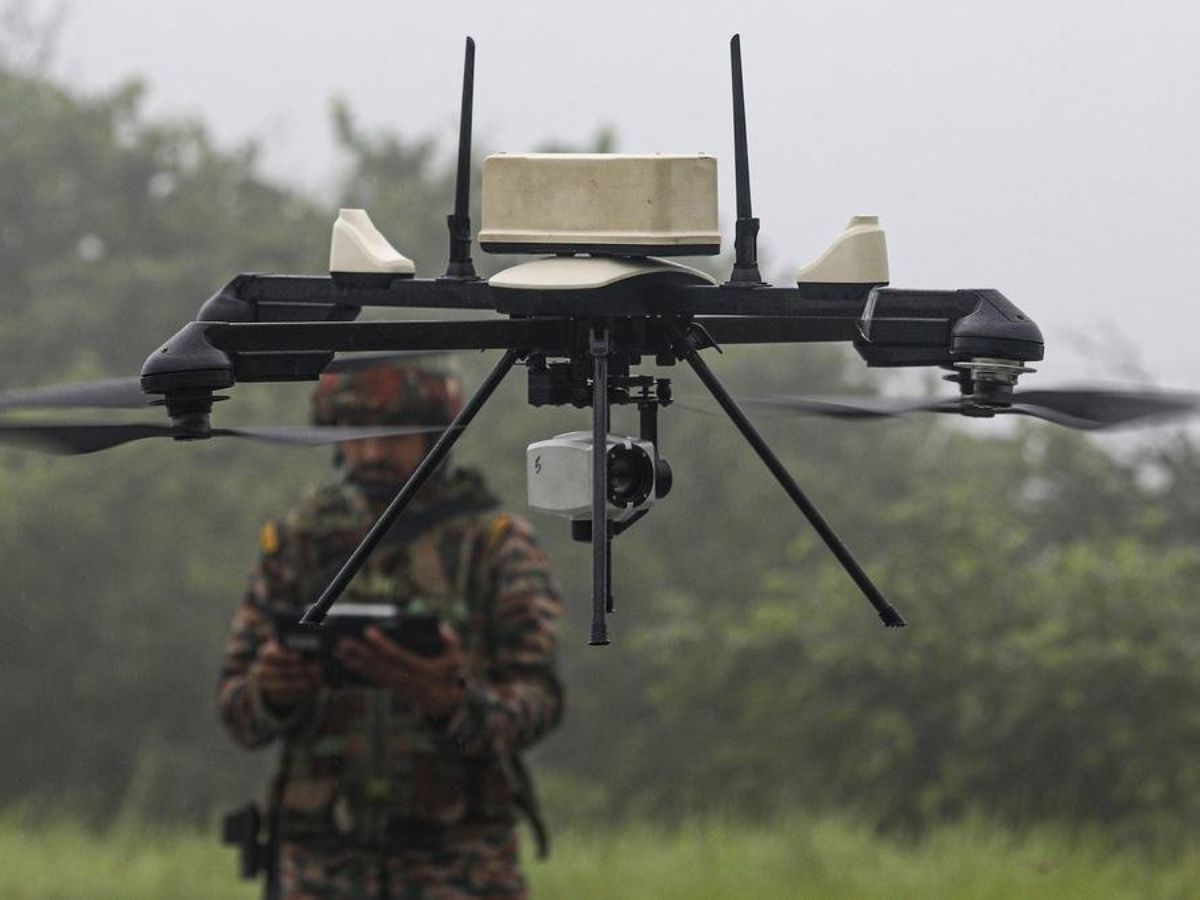
From Ground to Sky: How SAKSHAM Empowers the Indian Army’s Tactical Control of the Air Littoral (Image: @rinkiyadav_SPR)
New Delhi: The modern battlefield has undergone a fundamental transformation. The skies above the advancing columns, artillery positions, and logistics hubs have become contested killing zones where cheap, ubiquitous drones hunt armoured vehicles and infantry with impunity. The Indian Army's induction of the indigenous SAKSHAM (Situational Awareness for Kinetic Soft & Hard Kill Assets Management) Counter-UAS Grid System represents not merely a technological upgrade, but a doctrinal awakening: control of low-altitude airspace is no longer a supporting function to be delegated upward, but an organic, essential capability that ground forces must own to survive and prevail.
Wars are won on the ground, but not just the ground anymore. As history has shown, from the chariots of antiquity to mechanised tanks of the 20th century, control of the immediate battlespace has always defined victory. Today, that battlespace extends upward into the Air Littoral, the airspace up to 3,000 meters above the surface. The Indian Army’s induction of the indigenous SAKSHAM (Situational Awareness for Kinetic Soft & Hard Kill Assets Management) Counter-UAS Grid System is a game-changer, asserting control where it matters most for modern land warfare.
For generations, armies operated under a clear division of labour wherein ground forces owned the surface, air forces owned the sky. This comfortable delineation has collapsed. Today, without dedicated, integrated control of the airspace immediately above their positions, ground formations are fundamentally compromised before the first shot is fired.
SAKSHAM addresses this reality by providing a unified command and control architecture that seamlessly fuses ground manoeuvres, artillery fires, and multi-layered drone defence into a single operational picture. Its AI-enabled detection systems can identify and classify threats within seconds, while its integrated hard-kill (kinetic) and soft-kill (electronic warfare) capabilities provide commanders with immediate response options tailored to threat profiles.
This is not about extending traditional air defence downward; rather, it is about recognising that the Air Littoral has become a distinct operational domain requiring specialised, persistent, and organic control. A mechanised formation advancing without this protective umbrella is effectively naked, its every movement observable, its concentration points targetable, its logistics chain vulnerable. Freedom of manoeuvre on the surface now depends absolutely on denying adversaries freedom of action in the airspace directly above.
The drone revolution has been as profound as the machine gun's impact on infantry tactics a century ago. What was once the preserve of major militaries, aerial reconnaissance and precision strike, is now available to any adversary with a few thousand dollars and basic technical knowledge.
Small quadcopters modified to drop grenades have destroyed main battle tanks worth millions. Reconnaissance drones loitering at 500 meters altitude have called artillery fire onto the battalion headquarters. Swarms of coordinated UAS have overwhelmed traditional air defences designed for high-speed aircraft and missiles. The Air Littoral has become dense with threats that are simultaneously cheap to deploy, difficult to detect, and devastatingly effective.
Traditional air defence systems and centralised air force assets, designed for high-altitude threats and theatre-wide coordination, cannot respond effectively to this localised, persistent, and rapidly evolving threat environment. The timelines are too compressed, the targets too small, and the geographical distribution too wide. SAKSHAM's layered approach—combining passive detection, active radar, electro-optical tracking, and distributed effectors—creates a responsive grid tailored specifically to the physics and tactics of low-altitude drone warfare.
The system's integration of soft-kill capabilities is particularly crucial. Electronic warfare and GPS denial can neutralise entire swarms without depleting kinetic munitions, while AI-driven classification prevents costly responses to non-threatening objects. This intelligent triage is essential when facing adversaries who can afford to launch dozens of decoys for every actual threat.
The Indian Army’s move mirrors a wider global military realisation: land forces must own their immediate airspace. Forward troops and logistics cannot rely on distant air force assets for protection anymore; they need organic, persistent defences. SAKSHAM positions India among the world’s modern armies ready to dominate the air littoral and protect the critical nodes of land warfare. India is not alone in recognising this imperative. Across the globe, land forces are asserting control over their tactical airspace in ways that would have been considered doctrinal heresy two decades ago.
The United States Army has fundamentally restructured its short-range air defence posture, standing up dedicated manoeuvre-SHORAD (Short Range Air Defence) battalions equipped with systems specifically designed to protect advancing ground formations from UAS and rotary-wing threats. These units are organic to ground commanders, responsive to tactical timelines, and trained to integrate seamlessly with combined arms operations.
Similarly, the British Army has invested heavily in mobile counter-UAS capabilities that deploy forward with armoured formations, recognising that the protection gap between long-range strategic air defence and individual soldier air defence weapons had become a critical vulnerability. The German Bundeswehr's "Nächstbereichschutzsystem" (very short-range protection system) explicitly acknowledges that ground forces must own their immediate airspace defence.
These are not peripheral capabilities being developed by second-tier militaries—they represent fundamental doctrinal shifts by NATO's most capable armies. The lesson is clear: modern ground forces that cannot protect themselves from aerial threats at the tactical level cannot accomplish their missions, regardless of their superiority in armour, artillery, or infantry quality.
SAKSHAM positions the Indian Army within this global evolution, providing the institutional capability to implement similar doctrinal integration. Its modular, scalable architecture allows deployment from static infrastructure defence to mobile convoy protection, ensuring that air littoral control moves with manoeuvre forces rather than being tethered to fixed installations.
Modern conflicts have painfully illustrated the cost of neglecting air littoral control. From Ukraine’s battlefields to Nagorno-Karabakh’s contested skies, drone strikes have decimated armour, personnel, and infrastructure when local air defence was fragmented or absent. Reliance on slow, geographically distant air defence chains proved disastrous.
In the Nagorno-Karabakh conflict, Azerbaijani forces employed Turkish-made Bayraktar TB2 drones and Israeli-made loitering munitions to systematically destroy Armenian armour and artillery. Armenian forces, relying on outdated Soviet-era air defence systems designed for high-altitude threats and lacking integrated low-altitude detection grids, were unable to respond effectively. Entire armoured formations were neutralised not through superior tank tactics or artillery duels, but through uncontested exploitation of the Air Littoral. The lesson was stark: without dedicated control of low-altitude airspace, modern combined arms formations become targets rather than threats.
The ongoing conflict in Ukraine has reinforced these lessons with even greater clarity. Both sides have experienced catastrophic losses when failing to maintain integrated control of tactical airspace. Russian columns advancing on Kyiv without adequate air littoral defence were systematically attrited by Ukrainian drone-guided artillery and small UAS-delivered munitions. Ukrainian forces, conversely, have suffered severe losses when operating beyond the umbrella of their increasingly sophisticated layered air defence networks.
The critical insight from Ukraine is not merely that drones are lethal; it is that the response timeline for tactical air threats has compressed to minutes or seconds. Reliance on geographically distant air defence coordination centres or non-organic assets proves too slow. By the time a threat is identified, communicated up the chain, assessed, and engaged through centralised systems, ground forces have already suffered losses.
Ukrainian forces have adapted by pushing air defence integration downward to battalion and even company level, creating resilient, distributed networks that can respond at tactical speed. This improvised solution validates what SAKSHAM is designed to provide from inception: immediate, organic, commander-controlled air littoral defence that operates at the speed of the ground battle.
Even more telling is the impact on logistics and sustainment. In both conflicts, the failure to secure tactical airspace resulted in catastrophic attrition of supply columns, fuel convoys and ammunition depots; not through interdiction by strategic bombers or long-range missiles, but through commercially available quadcopters and small fixed-wing drones.
The Air Littoral has become the primary domain for operational-level interdiction, and forces that cannot control it cannot sustain themselves. SAKSHAM’s embedded grid is a direct answer to these failures, ensuring India’s forces can respond instantaneously to drone threats at the tactical edge. Recent conflicts have provided brutal validation of why organic, distributed air littoral control is essential.
The SAKSHAM system represents more than the sum of its sensors, effectors, and command architecture. It embodies a doctrinal recognition that has taken some militaries decades and considerable bloodshed to accept: in modern warfare, ground forces must own the airspace immediately above them with the same dedication they devote to controlling the terrain beneath their feet.
This is not about the Indian Army encroaching on the Air Force's domain—it is about acknowledging that distinct operational requirements demand distinct solutions. Strategic air superiority and tactical air littoral control are complementary, not competing, capabilities. Just as infantry carries its own organic firepower rather than calling for artillery for every engagement, ground formations must possess organic air defence capabilities scaled to the persistent, distributed threats they face.
SAKSHAM's indigenous development is particularly significant. It ensures that the Indian Army can adapt, upgrade, and scale the system according to operational experience without dependency on foreign suppliers or their operational timelines. As adversaries evolve their drone tactics—and they will evolve rapidly—India's ability to iterate and improve its counter-UAS capabilities will prove as important as the initial deployment.
Looking forward, the Air Littoral will only grow more contested. Autonomous drones, AI-enabled swarms, and increasingly sophisticated electronic warfare will characterise the next generation of threats. Ground forces that establish robust air littoral control now will be positioned to adapt; those that do not will find themselves perpetually reacting to adversaries operating with impunity in the skies above their positions.
The Indian Army's commitment to SAKSHAM signals its understanding of these realities. In an era when a drone costing less than a motorcycle can destroy a tank costing millions, when swarms of coordinated UAS can overwhelm formations that would have dominated twentieth-century battlefields, the ability to see, decide, and act within the Air Littoral is not a luxury—it is the foundation upon which all other combat capabilities rest.
The future of land warfare will be won or lost in the first 3,000 meters of airspace. With SAKSHAM, the Indian Army has claimed its stake in that vertical battlefield. SAKSHAM is not a mere technical addition; it redefines Indian Army doctrine for the drone age. By securing the Air Littoral organically, the Army positions itself to dominate not just the ground but the air immediately above, ensuring every manoeuvre, strike, and resupply is protected. It is a strategic cornerstone for India’s readiness in multi-domain conflicts, validating the Army’s recognition that airspace control is now central to successful land warfare in the 21st century.
In the case of the Indian Army, the Air Littoral assumes added significance as formations—both infantry and armoured—are already deployed in Tactical Battle Areas (TBA) under a No War, No Peace scenario, where control of this layer directly influences survivability and deterrence.
Maj Gen. RPS Bhadauria (Retd) is the Additional Director General of the Centre for Land Warfare Studies (CLAWS), New Delhi, and was formerly the Director of the Centre for Strategic Studies & Simulation (CS3) at USI of India, having served in the Indian Army for 36 years.
