
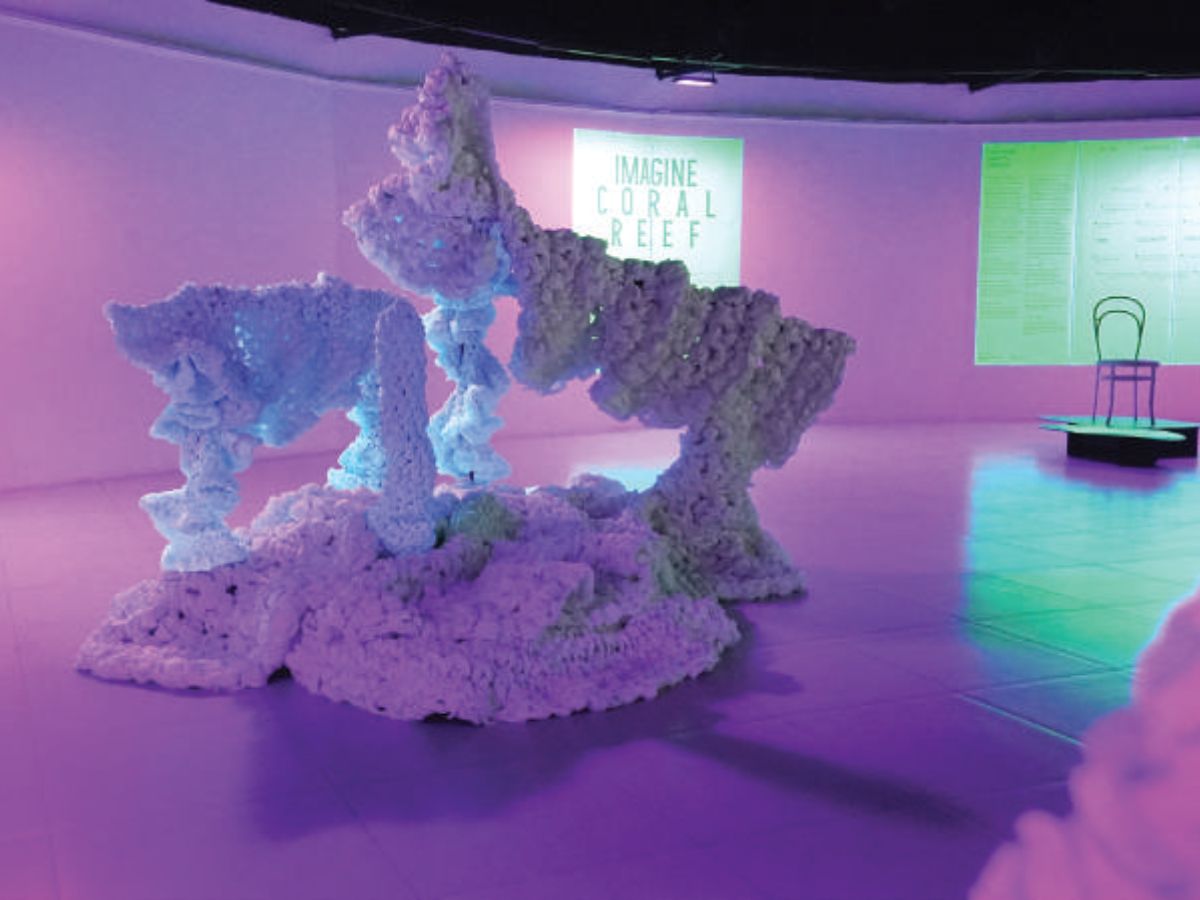
At the bustling edge of Hauz Khas Village, the beautiful interiors of the Lokayata Art Gallery have been deliberately dimmed. Inside, glowing white coral formations stretch across the room—delicate, intricate, and unsettling. The installation is part of Imagine: Coral Reef. Regenerative Design, a travelling exhibition from Austria that seeks to reorient the future of design in an age of climate crisis.
Commissioned by the Austrian Ministry of Foreign Affairs and supported by the Austrian Cultural Forum, the exhibition opened in New Delhi on February 6 and runs until February 25 before travelling to Bengaluru. It marks the first time the project has been shown outside Europe.
Austria’s Ambassador to India, Dr. Robert Zischg, underscored the urgency behind the initiative. “The exhibition Imagine Coral Reef – Regenerative Design shows solutions of design to overcome environmental crises,” he said. “It was developed in Austria, and here in India, students added design ideas which they developed in a workshop with the Institute of Design Research. I am glad that it has found its way to India and hopefully adds to Indian practices and discussions.”
The exhibition takes coral reefs—often described as the “rainforests of the sea”—as a metaphor for interconnected ecosystems. These fragile marine habitats, increasingly threatened by human-induced climate change, turn ghostly white in bleaching events before they die. The installation’s visual language draws directly from that moment.
“We started our research with coral reefs as an ecosystem,” explained Julia Sauter of the Institute of Design Research Vienna (IDRV), who co-curated the exhibition. “Just before corals die, they turn completely white. That is why you see these white structures here. We wanted to capture that ‘almost gone’ moment.”
More than 30 kilometres of thin white paper have been hand-crocheted into coral-like forms. Under ultraviolet lighting, the structures emit an eerie glow—what Sauter calls “the beauty of catastrophe.” The lighting avoids conventional spotlights; instead, the forms appear to glow from within, immersing visitors in an underwater-like environment.
The spatial concept and overall exhibition design were developed by Lotte Kristoferitsch of EOOS NEXT, who collaborated closely with IDRV. “The exhibition aims to make the abstract concept of regenerative design tangible, emotional and inspiring,” Kristoferitsch noted. “By using the coral reef as a metaphor, we highlight both the beauty and vulnerability of natural ecosystems.”
The show has previously travelled to Berlin, Sarajevo and Tirana, adapting itself to each new venue. “A key challenge is that we never know in advance how the space will look,” Kristoferitsch said. “Ideally, we need darkened rooms to create the immersive reef experience. In Delhi, being on the ground floor, we have a unique day-and-night dynamic—during the day the doors are mostly closed to preserve darkness, but in the evening passersby can glimpse the glowing reef and are drawn inside.”
Central to the exhibition is the idea of regenerative design—an approach that goes beyond sustainability. “You can imagine regenerative design as being one step further than sustainable design,” Sauter explained. “We are looking at functioning ecosystems and trying to find principles that we can apply to design processes so that we design in a way that is more connected to nature—not just less harmful, but actually restorative.”
Drawing on the work of German biologist and philosopher Andreas Weber, the curators translated seven principles of nature into the design domain. Each exhibit in the show corresponds to one of these principles. Projects with links to Austria are featured as part of a broader cultural exchange, though many address global contexts.
Unlike static exhibitions, Imagine: Coral Reef is conceived as a “learning exhibition.” At each stop, it evolves through workshops with local universities. In Delhi, Sauter conducted a three-day workshop at Sushant University; in Bengaluru, similar sessions are planned at the National Institute of Fashion Technology (NIFT). The students’ prototypes are incorporated into the exhibition itself.
Prof. Kaushalpreet Kaur, Dean of the School of Design at Sushant University, described the collaboration as transformative. “This workshop engaged students with systems thinking, sustainability and responsibility—showcasing how design can move beyond problem-solving toward regeneration,” she said. “It reflects the power of international collaboration in design education.”
One workshop exercise focused on reimagining everyday dental hygiene products—such as toothbrushes and toothpaste—through regenerative principles. “We were looking for a common product used worldwide that is also often thrown away,” Sauter said. “The goal was not to create finished market-ready objects, but to understand the principles and apply them in practice.” Some students explored biodegradable toothbrushes rooted in local craft traditions; others experimented with natural materials and circular systems.
Sauter said she was deeply impressed by her interaction with Indian students. “It’s a complex and sometimes speculative topic,” she admitted. “In previous countries, students sometimes struggled to imagine it. Here, I was blown away by how quickly they adapted and how much knowledge they brought—about local crafts, materials and cultural practices. That richness is something I don’t bring with me; it comes from them.”
Michael Pal, Director of the Austrian Cultural Forum in New Delhi, sees the exhibition as timely and urgent. “Imagine Coral Reef demonstrates how design can move beyond sustainability towards regenerative thinking, inspired by one of nature’s most complex ecosystems,” he said. “By bringing this exhibition from Vienna to New Delhi and Bengaluru and organising hands-on workshops for design universities in India, we aim to encourage dialogue among designers, students and the wider public on responsibility, innovation and our shared future.”
For Pal, the metaphor of the reef is both poetic and political. “This exhibition is a timely reminder of the urgent need to protect and preserve our oceans,” he added. “We invite art lovers, ecological activists and anyone passionate about the natural world to experience this journey and renew their commitment to safeguarding precious ecosystems.”
Austria may be landlocked, but as the curators emphasise, global ecological interdependence transcends geography. “Our actions profoundly affect these fragile habitats,” Kristoferitsch reflected. “Working on this project has deepened our understanding of the intricate connections between human behaviour and underwater ecosystems. It is both humbling and inspiring.”
As the glowing white corals pulse in the dim Delhi gallery, visitors are left with a question that extends far beyond art: can design move from minimising harm to actively healing the planet? The exhibition suggests that, like coral reefs themselves, regeneration is possible—but only through collective responsibility and imaginative transformation.




