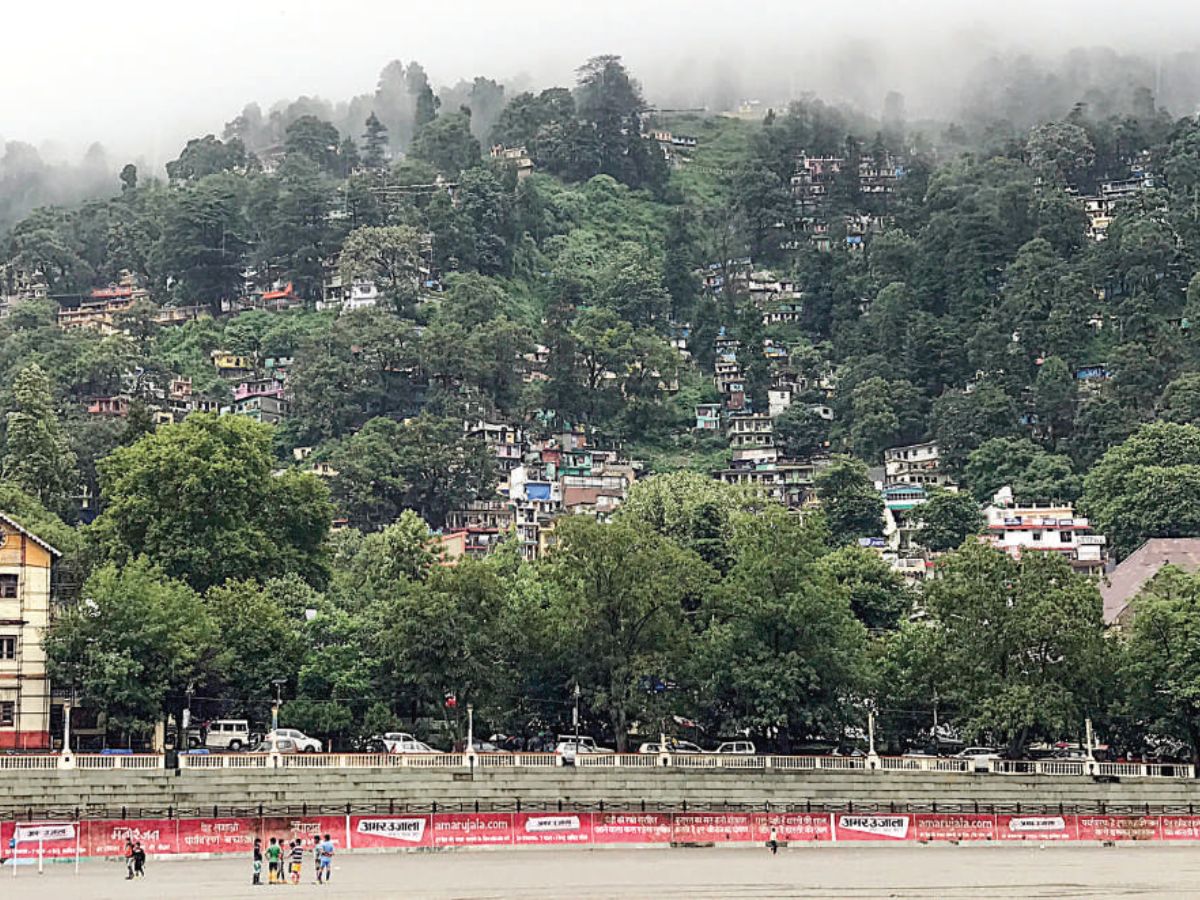
Nainital
Nainital was finally within reach. After months of Delhi’s relentless clutter, I was quite desperate to step away—to unclog the lungs, unhook the mind, and remember what real air felt like. I had been longing for Nainital: the lake, the mountains, the Kumaoni cuisine, the promise of a gentler rhythm…so my husband and I boarded the train to the hill station with the naïve optimism of people who believe they will see the world through a bay window—a wide, sweeping Himalayan panorama worthy of a travel brochure. What we got instead was a pane so thickly layered with coagulated grime that it resembled an archaeological specimen. The only “view” was a murky blur, and every now and then, the ghostly outline of a discarded chips packet stuck to the outside like a malevolent decal. Romance, as they say, died quietly in Coach C.
The journey itself was a catalogue of all that we Indians excel at: littering with a flourish, eating with gusto, and treating the landscape as though it were a communal dustbin. Plastic bottles rolled under seats as though auditioning for a ballet. Empty packets floated along the tracks like urban tumbleweed. One feels a certain patriotic sting—we are, undeniably, a nation of litterbugs, and we execute that role with unfailing enthusiasm!
When the train, at long last, chugged into the Kathgodam station, the ordeal began. Taxi drivers descended upon us like a wellorganised cavalry regiment, each quoting a fare with the studied confidence of someone quoting scripture. One man claimed he would take us to Nainital in “record time”, which, judging by the vehicle, meant the record might be set by gravity rather than horsepower. Nevertheless, we chose one, bundled ourselves in, and surrendered to the ascent.
Now, if you think the plains are chaotic, the mountains merely refine that chaos into high-altitude theatre. Someone was perpetually spitting out of a window, someone else was coughing into the ether, and masks—once the prized face furniture of the pandemic era—had vanished from memory. It’s marvellous how swiftly we shed our collective fears. Only yesterday we were disinfecting door handles with missionary zeal; today we exchange airborne droplets with strangers as though participating in a cultural festival.
And yet, hovering over this tableau was that larger question—the same one that has shadowed our collective consciousness since 2020. How, precisely, did the vaccination arrive with such astonishing speed?! A vaccine, in ordinary circumstances, takes years—sometimes a decade—to make it to the anvil. Smallpox demanded the dogged persistence of Edward Jenner; penicillin emerged only after Fleming’s accidental discovery was refined painstakingly over time. Historically, science is a careful, plodding horse, never given to sudden gallops.
So how did we, a country that routinely laments over a paucity of funds for pensions and public sanitation, suddenly find the resources for mass vaccination on an unprecedented scale?! Where did the river of money spring from?! Was it political will, pharmaceutical alchemy, or global panic that loosened the purse strings?! One wonders—gently, humorously, but pointedly—how miracles of financing appear precisely when the world seems too crowded, too heated, too on the brink of imploding under its own weight…
And yet, while sitting across the lake, in a quieter moment, my mind drifted back to the earlier hysteria—the lockdowns, the sirens, the daily tallies. India’s first vaccination drive commenced in January 2021; Europe’s, including the Netherlands, had begun a little earlier, though still after a remarkable sprint through regulatory hoops. So many nations, so many varying timelines, and all of it executed with a speed that defied historic precedence. Perhaps, it was necessity, perhaps desperation, perhaps a brand-new world where pharmaceutical timeframes can be fast-tracked like VIP passengers through airport security.
I spent five days in Nainital, and the town, to its credit, soothed much of this inner inquiry. The lake shimmered with its usual understated elegance, surrounded by apple-cheeked schoolchildren on picnics and honeymoon couples taking selfies in what used to be quiet corners but are now designated “Selfie Points”, complete with signs. The mountains, once symbols of solitude, now double as backdrops for perpetual photographic evidence. Nature, poor soul, is forever being coaxed into saying, “cheese”.
Tourism was in full swing—people sitting in boats, coughing over each other with the camaraderie of old pals; families eating corn-on-the-cob with a level of abandon that would give epidemiologists heartburn. Not a mask in sight, not a sanitiser bottle to be found. The fear that once had us scrubbing our vegetables with potassium permanganate had evaporated like morning mist over the lake.
Somewhere between Mall Road and the lakeside cafés, I felt strangely oxygenated—as though the mountain air itself were staging a small mutiny against my city-habituated lungs. Even my cheeks seemed to take on the faintest pink hue, that gentle alpine flush that makes one suspect, if only playfully, that Rudolph’s famous red nose might simply have been the consequence of vigorous Himalayan breathing. Up here, whimsy and physiology often shake hands…
By the fifth day, the mountains had done what mountains do—sanding down one’s jagged thoughts, even while leaving the essential questions intact. Christmas was approaching, and the town was already gathering its festive trinkets. Strings of lights clung to sloping roofs, papier-mâché Santas looked faintly baffled, wreaths hung at charmingly odd angles. Children tugged their parents into bakery queues, cheeks bright and spirits high.
As I watched them, the world felt both heartbreakingly beautiful and oddly fragile—as if held together by breath and goodwill alone. So much fear endured, so many lessons learned, and yet here we are once more, coughing into one another’s personal space, touched by forgetfulness and carried along by routine.
Yes, in these quiet, oxygenrich moments, my thoughts, yet again, drifted back—soft as snowfall yet persistent as fog—how did we forget so soon, and why so completely?! And as the lake receded behind me, folding itself back into the mountains, one question—quiet, insistent, unshowy—remained: is our short memory a saving grace, or is it the very thing that might undo us?!
