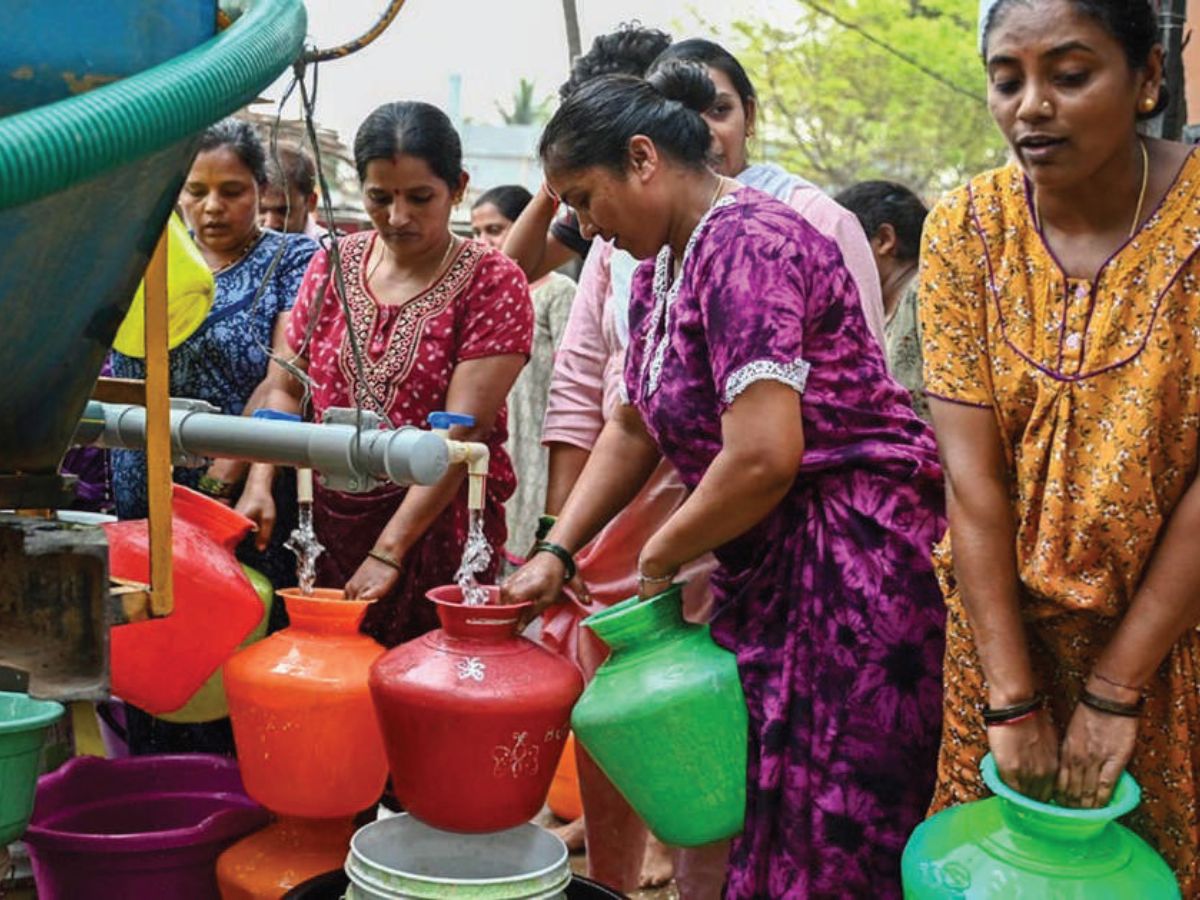
Without improving public health, smartcity, clean-city, and “Viksit Bharath” will remain hollow claims.
Potable (drinkable) water implies it meets regulatory health guidelines for drinking, and can be used for cooking, brushing teeth, bathing, and food preparation. It can contain permitted dissolved minerals and salts. Not all safe water (like water for irrigation) is potable. Polluted water sources, wastewater, and sewage mismanagement cause 830,000 preventable deaths worldwide annually, as per the World Health Organization’s 2022 report. Without improving public health, smartcity, clean-city, and “Viksit Bharath” will remain hollow claims.
INDORE: The contamination of piped water with E. coli, Salmonella, and Vibrio cholerae from sewage in Indore caused many to suffer vomiting and diarrhoea, and die of multi-organ failure. Multiple breaches in a 30-year-old water pipeline allowed raw sewage leaking from a toilet to mix with the drinking water supplied to nearly 50,000 residents.
BANGALORE: Water contamination in Bengaluru due to sewage from a leaking GI (galvanized iron) sewage pipeline connection seeping into an adjacent 40-year-old, severely corroded drinking water cast iron (CI) pipeline was detected during a robotic inspection, following complaints of foul-smelling water and a spate of water-borne illnesses. The pipeline is being replaced with ductile iron (DI) pipes. These are made of a strong, corrosion-resistant alloy of iron, carbon, magnesium, and silicon. These pipes are typically protected internally by cement linings and externally with zinc and asphaltic coatings or polyethylene encasements.
PURI: Under the “Drink from Tap” (DFT) mission, Puri in Odisha has potable tap water meeting international standards. Advanced multi-stage treatment of pollution-free water, along with real-time quality monitoring with sensors, and replacement of old pipelines with high-pressure pipelines, has made the continuous supply of potable water possible. As part of the state government’s Sujal initiative, officials with local ‘Jal Sathi’ women are doing field checks to ensure water meets strict standards for potability.
SWACHH SURVEKSHAN (SS): Since 2016, an annual cleanliness survey has been conducted across 73 Indian cities and state/UT capitals, but sewage and wastewater treatment were not surveyed till 2023. Indore, ranked India’s cleanest city for eight consecutive years since 2017, had ignored the integrity of water and sewage pipelines and repeated complaints about foul-smelling water by the residents.
PROBLEMS OF INTERMITTENT WATER SUPPLY (IWS): Water scarcity and leakage are often managed by IWS, which causes contaminated groundwater to be sucked in during pressure drops. The pressure surges cause pipe fatigue, joint failure, bursts, and leaks, increasing water loss. Alternating low and high pressure creates a vicious cycle that can be broken only by upgrading the entire pipeline and continuous water supply (CWS).
TRENCHLESS DETECTION OF PIPE LEAKS: Lack of maps of old underground water pipelines, reliance on manual tracking and digging extensive trenches to detect leaks, difficulty in real-time monitoring, and poor system performance are major problems with old piped water supply lines. Trenchless technology uses non-invasive techniques like Ground Penetrating Radar (GPR), infrared thermography, acoustic sensors (hydrophones), fibre optics, and drain cameras, through small access points to find corrosion or cracks. For main pipelines, free-flowing inertial sensors are used that travel inside them and are retrieved at a receiving station. Drones equipped with infrared cameras and laser sniffers that scan the surface above the pipeline are also used. All old leaking underground pipelines need to be replaced with a modern system of high-pressure corrosion-resistant pipes with leak detection systems (LDS), access points, and integrated sensor systems for sophisticated internal and external monitoring.
WATER TESTING: Consumers should check the water for clarity, salty taste, hardness, and microbial presence. Inexpensive drinking water TDS (Total Dissolved Solids) testers are available. TDS includes calcium, magnesium, potassium, sodium, bicarbonates, chlorides, and sulphates, and small amounts of organic matter. If the TDS is less than 200 ppm, a UF (Ultrafiltration) or UV (Ultraviolet) purifier is adequate. If TDS is 200–500 ppm, a UV or RO (Reverse Osmosis) purifier is required, depending on microbial risk. If TDS is more than 500 ppm, a RO or RO+UV purifier is required. Comprehensive water testing services are available that analyse water samples for a broad spectrum of physical, chemical, microbiological, and radiological parameters, including disinfectants, pesticides, fertilisers, industrial effluents, and heavy metals, to ensure safety, quality, and compliance with regulatory standards.
WATER PURIFIERS: The three common types of drinking water purifiers are RO, UV, and UF. RO purifiers use a semi-permeable membrane to remove dissolved salts (desalination), heavy metals, and chemicals. They are best for high TDS borewell or salt water, but they waste water, require electricity, need regular filter changes, and are costlier. RO also removes beneficial minerals, hence some models add mineral cartridges to balance taste and nutrition. UV purifiers kill microbes and are adequate for clear water, but not for high TDS. A UF purifier uses hollow fibre membrane filters to remove bacteria, cysts, and dirt. It cannot remove dissolved salts or chemicals. It has low cost and maintenance. It does not need electricity, hence it is portable and suitable for areas with intermittent electric supply.
Multi-stage purification combining all three methods is used for comprehensive purification of mixed water sources and for all water types. These are expensive, bulky, waste water (up to 3 litres wasted for every 1 litre purified), and need more maintenance. RO membranes last 2–3 years, UV lamps about 1 year, and UF filters about 2 years. Neglecting replacement reduces safety. Domestic ozone sanitation systems are also available that eliminate bacteria, viruses, parasites, and minerals like iron and manganese.
OTHER METHODS OF MAKING WATER POTABLE: Water can be made potable through simple methods like boiling, chemical disinfection (chlorine or iodine), activated charcoal filtration, solar disinfection (SODIS), and distillation. These are especially useful in emergencies, rural areas, or when modern purifiers are unavailable. Boiling does not remove chemical contaminants or dissolved salts. Chlorine tablets are effective against bacteria and viruses, but less against protozoa. Iodine tablets leave a taste and odour. Activated charcoal filtration absorbs impurities, chlorine, and organic compounds, improves taste and odour, but does not kill microbes; hence has to be combined with other methods. Solar Disinfection (SODIS) is done by filling clear PET bottles with water and exposing them to direct sunlight for 6–8 hours. UV rays and heat kill pathogens, but do not deactivate chemical pollutants. It requires clear water and strong sunlight, and is not effective on cloudy days or in forested areas.
Distillation removes microbes, salts, heavy metals, and most chemicals. It produces very pure water, but is energy-intensive (except for solar distillation), slow, and removes beneficial minerals. Rainwater is naturally distilled water, but it has dissolved air pollutants. Ceramic filters and clay pots remove microbes, are durable, reusable, need no electricity, but do not remove dissolved salts or chemicals. Household sand-gravel-cloth filtration removes only turbidity and larger particles, and is used only for turbid water before disinfection by other means.
Other aspects of unsafe water were discussed on February 9th, last year. Till pollution of water sources is stopped and the “Drink from Tap” (DFT) mission is fully executed, residents should use appropriate water purifiers or boil filtered water to prevent waterborne diseases.
Dr. P.S. Venkatesh Rao is a Consultant Surgeon, Former Faculty CMC (Vellore), AIIMS (New Delhi), and a polymath in Bengaluru, drpsvrao.com
