Three days of dialogue, diplomacy, and direction define the Indian Navy’s cooperative maritime roadmap.
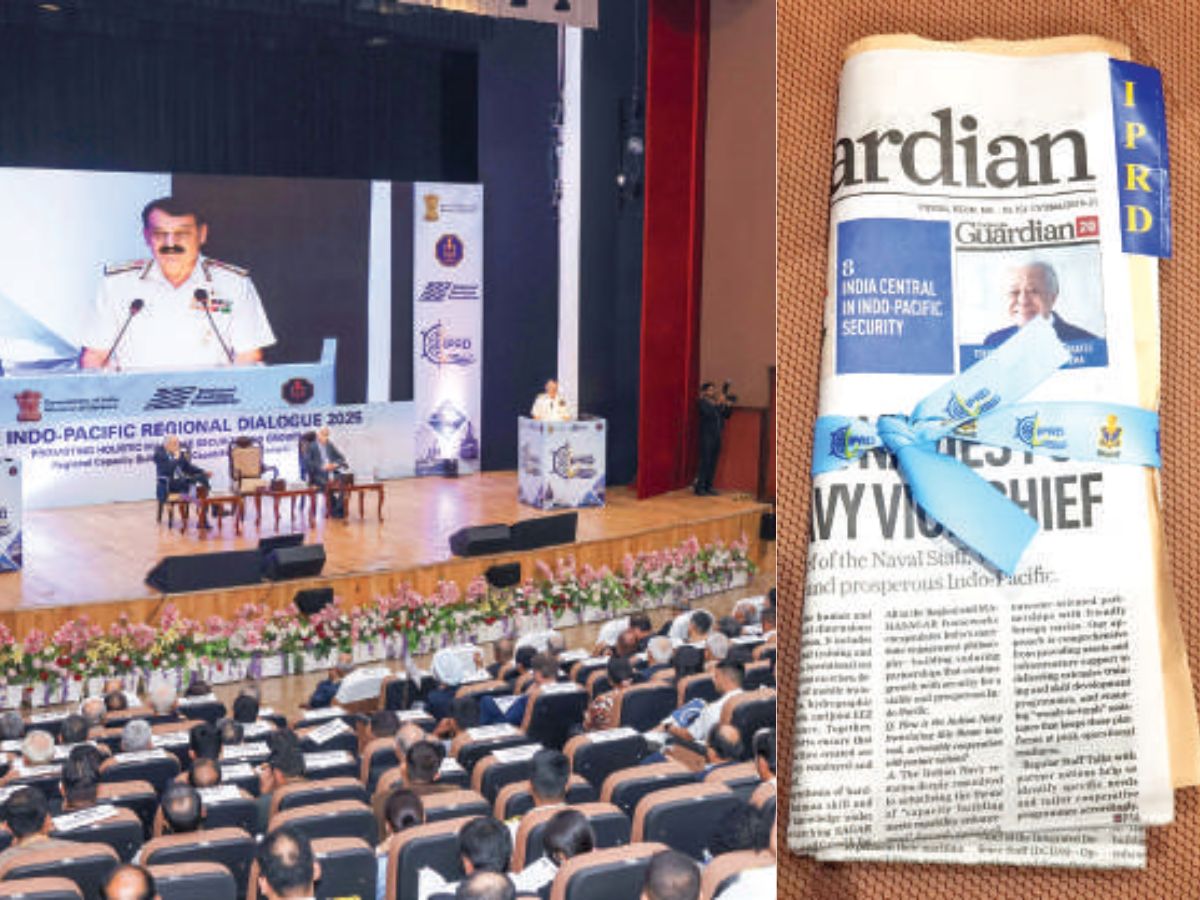
Chief of the Naval Staff, Admiral Dinesh K. Tripathi speaks at IPRD 2025. The Sunday Guardian, which did a curtain-raiser of IPRD 2025, was kept at the venue by Indian Navy for participants.
New Delhi: When the seventh edition of the Indo-Pacific Regional Dialogue (IPRD 2025) closed at the Manekshaw Centre on 30 October, it did so without fanfare or slogans—but with an unmistakable sense of purpose. Over three days, the Indian Navy and its knowledge partner, the National Maritime Foundation (NMF), turned a familiar catchphrase—“capacity building and capability enhancement”—into a working plan for regional security and growth.
The theme, “Promoting Holistic Maritime Security and Growth through Regional Capacity Building and Capability Enhancement,” ran through every panel and publication. Delegates and experts from more than 30 nations, stretching from East Africa to the South Pacific, debated how cooperation—not competition—can keep the Indo-Pacific open, secure, and sustainable.
The opening day on 28 October began with Admiral Karambir Singh, former Chief of the Naval Staff and Chairman of the NMF, warning that the maritime domain faces “strategic turbulence” driven by great-power rivalry, non-state actors, and climate stress. His remedy: a cooperative maritime architecture that endures beyond personalities or power cycles.
Indian Navy Chief Admiral Dinesh K. Tripathi followed with a clear line of sight. The Navy, he said, is executing MAHASAGAR — Maritime Holistic Approach for Security And Growth for All in the Region—the successor logic to Prime Minister Narendra Modi’s SAGAR doctrine. He released Future Maritime Warfare, an NMF monograph urging navies to match concept with capability.
A multi-nation panel—Bangladesh, Japan, Indonesia, Singapore, and South Africa—tackled the first operational theme: “Co-operative Capacity-Building and Capability-Enhancement to Address the Security Impacts of Climate Change.” Its outcome: a recommendation for a regional impact-assessment and action plan linking environmental data to naval tasking.
The day ended with a special address by Dr Christian Bueger and the release of a dedicated issue of Maritime Affairs, capturing the scholarship generated by six years of IPRD iterations.
The second day, 29 October, shifted westward to Africa. Under the MAHASAGAR vision for the Global South, the morning session examined how to strengthen Africa’s Integrated Maritime Strategy 2050 (AIMS 2050) and tie India’s Western Indian Ocean work into frameworks such as the Djibouti Code of Conduct-Jeddah Amendment (DCoC-JA).
Former Vice Chief of Naval Staff and ex-National Maritime Security Coordinator Vice Admiral G. Ashok Kumar (Retd) reminded delegates that good laws make good oceans. India’s Maritime Anti-Piracy Act 2022, he said, now gives “legal finish” to operations that earlier ended in diplomatic limbo. He released two fresh NMF studies—Quantum Era Warfare and Forging Strategic Convergence (with Indonesia’s Indo-Pacific Strategic Intelligence)—pushing the debate into cyber- and quantum-enabled defence.
The afternoon turned practical: a session on maritime resilience brought officials and experts from Australia, the Philippines, Sri Lanka, South Korea, and India to discuss supply chains and infrastructure protection. On the sidelines, NMF signed MoUs with Japan’s Research Institute for Peace and Security (RIPS) and Pacific RBS (Papua New Guinea)—a quiet but significant eastward bridge.
The closing day on 30 October drilled into the “Blue Economy (including Seabed Infrastructure) as an Instrument of Foreign Policy.” Experts from Israel, Vietnam, and the Philippines converged on a single anxiety: the vulnerability of undersea cables and energy grids. Israel’s view from the Eastern Mediterranean focused on commodity flow; Vietnam and the Philippines described grey-zone interference in the South China Sea.
For India, the way forward was partnership. The discussion linked the India-Middle East-Europe Economic Corridor (IMEEC) on the western flank with ASEAN-India cooperation to the east. The session also saw the release of NMF’s Maritime Perspectives: The Blue Economy and Resilience, emphasising that sustainability and security are two sides of the same chart.
Sanjeev Sanyal, Member of the Economic Advisory Council to the Prime Minister, gave the day’s special address. He traced India’s maritime heritage from ancient stitched-plank ships to modern shipyards, thanked the Navy for supporting the reconstructed INSV Kaundinya, and launched Operationalising Project MAUSAM. “Heritage,” he said, “is not nostalgia—it’s industrial strategy.”
The final session turned to the Pacific Island Countries. Peter Ilau, former Commander of the Papua New Guinea Defence Force, proposed a Pacific-India Digital Corridor to link fibre networks and innovation systems. Dr Gudrun Wacker of Germany’s SWP called the islands “big ocean states,” noting that their exclusive economic zones together span 7.7 million square miles.
Secretary-General Sanjiv Ranjan of the Indian Ocean Rim Association (IORA) moderated the final conversation on aligning IORA, the Indian Ocean Naval Symposium (IONS), the Indian Ocean Commission (IOC) and the ASEAN Outlook on the Indo-Pacific (AOIP). The consensus: reduce duplication, raise interoperability, and let institutions interlock rather than overlap.
For Vice Admiral Tarun Sobti, the Navy’s Deputy Chief, IPRD’s slogan is already practice.
“The Indian Navy is the primary manifestation of India’s maritime outreach,” he said during the dialogue. “We exercise with Egypt, Greece, Japan, Australia, Fiji and Papua New Guinea. Each deployment is a statement of partnership.”
The Deputy Chief explained the theme in operational English: capacity building means hardware—ships, aircraft, coastal radar chains; capability enhancement means the trained people who can use and sustain them. Mauritius remains the textbook case: Indian-built ships, Indian training, Indian refits at GRSE Kolkata—a relationship measured in decades, not deliveries.
He also underlined a pivot to non-traditional security: monitoring exclusive economic zones, countering illegal fishing, and coordinating disaster response. “Most countries don’t have adversarial neighbours,” he noted. “They need help managing their own waters. That’s where cooperation works best.”
Political analyst Sumit Peer placed this maritime surge in context: “When Prime Minister Modi came to power, he brought the sea back into India’s strategic imagination. SAGAR, Sagar Mala, Gati Shakti—even Bharat Mala—share a maritime logic. The coastline is not the edge of India; it’s the front line of growth.”
With new destroyers, frigates and submarines joining the fleet almost monthly, India’s maritime capacity is expanding alongside its diplomatic one. Peer argues the real shift is psychological: from seeing the Indian Ocean as a vulnerability to treating it as leverage.
Across three days, a pattern emerged: Maritime infrastructure—ports, seabed cables, and logistics corridors—is now strategic capital. Blue-economy resilience underpins prosperity. Human capital remains the decisive capability. Institutional synergy must replace siloed regionalism.
The dialogue’s publications and MoUs give this consensus administrative life; upcoming events—Exercise MILAN 2026, India’s chairmanship of IONS, and the next Goa Maritime Conclave—will test how theory travels to theatre.
What follows IPRD 2025 is a deliberate shift from symbolism to systems. Expect closer alignment between MAHASAGAR and AIMS 2050 on the Africa track, pilot projects on undersea infrastructure resilience, and expansion of training pipelines for smaller coastal and island states.
As Vice Admiral Sobti summarised, “Build the kit, build the people, and keep showing up together.” It’s an unspectacular line, but in the Indo-Pacific—where storms are frequent and alliances fragile—it may prove the most strategic doctrine of all.
— Aritra Banerjee is a Defence, Foreign Affairs & Aerospace Columnist, Co-Author of the book ‘The Indian Navy @75: Reminiscing the Voyage’ and was the Co-Founder of Mission Victory India (MVI), a new-age military reforms think-tank.
