Modern consumerism exploits inner emptiness, driving endless buying that exhausts people and planet, until selfunderstanding replaces consumption as meaning itself.
Inner poverty: Consumption as hollow consolation
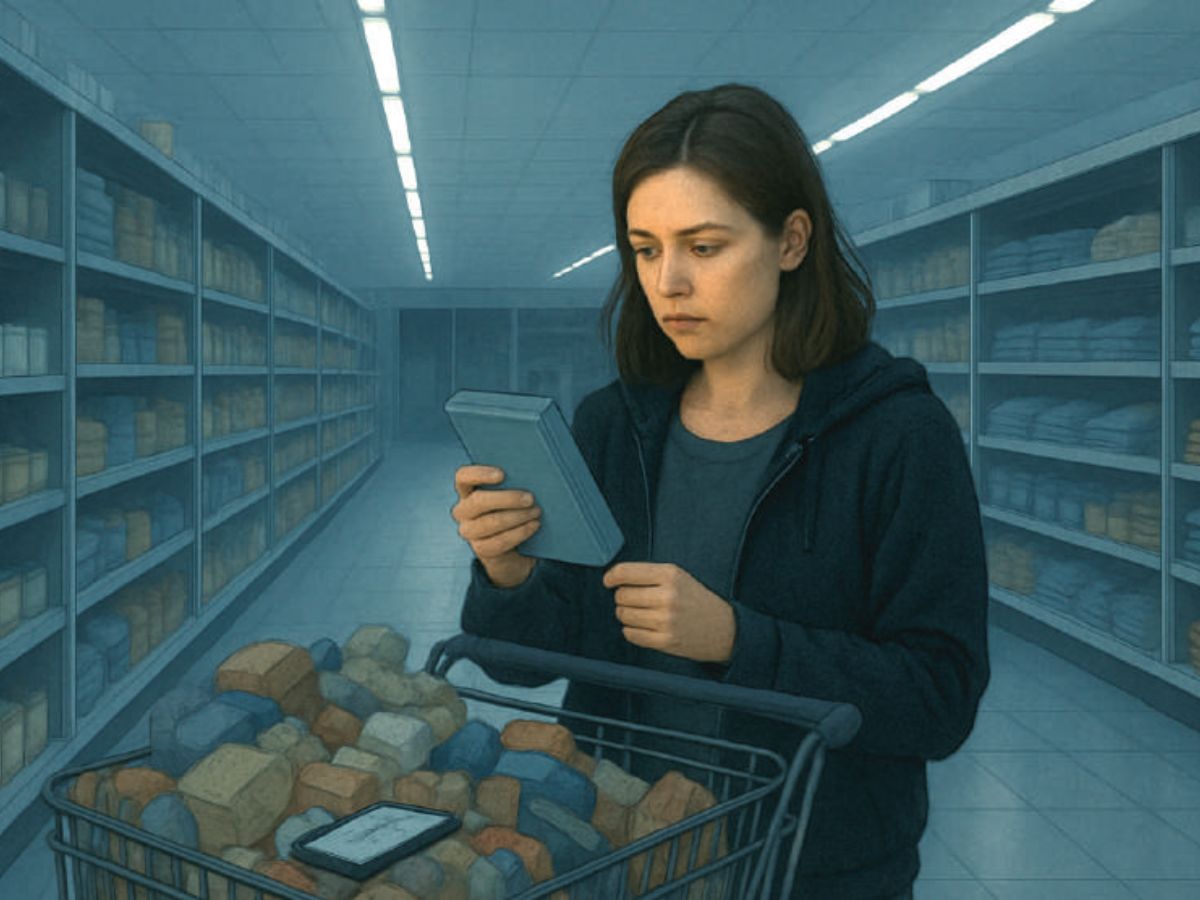
A woman stands in a store at ten in the night, her cart already full, her phone buzzing with messages she will not open. At home, her daughter has fallen asleep waiting for her. She picks up a packet she does not need. Six identical ones sit unopened in a drawer she has forgotten about. What she remembers is only the feeling that preceded each purchase: a tightness in the chest, a whisper that something is missing, a hope that the next object might quieten it. It never does, but she refuses to acknowledge that, and the store is still open.
Somewhere in another aisle, a man holds a shirt against his chest, though his wardrobe already overflows. He will wear it perhaps twice. Neither shopper is poor, yet both wear the expression of people looking for something in a place they have never been.
In the 1970s, the average person encountered roughly five hundred advertisements a day. Today, estimates range between four thousand and ten thousand. Global consumer spending now exceeds sixty trillion dollars annually. Household debt in the United States alone has crossed eighteen trillion dollars. The fashion industry produces over one hundred billion garments each year; ninety-two million tonnes of these end up in landfills, a rubbish truck of clothing is buried or burned every second. These figures are usually discussed in the language of economics or environmentalism. But they are symptoms, not the disease. The Earth is being exhausted by people who are themselves exhausted within.
Every civilisation tells itself that its achievements lie in technology, wealth, or progress, but the real engine behind human activity has always been simpler and sadder. Man cannot sit peacefully with his own incompleteness, so he learns to bury it under objects. What appears as an economic system is often only the organised expression of inner hunger. What looks like demand is usually psychological discomfort in disguise.
The world buys because the mind aches.
Buying for what? Filling what?
The Architecture of Manufactured Desire
Advertising did not create the emptiness, but it has built an empire by exploiting it. Over one trillion dollars is spent each year convincing people that what they already possess is insufficient. Every image, promotion, and influencer post carries the same silent accusation: you are not enough. A gadget promises competence, a perfume promises desirability, a car promises worth. None of these promises come true, yet they remain attractive, because the alternative is to confront the emptiness without distraction.
One keeps buying because one does not want to meet oneself. The click at midnight is not for a product; it is for a feeling, a momentary sedation, a small illusion of fullness. The relief fades before the package arrives, so the cycle repeats. Studies suggest the average garment is now worn only seven to ten times before being discarded. One in three young women considers clothes worn once or twice to be old. The restlessness is not about fashion. It never was.
Look closely at your desires and ask how many of them are genuinely yours. A bigger home often represents social pressure rather than personal need. A certain brand of clothing is an attempt to upgrade the image rather than the person. The newest phone is rarely required for its function but wanted for the feeling that one is still current, still relevant, still enough. Peel back the justifications, and most desires turn out to be anxieties that have learned to dress well.
This anxiety is the fuel of the modern economy. If people woke tomorrow feeling whole, half the consumer machinery would be obsolete by evening. The system, therefore, has a perverse incentive to keep everyone slightly incomplete. New fears are manufactured, new inadequacies discovered, new comparisons made available at the speed of a scroll. We have grown so fluent in the dialect of wanting that we mistake it for our mother tongue.
The tragedy is not only that the world manipulates, but the deeper tragedy is also that one cooperates. One scrolls, watches, compares, and willingly walks into the marketplace looking for something the marketplace cannot stock. The inner void remains untouched, and quietly, it expands.
From Inner Poverty to Planetary Collapse
Here is the connection that economists rarely make and environmentalists rarely name: the same inner poverty that keeps a woman in a store at eleven in the night is now destabilising the planet’s climate. The link is not poetic; it is mechanical. Every restless desire leaves a physical trace: A third car produces emissions, a wardrobe refreshed every season produces textile waste that will outlast the buyer’s grandchildren, a holiday taken not for rest but for photographs leaves a carbon footprint that remains long after the images have bored everyone. Multiply these choices by eight billion people, most of them trying to purchase what cannot be sold, and you arrive at the present emergency.
The planet is not being destroyed by a handful of villainous corporations, though their hands are dirty and must be tied. It is being stripped by ordinary people, compensating for an inner vacancy with outer objects. Climate change is a function of human numbers and human wants, and both spring from the same root: insufficiency. People want more because they feel they are less.
Technology will help, but no invention can cure a mind that cannot be still. Efficiency gains are swallowed by expanding wants. We build better engines and then drive further; we produce cleaner electricity and then consume more of it. A person who is inwardly restless will be outwardly wasteful. A restless civilisation will gut the Earth no matter how many panels it installs or forests it pledges to protect.
Walk through any large city and watch the faces. Many of them carry hurry, distraction and a dull fatigue. People rush from work they do not love to buy things they do not need to maintain images that were never their own. They hope that consumption will manufacture identity, that accumulation will generate meaning, that movement will produce peace. It never does. The hollowness is not a defect; it is a message. The search has been pointed in the wrong direction all along.
Clarity as Ecology
The solution is not moral restraint. Guilt is a weak engine, and deprivation without insight only breeds resentment. You cannot scold a civilisation into sanity. The real work is understanding the mind that wants so endlessly. Why does it want? What does it hope each object will finally settle? Self-knowledge, not self-control, is the only ecological solution that does not quietly collapse.
What a society worships, its economy will manufacture. Worship ownership, and production follows. If status flows from owning, every room becomes a display case and every bond a negotiation. If status flows from understanding and contribution, people begin to loosen from the grip of endless wanting: not through gritted teeth, but because they no longer need objects to feel real.
Policy has its role: Tax waste rather than labour, penalise planned obsolescence, regulate the machinery that profits by farming human insecurity, and shrink the industries that would collapse if people felt whole. But policy without inner change breeds only resentment and clever workarounds; inner change without policy stays private and powerless. The two are legs of the same walk.
The inner work begins with a question asked before any purchase: What am I actually looking for here? Not what it costs in money, but what it costs in honesty. Do I want this thing, or do I want the feeling I imagine it will bring? Am I buying for living, or for proving? These questions are not self-denial; they are self-discovery. Ask them long enough, and you begin to see how little of what you call preference is actually yours: how much is borrowed fear, absorbed comparison, inherited inadequacy wearing your face.
When clarity comes, consumption loses its grip. One buys what genuinely serves, not what props up an image. One acquires less, not from poverty of means but from richness of understanding. The ecological footprint shrinks as a side effect of sanity, not as its price.
A civilisation rooted in such clarity would not need to wrestle itself toward sustainability. It would live lightly because its people had stopped using the planet as a medicine for a disease it cannot cure. The marketplace would remain. The advertisements would keep their whisper. But a person who sees clearly moves through it all untouched—not by withdrawal, but by understanding.
The woman with the packet and the man with the shirt are not failing morally. They are searching where nothing has ever been found. The choice before them is not between buying and not buying. It is between continuing to circle the aisles until closing time, or turning around to face what they have been avoiding all along.
The planet cannot keep waiting for that turn. And if the woman stopped long enough to notice, she would see: neither can she. The child fell asleep waiting. The packet was never the point.
Acharya Prashant is a Teacher, founder of the PrashantAdvait Foundation, and author on wisdom literature.
