Pt. Naviin Gandharv shares his journey, challenges, and mission to popularise Belabaharr globally.
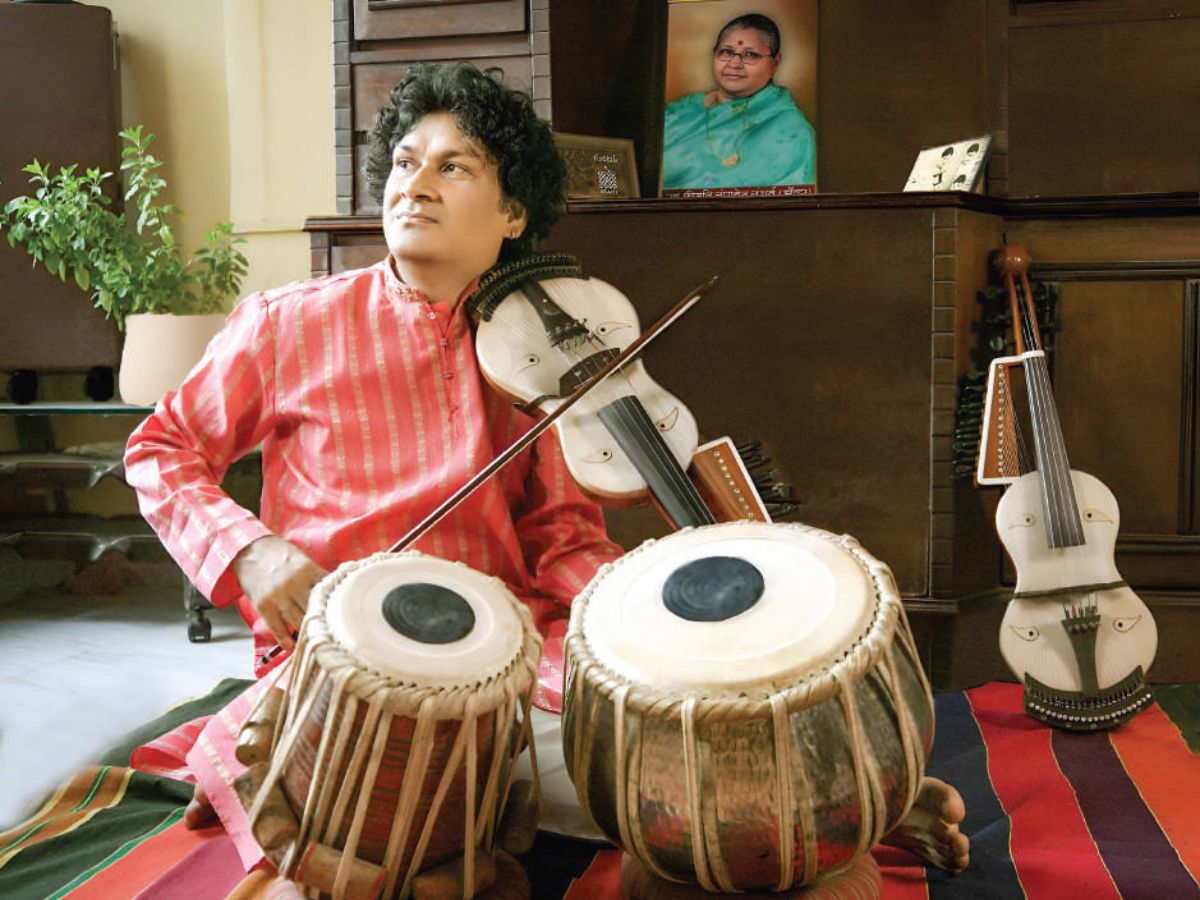
Pandit Naviin Gandharv
It is rare indeed to have the opportunity to turn one’s passion into one’s vocation. A shining example of someone who has done so is Pandit Naviin Gandharv, Tabla soloist, exponent of the unique instrument known as the Belabaharr, and the founder of Anuraaj Classical Band.
After a recent performance at the Governor House for Prime Ministers Narendra Modi and Keir Starmer, alongside other dignitaries, The Sunday Guardian caught up with him for an exclusive chat.
Excerpts from an edited interview:
Q. How did you enter the field of music and why?
A. I belong to a musically rich family from Dewas, Madhya Pradesh. My paternal grandfather Pt. Kashiram Gandharv ji was a respected Sarangi artist and maternal grandfather Pt. Mansingh played many instruments, focussing on the Sarangi and the Tabla. My father Pandit Babulal Gandharv invented a unique bow instrument called the Belabaharr.
At the age of 10, I was fascinated by the Tabla. My father encouraged my interest and put me under the tutelage of Pt. Vishwanath Mishra. At first, I won competitions at intercollegiate youth festivals and then progressed to performing at smaller community events. Soon, I was presented with a rare opportunity to learn the Tabla from the legendary wizard, Ustad Allarakha.
Q. Please talk about your journey as a musician and the difficulties you have faced along the way.
A. By the time I was 25, I was Tabla accompanist to my father and other maestros like Ustad Irshad Khan. But I knew my potential was far greater than this, and I felt the pull of the Belabaharr.
Making the shift from Tabla to Belabaharr was not easy. I had the temperament of a Tabla player, but I worked hard and followed my instinct. In two years, I managed to play audibly and got my first stage performance at SurSingar. This feat was unprecedented in such a short period of time.
Simultaneously, I began to promote the Belabaharr around India to increase awareness of this wonderful instrument. This wasn’t easy by a long shot. I approached people from across fields, but nothing worked out. Throughout, however, my mother was a staunch support, exhorting me to never lose heart.
In this period, I faced another challenge: those who had me as their Tabla accompanist began to feel envious of the new recognition I was receiving as a lead artist. A few of my contemporaries boycotted me, which led to a monetary crisis.
I sought out government sponsorship too but unfortunately, nothing worked. This is when I created the band Anuraaj with my brother Devanand ji, a great keyboardist and composer. We play classical music in a contemporary style. Later, Pramod Gudekar and Prashant Sonagra joined us.
Q. Please talk about your instrument. What have been the challenges of playing it and putting it on the world stage?
A. The Belabaharr has a sonorous sound resembling the Sarangi, which is quite distinctive. It can be applied to play different kinds of music—from Indian classical music with complex taal mathematics and exceptional content, to light music, folk, ghazals, bhajans and even Western music very comfortably.
However, popularising it has been a challenge for a young artist like me. Further, shifting from the Tabla to the Belabaharr presented a physical challenge as the position of the Tabla is straight whereas the body needs to have a curve to get a proper grip of the Belabaharr. The severe pain has to be borne continuously.
Q. What have been some of the most noteworthy performances of your career so far?
A. One of my earliest memories as a professional is of performing at the Virasat International Festival at Dehradun in 2012, and at Baptist University Hall in Hong Kong where I collaborated with Grammy award winner Falu Shah.
My Tabla solo performance at Adhyatmik Rajgurukulam in Goa, and my performances at the Khushwant Singh Literary Festival for three consecutive years have been very special. My recent performance for PM Modi ji and the UK PM Keir Starmer was highly noteworthy as well.
Q. Please talk about your recent performance for PM Modi and the UK PM. How did this opportunity come your way?
A. It was the highest honour to perform for UK’s Prime Minister Hon. Keir Starmer and our beloved Hon. Prime Minister Narendra Modi ji at the Governor House.
I thank the ICCR and Cultural Ministry for this opportunity as they needed an artist who is on his toes and is versatile enough to play multiple genres—from Hindustani Classical to bhajan folk. I can also perform English songs well. I feel my unique skills were well-placed for this high-profile event.
We started with Raag Jhinjhoti before the entry of the dignitaries which made the atmosphere very pleasant. This was followed by a Ganpati Bhajan sung by Bharat Ratna Lata Mangeshkar Ji originally, called ‘Ganraj Rangi Nachato’. We also played the English song ‘Sapphire’, which the audience thoroughly enjoyed. This was shared on social media by Modi ji.
I am filled with gratitude for his generosity, as it helped my mission to promote the Belabaharr. At the performance, I also played a Gujarati folk song on the Belabaharr on Lord Krishna called ‘Odhaji’, followed by bhajans like Vaishnav Jan Toh, Om Gan Ganpataye and classical raagas like Raageshwari etc.
Q. How should musicians popularize the Hindustani Classical genre across the world in this digital age?
A. I can’t suggest what others should do but I regularly do Riyaz to master the lyrical and emotional connect needed to win hearts. I guide musicians who are inspired by my music by posting clips of me playing the Belabaharr and Tabla solo on social media and sharing others’ talent which has rich content.
Q. What are you working on next?
A. My priority is to grow the reach of my music. So, I share new techniques which I have discovered, conduct workshops and perform at concerts. With my band Anuraaj, I try to give a contemporary flavour to my music by merging the Raga and the Taal element with different kinds of instruments.
With Modi ji’s encouragement, I am spurred on to achieve even greater heights. I believe that I will live up to his trust and have the opportunity many times over to represent Bharat by performing Hindustani Classical solos on the Belabaharr and Tabla, as well as with my dynamic Anuraaj classical band in India and abroad.
Noor Anand Chawla pens lifestyle articles for various publications and her blog www.nooranandchawla.com.
