Ladakh’s unrest reveals deeper ecological collapse threatening the Himalayas and India’s survival.
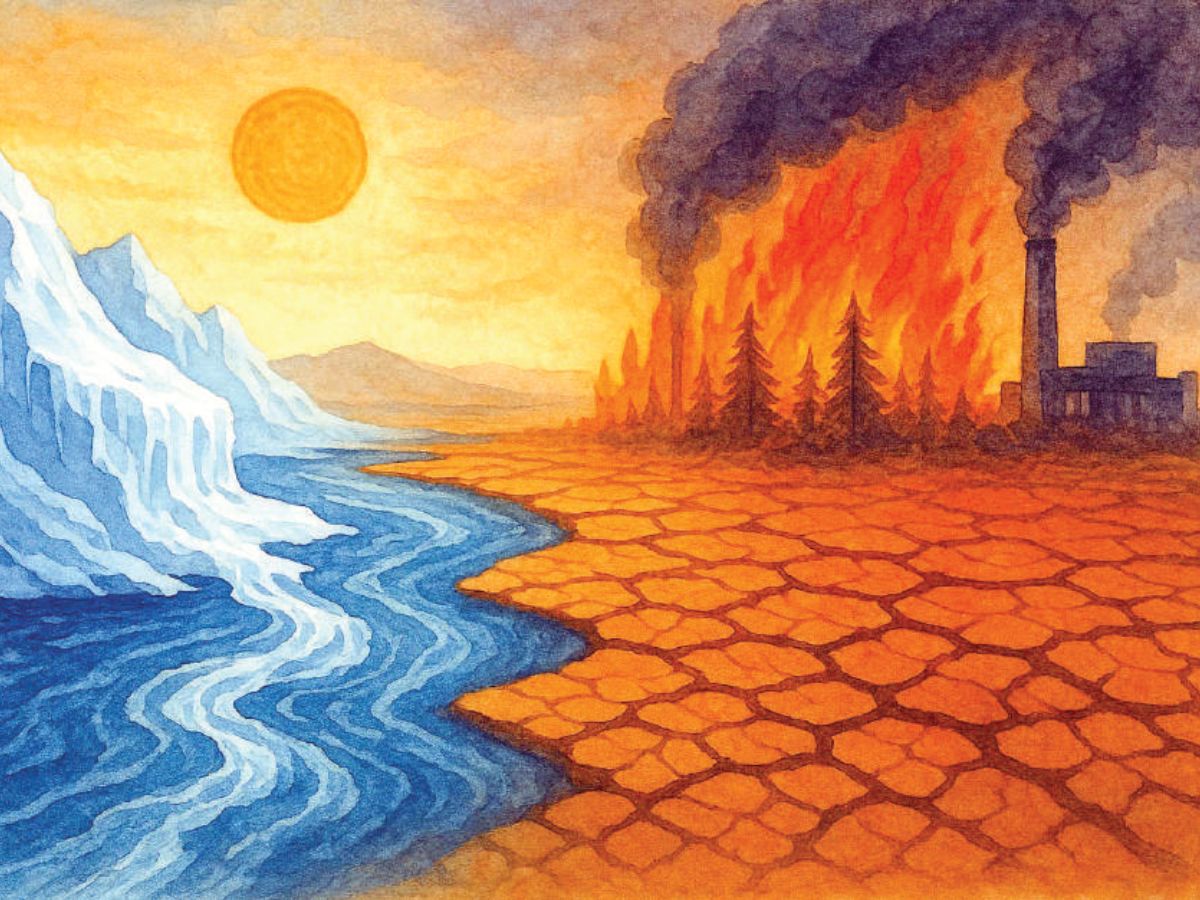
Ladakh’s environmental crisis, highlighted by protests and Sonam Wangchuk’s arrest, signals the urgent threat of climate change, glacial melt, and water scarcity. (Image: File)
The mountains have again started to talk in the quiet, high air of Ladakh, but it seems the country isn’t listening. What happened in Leh this September wasn’t just another protest; it was a sign of something bigger. Curfews were put in place, people died, and Sonam Wangchuk, who had long been calling for a balance between the environment and development, was arrested under the National Security Act. Soon, protests spread to Delhi, Chandigarh, and Dehradun, but the true tremor is still not heard. Ladakh is warning of something that can’t be stopped by borders or police orders. It isn’t a problem with the government or a fight between regions. It is the slow destruction of the Himalayas, and with it, the destruction of everything that comes from its melting heart.
People have traditionally talked about the Himalayas as a wall that protects India from the north and never moves. But walls are supposed to stay motionless; this one is falling apart as it moves. Geologists claim that the Himalayas are not old since they are always expanding and changing as the earth’s crust moves. It is weak because it is young, and its scars are now clear. The signals along the Himalayan arc are like lines giving the same core warning: cloudbursts tearing across Himachal’s mountains, landslides swallowing Uttarakhand’s communities, and glacier lakes bursting in Sikkim’s valleys. This sad rhythm has also reached Ladakh. The glaciers that used to feed Ladakh’s rivers are slowly fading away. It took hundreds of years for the ice to build, but it is now disappearing in just a few decades. According to studies by the Wadia Institute of Himalayan Geology and the Indian Institute of Science, Ladakh’s glaciers have lost over 14 percent of their total mass since 2000, with some retreating by nearly 20 metres each year. Whole ridges that used to be covered in white are now naked rock, which absorbs more heat and speeds up their further warming. What looks like stillness from a distance is actually a creeping collapse. There are streams where there should be snow and mirrors of meltwater where the mountains used to hold ice blocks.
Water doesn’t fall from the sky in arid Ladakh; it climbs down from the mountains. Every summer, life depends on how much of the ice from the winter comes back as water. But when the snowline becomes higher each year, that return gets smaller. Springs that used to flow through stones are now quiet, and fields that used to be full of grain are now pale. When there isn’t any snow, people use what they have left, like thin streams and shallow wells. It feels like every drop is earned. To stay alive here, you have to wait: for the melt, for the rain, and for a balance that may never come back. The mountains are changing faster than the people who need them can keep up, and the lack of water is starting to sound like a grave warning.
The changing climate doesn’t wait for policy; it comes directly to the table. Billions of people throughout the world already don’t get enough food to quench them. A billion people go to bed hungry every night, and two billion more don’t know when their next meal will be. The FAO’s 2023 report confirms that more than three billion people suffer from some form of malnutrition, and climate disruption is expected to cut India’s major crop yields by 6 to 25 percent by mid-century. The seasons are starting to get erratic in the farmlands of India. What was earlier a regular pattern of planting and rain now goes back and forth between drought and flood. Fields ripen at different rates. Harvests don’t get smaller because people are not working hard; they get smaller because the weather is confusing. When the water and temperature aren’t right, the soil’s yielding cycle starts to become erratic as well. This is not a lack of grain but a lack of planning. We know how to distribute things, but we don’t know how to regenerate them. Every drought and every strange monsoon reminds us that the real famine starts long before the last grain is gone. It starts when the land is expected to give more than it can.
The world doesn’t fall apart all at once. It comes apart in circles, with each cause leading to its own effect. The Earth’s mirror goes away with melting snow and ice as white reflects sunlight back, now turning black rock, which makes them absorb heat instead of reflecting it. The soot from diesel trucks and particles from buildings make glaciers even darker. These are data points that can be tracked and are quite alarming. Scientists call them feedback loops. Recent IMD data show over 300 extreme-weather days every year across India, a rhythm that mirrors these loops in real time. Once they start, they don’t require humans to keep burning fuel; they heat up on their own.
Why does it still feel far away for many, if the danger is so clear? It’s because distraction has become a safe escape for us. The entertainment on our screens and the chase for GDP keep us numb while the world burns below. Climate change is something many consider like a graph, an argument, or a storm in another area of the planet, even if it impacts how we breathe. We often think that doing something small at an individual level will change things. We believe that the equilibrium will come back if we make a few smart choices and hold back a little. But the environment doesn’t wait for us to change things individually; it changes because of how we live as an entire species. Policies are made, grids are powered, and cities are built. This is where real change starts. It requires a redesign of the systems that feed and energize us, not just a kinder usage of the ones that are currently there. The world doesn’t need fewer footprints; it needs a whole new direction. Each ton of carbon has its own mark. Most of them belong to people who can afford too much: the jets, the factories, and the never-ending thirst for more. The wealthy ignite the flames, while the impoverished inhale the smoke. India’s goal isn’t only to expand; it’s to grow in a sustainable way that gives people dignity. When people can be comfortable and society’s growth is sustainable, that’s a real sign of development.
More than a protest, what’s happening in Ladakh right now is a warning. What seems like a protest is really just a reflection of the stats. The warnings about glaciers melting, snow becoming black with soot, and water evaporating are not the core issue. They’re only footnotes to scientific findings. Their voices echo what scientists have already found out: the mountains are losing their breath, and the rivers that run from them are learning to stammer. Those who think that Ladakh’s turmoil is only happening in one area don’t grasp what it really means. It’s not only about politics; it’s more about physics. Dismissing Ladakh would be like dismissing the tremor because it started at the edge of the map. The trembling doesn’t stop where it starts.
Taking care of Ladakh is not just a favour to the mountains; it is a way to protect oneself. The area needs to be treated as the vulnerable zone it is. Construction should be limited, tourists should be limited, and every project that touches its slopes should have built-in accountability. But the real change will be at the level of the human mind. As long as we keep seeing the Himalaya as a background for our progress instead of the foundation that supports it, every new road or resort will only bring us closer to collapse. And legislation alone won’t keep the slopes in place. Sonam Wangchuk’s arrest may make the news, but the main problem is that we won’t be truly free when he is released. Instead, we should protect the Himalayas. They keep the weather constant, feed the rivers, and keep the monsoons powerful. Ladakh is not rebelling; it is remembering. The voices coming from its valleys are not acts of rebellion; they are a call to remind us of what we have forgotten: that even survival is connected to inner clarity. To look at Ladakh today is to look at ourselves. The cracks in its ice are reflections of our own restlessness, our refusal to pause in the midst of a catastrophe.
Acharya Prashant is a philosopher and teacher of global wisdom literature, founder of the PrashantAdvait Foundation, and bestselling author who brings timeless insight to urgent modern questions.
