
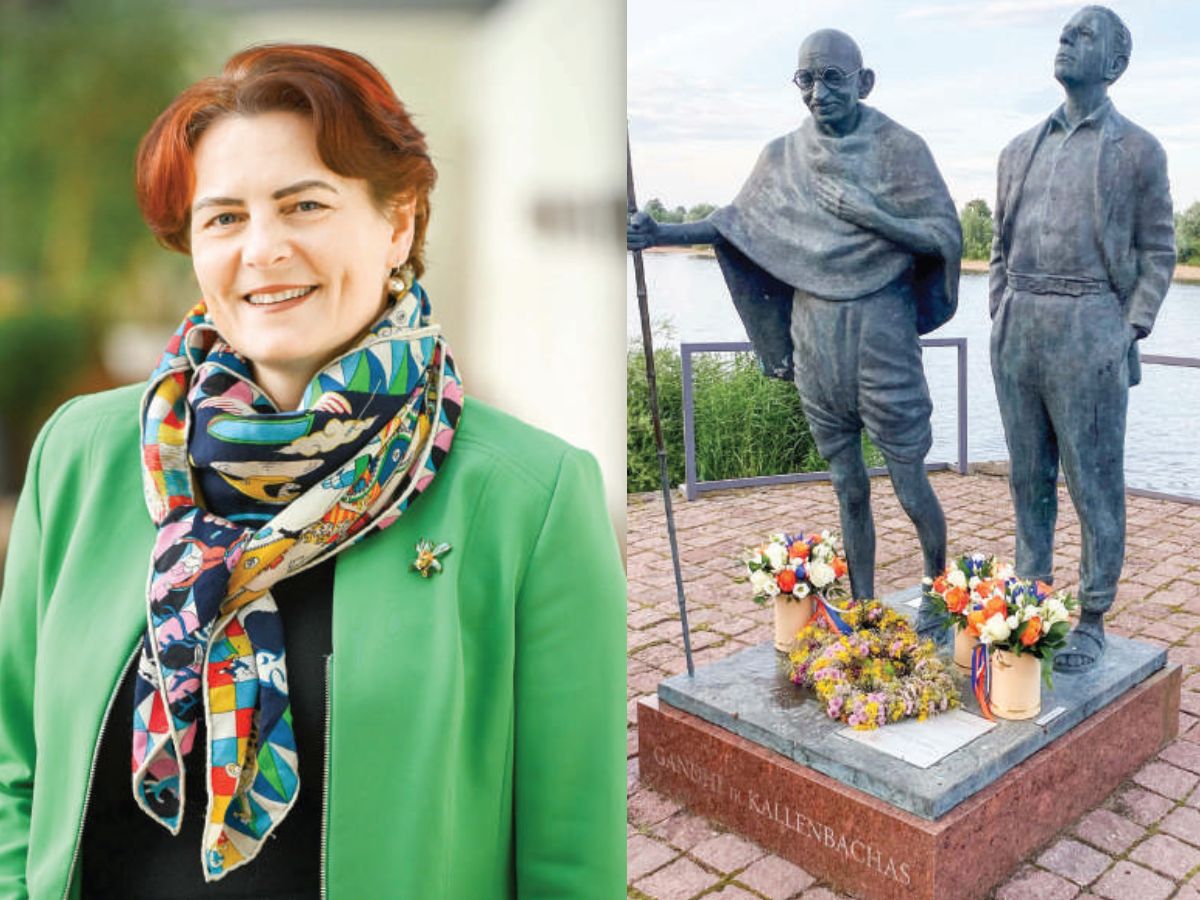
For Ambassador Diana Mickevičienė of Lithuania, diplomacy extends far beyond closed doors and official corridors. She sees it as a living, evolving dialogue shaped by literature, art, history, science, and the warmth of people-to-people connections. Recently honored with the Award for Contribution to India–Lithuania Relations, she humbly notes, “I don’t want to focus too much on the award because I feel I am just doing my job.” Yet, her efforts to bring Lithuania closer to India tell a story that transcends modesty.
The award is linked to an extraordinary historical discovery involving Herman Kallenbach, a Lithuanian-born Jew and close confidant of Mahatma Gandhi during the South African struggle for justice. Often misrepresented as German due to his region being under the German Empire at the time, Kallenbach was in fact a Lithuanian Jew. Mickevičienė explains, “You can basically tell the history of the world through the friendship of Gandhi and Kallenbach. It connects Lithuania and India, but also South Africa and even Israel.”
In 2015, Lithuania commemorated this connection with a monument to Gandhi and Kallenbach, sculpted by Romualdas Kvintas. Around it, a festival and annual award were instituted to celebrate those strengthening Indo-Lithuanian ties. “It happens every summer in Rusnė, the only island in Lithuania, and has become a traditional end-of-July event where everyone who loves India gathers,” she says. This year, Mickevičienė and Indian Ambassador to Lithuania Devesh Uttam received the award. “It was a big surprise,” she admits, noting that 2025–26 has been declared the Year of People-to-People Connections between the two nations.
The Year of People-to-People Connections coincides with two remarkable anniversaries: 400 years since Andrius Rudamina, a Lithuanian Jesuit, arrived in Goa in 1625 en route to China, becoming the first known Lithuanian in the larger Asian region; and 130 years since Indian scholar Dr. Jivanji Jamshedji Modi visited Lithuania in 1895, fascinated by the linguistic link between Sanskrit and Lithuanian. Modi’s interactions with local scholars paved the way for academic exchanges decades before official diplomatic ties existed. “While our diplomatic relations are just over 30 years old, the people-to-people connections stretch back centuries,” Mickevičienė emphasizes.
A key initiative has been introducing Lithuanian literature to India. Before her tenure, no full Lithuanian work had been translated into Hindi. With Sahitya Akademi’s support, the first Hindi translation of Jaroslav Melnikas’s dystopian writings is now being published. Lithuanian poets have also collaborated with Indian counterparts for residencies in Kolkata and Punjab, translating works, traveling together, and performing joint readings. Lithuanian writers have appeared at festivals in Hyderabad, Debrugarh University, and Goa. Mickevičienė cites a serendipitous example: Dr. Jayasrinivasa Rao, a Kannada-speaking professor in Hyderabad, single-handedly published an anthology of Baltic poetry in Kannada, demonstrating the organic depth of these connections.
Lithuania’s engagement extends beyond the humanities. Mickevičienė proudly notes that her country produces 10% of the world’s scientific lasers—a remarkable achievement for a nation of three million. Lithuanian femtosecond- and picosecond-precision lasers are already powering Indian research labs and industries, vital for smart manufacturing. Lithuanian companies regularly exhibit at India’s World of Photonics expo, reinforcing science as a bridge in bilateral relations.
Art also features prominently in her vision. She highlights Mikalojus Konstantinas Čiurlionis, a painter, poet, and composer often called the “Lithuanian Tagore,” whose works continue to influence contemporary culture. Recent performances in Delhi, as well as upcoming tours by Čiurlionis’s great-grandson Rokas Zubovas, aim to connect Indian audiences with this legacy. Mickevičienė envisions exploring parallels between Čiurlionis’s symbolist paintings and those of Bengal’s Abanindranath and Gaganendranath Tagore: “Imagine Tagore and Čiurlionis speaking through art across continents—that is the magic we want to create.”
Lithuania also showcases its folk heritage in India. An exhibition of sodai—fragile straw decorations recently inscribed on UNESCO’s Intangible Heritage list—is planned for Delhi. Earlier, a Lithuanian storyteller participated in Assam’s Brahmaputra Festival alongside indigenous oral artists, and Mickevičienė even moderated a session comparing Manipuri Mahabharata storytelling with Lithuanian folk narratives.
One notable step has been the formal introduction of teaching Lithuanian at JNU. “Hindi has been taught at Vilnius University for 25 years, and now we have a Lithuanian teacher at JNU School of Languages. Though the class is small, it’s a big step,” she says. Plans are underway to extend this initiative to other Indian universities through workshops and lectures.
For Mickevičienė, diplomacy ultimately revolves around human connection. She fondly recalls the Indian Embassy in Lithuania winning a local fish-soup cooking competition with a masala-infused version: “Imagine—a masala fish soup at a Lithuanian fishing festival! It was such a beautiful moment.” Whether through literature festivals, art exhibitions, laser technology, or folk crafts, her mission is clear: to transform Indo-Lithuanian relations from polite diplomatic gestures into a living, creative partnership.
“From art to lasers, Lithuania and India can find so many ways to connect. That’s what makes this journey exciting,” she concludes, her voice brimming with optimism.




