Lord Meghnad Jagdish Chandra Desai ( July 10.1949-29 July 2025) was known for sharp intellect, fearless views, ability to blend Marxism, Keynesianism and liberal economic ideas and bridge ideological divide. He underlined the relevance of Marxism for Capitalism and Globalisation. He was an atheist but had a secular mind. He extolled capitalism and free market but his heart beat for the poor and developing world. No wonder, he founded LSE’s Centre for the Study of Global Governance and headed it from 1993-2003. He had also led LSE’s Development Studies Institute.
With Prof Amartya Sen and Mahbub ul Haq he was instrumental for the creation of pathbreaking Human Development Index. With a PhD from the University of Pennsylvania, Berkley he taught economics, macroeconomics, Marxism economics and developmental economics at the London School of Economics for 35 years (Prof from 1965-83). This was an impactful voice; his well-argued, bold and frank opinions on economic, political and strategic issues expressed through his 20+ books, over 200 articles and countless lectures were heard globally. He joined the Labour party in 1971 and was created a Life Peer as Baron Desai in 1991. On his death, the LSE Bog said, “He had an extraordinary range as a social scientist and economist.
From Marxist philosophy, to technical econometrics, to the inner working of monetary system…he brought his economic insight to bear on public policy and international affairs.” When I met him at the LSE in 1987, what attracted me more than his forceful lecture was his jet-black hairdo; he looked a lost Siamese twin of Sathya Sai Baba and kept that curly look of his hair even when they turned silver. And, of course, his unassuming, friendly nature sans all signs of pompousness and arrogance. We chatted for a while and felt as if we have been friends for years. Infrequently, we remained in touch for decades even when I had left London.
By the time I took over as the Dean of the Foreign Service Institute of the MEA in 2006, he had become Professor Emeritus of Economics at the LSE and was game for sharing his views not only about the global economy and Indian and the British politics but on anything under the sun, be it American Presidents or Indian Prime Ministers or Russia’s threat and China’s emergence as a major economy. He graciously came to the FSI to chair a lecture by Dr Ramchandra Guha, historian and another by Dr Azim Prem ji, chairman of Wipro enterprises and impressed everyone not only with his vast knowledge and erudition but also dry sense of humour.
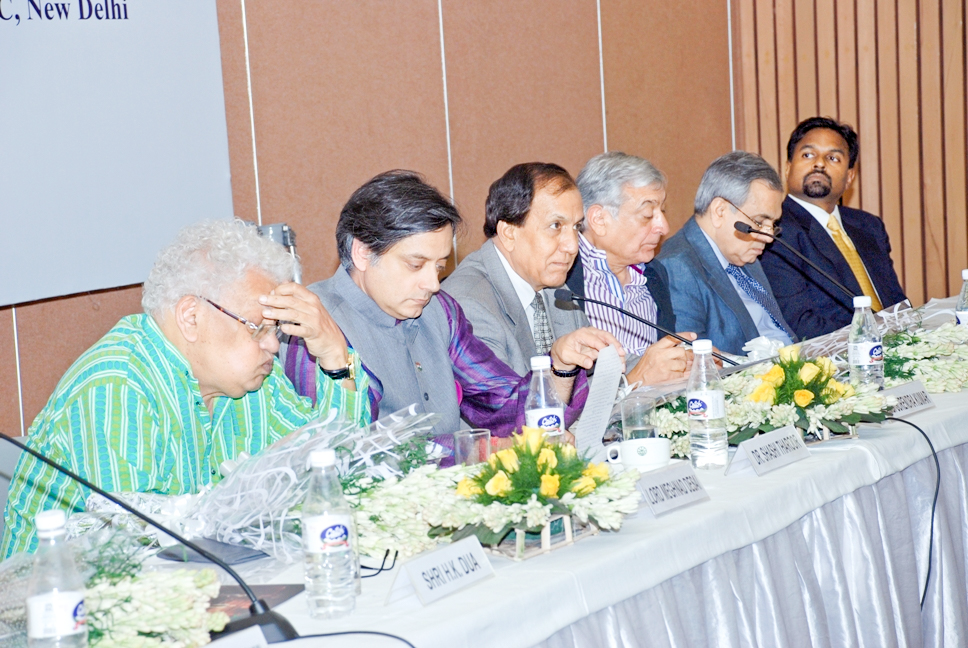
Once he reportedly said that if Marx were alive, he had no doubt, he would have become a Thatcherite. On another occasion he disarming quipped, I keep coming to India as this is the only Country where I am treated like a Lord. He was a great supporter of Indo-American Friendship Association (IAFA) and never said no to an invitation to participate in a discussion and he was the quickest to respond. I would send him a page long letter at midnight (IST) sharing the topic the discussion and the names of other panellists and lo and behold, his response arrived next morning: Will do! In August 2011, he was on an IAFA panel with the likes of Dr Shashi Tharoor, H.K. Dua, Ambassador Kanwal Sibal and Dr Rajiv Kumar.
During two-yearlong Covid period, he appeared on IAFA’s virtual discussions several times; we even discussed his biography: “The Rebellious Lord” virtually on Zoom. Another thing which brought us nearer was Bollywood. Desai, one of the most influential economists of his time, who wrote books like: “Marx’s Last Revenge”, “Rethinking Islamism: Ideology of the New Terror and Rediscovery of India”, also wrote “Nehru’s Hero: Dilip Kumar and Pakeezah: An Ode to a Bygone world”. Having written “Legends of Indian Cinema and Unforgettable Divas of Bollywood” myself I am a huge fan of Dilip Kumar and Meena Kumari. Meghnad Desai had no ideological hangover; he freely gave his advice to the government, whether it was Dr Manmohan Singh or Narendra Modi. At the time of election results, and on the day of the budget presentation, he was a popular face on Indian TV channels. He will be missed world over.
Surendra Kumar is a retired Indian ambassador and the president of IAFA.
