
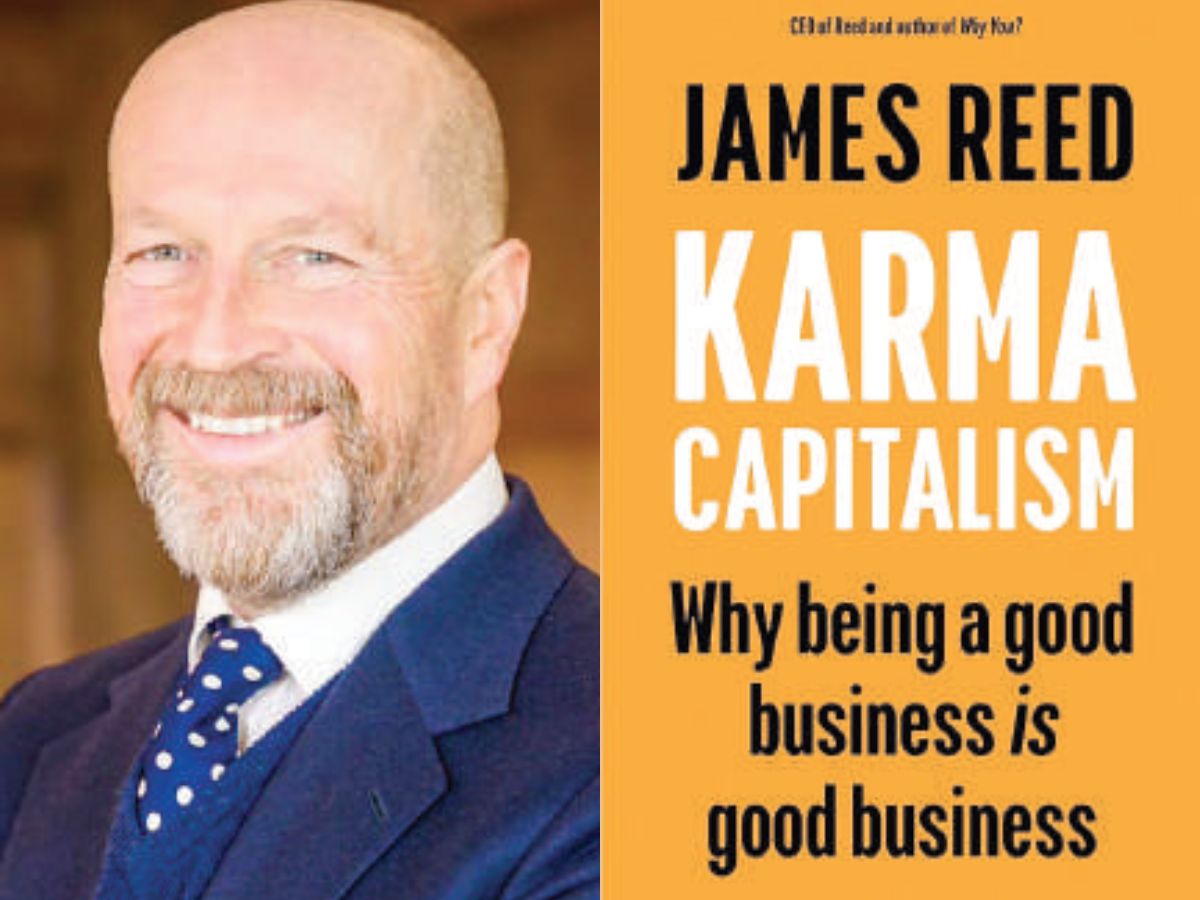
There are many inspiring aspects to James Reed’s new book “Karma Capitalism”: his admiration for his father, his devotion to his family, his vast professional experience, his passion to make the workplace and the world a better place, and his innovative approach to philanthropy. All these were crystallised in one moment of epiphany when he had a near fatal fall off the majestic Matterhorn mountain. He was rescued by an angel named Roberta who descended from a helicopter.
James Reed is CEO of Reed, the global recruitment and philanthropy company and the first agency to go online; and Chairman of Big Give, the charitable “sister” organisation founded by his father Sir Alec Reed in 2007. Big Give match funds donations thus doubling donations to individual charities. Big Give has raised £350 million since 2008, benefitting thousands of charities, providing education, homes, health and lifting people out of poverty worldwide.
Reed is driven by a sense of social responsibility and his desire to change the DNA of companies by becoming Philanthropy Companies (PhilCos)—businesses that are at least 10% owned by charitable foundations. As well as Reed, many other recognised brands are already PhilCos—Bosch, IKEA, Lego, Cadbury, ABF, and Rolex. Throughout a process described in the book, he hopes to encourage corporations to adopt the PhilCo philosophy and ultimately reform the DNA of capitalism away from uniquely benefiting shareholders, towards a transfer of opportunity and benefits to other stakeholders (customers, employees, and the global citizenry). This does not change the business model, but it is a different, more culturally conscious modus operandi.
Reed knows his mission will be a challenge to the mainstream and he is not expecting instant results. The aim of a more inclusive society is supported by Generation Z, who are reacting to soaring global inequality, and he believes the time is ripe to question conventional corporate structures. The PhilCo approach takes the pressure off charities, who have suffered repeated setbacks since 2008, especially from corporation donations. Reed employees and members give testimony how PhilCo status has improved their motivation, work ethic, and output, and other organisations share similar testimony.
Reed chronicles the development of capitalism from Tudor times, to the generosity of the Cadbury family, and the injustices of the East India Company to the deregulation of building societies and the rise of banks culminating in asset stripping, and ultimately the cost to taxpayers. He points out the future imbalance where the young minority will be working to support the increasingly old majority (with the exception of India). This introduces today’s problem in the UK (and Japan), of how governments will afford pension costs and state benefits.
His in-depth study into corporate ESG practices reduces well-intentioned initiatives into bureaucratic virtue-signalling monopolies with no regulated accountability. There follows some compelling analysis into how corporate longevity is achieved; the answer is explained in the PhilCo model. He cites Denmark where 60% of the stock market has PhilCo structures.
PhilCo models build brand and customer loyalty and enhance productivity; citing several pioneering PhilCos and the charities that benefit from them: IKEA = education, Carlsberg = science and humanities. The early part of the book gives empirical evidence of how and why a PhilCo works; the latter half is a step-by-step of how to become one of the four PhilCo models, and how this benefits morale and resilience.
Karma Capitalism is a persuasive exploration of how to do business differently. It is time to shrink the divide between the haves and have-nots. PhilCos’ harmonising of business and philanthropic practice is an effort to share wealth, keeping government small and making capitalism sustainable. In a nutshell, PhilCos have soul. Karma Capitalism is published by Penguin Random House and is available from 6 November.




