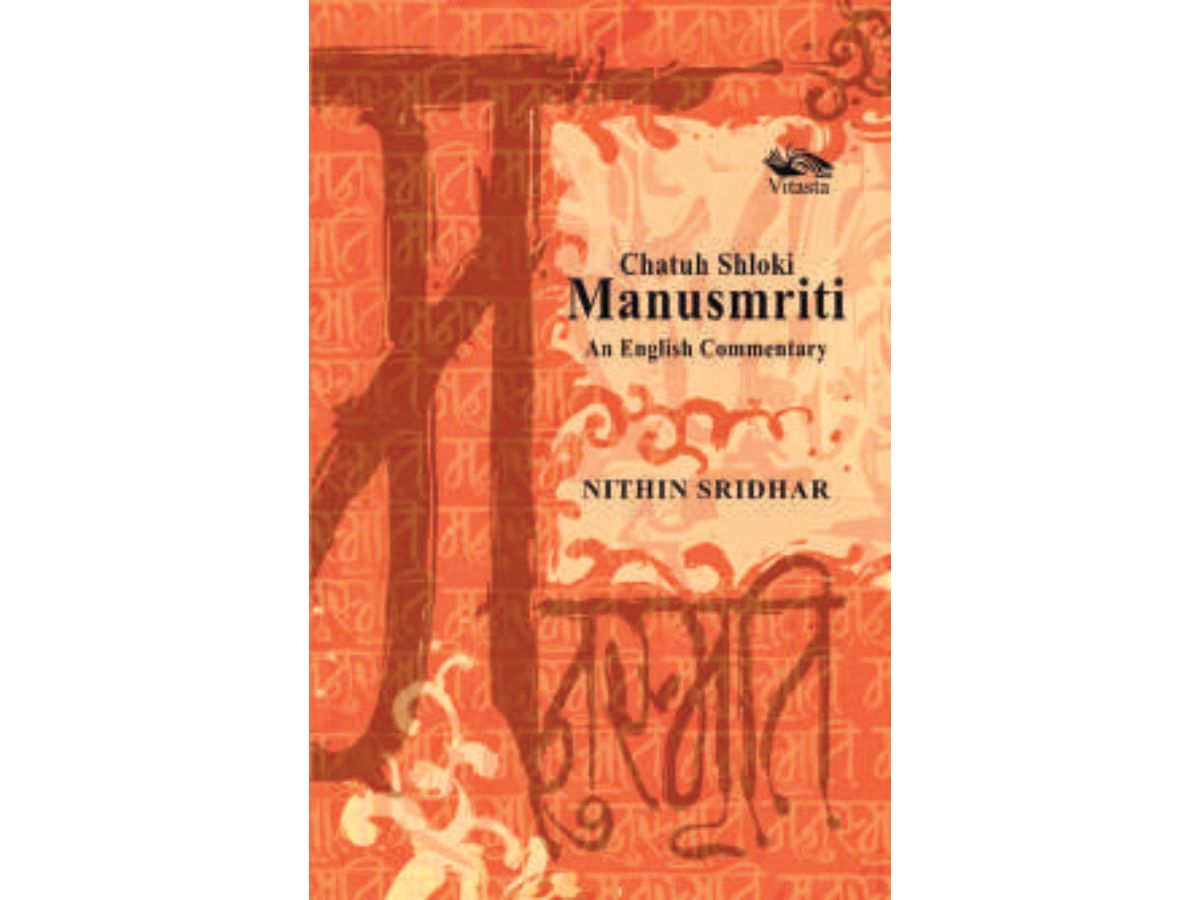
New Delhi: Manusmriti occupies a prominent place in the Indian textual tradition as one of the authentic sources of dharma. However, contemporary engagement with the text has been wrought with prejudice and discomfort left in the wake of colonialism. The present work aims to address this gap and facilitate a better understanding through a philosophical analysis of the first four verses of Manusmriti, shedding light on the object, purpose, and relevance of dharma texts.
Rather than reducing the Manusmriti to a mere relic of the past through historical study, the book situates the text within the broader Hindu epistemological, ontological, and theological worldview and extracts the timeless teachings embedded within it.
The book addresses common misconceptions on topics such as the definition of dharma, the integrity and importance of Manusmriti, the notion of ritual competency, and the Hindu conception of varna. Drawing from the entire Hindu textual tradition—spanning the Vedas, Upanishads, Smritis, Itihasa-Puranas, and the Gita—the commentary also references the works of renowned acharyas, including Adi Shankaracharya, Ramanujacharya, Madhvacharya, Vallabhacharya, Sayanacharya, Kumarila Bhatta, and Sri Aurobindo.
Praise for the Book
“An essential reader on Manusmrti.” — Smt. Nirmala Sitharaman, Minister of Finance and Corporate Affairs, Government of India
“Nithin Sridhar’s monograph is a great value addition to our understanding of Manava Dharmasastra.” — Dr. Bibek Debroy, Chairman, Economic Advisory Council to the Prime Minister of India
“This book serves as a model for students and researchers in Indian Knowledge Systems (IKS) who aspire to conduct focused textual studies.” — Prof. Shrinivasa Varakhedi, Vice Chancellor, Central Sanskrit University
“I applaud Mr. Nithin Sridhar for his outstanding scholarly publication which effectively counters many common doubts, misperceptions, and prejudices around the concept of dharma.” — Sri Akhilesh Mishra, Ambassador of India to Ireland
“Nithin’s work will invite a fresh conversation on the converging domains of secular and religious laws.” — Prof. Sthaneshwar Timalsina, Professor, San Diego State University
“This is a remarkable work that sets out to make observations in English in the traditional vyakhya style.” — Dr. Bharat Gupt, Fellow, Sangeet Natak Akademi and Trustee, Indira Gandhi National Centre for the Arts.
