
“Who goes to Mongolia,” asked an incredulous concierge as we checked out of our hotel in Seoul, en route to Ulan Bataar.
We were last there in 1990, I told him, when the Soviet Union was unravelling and the sudden parting of ways had left the newly independent nation with bare shelves and long power cuts. But the mood was jubilant, there was a new-found pride in being Mongolian, and the name of Genghiz Khaan was being revived all around.
We had taken the Trans-Siberian Railway from Beijing, I remembered, an almost two-day journey at the time. Given the acute shortage of everything in the new nation, the train had become a veritable barter house as passengers traded all manner of goods with each other, much as their forefathers had done before them. We, too, rattled across the endless steppe, but instead of caravans laden with tea, salt, wool and silk, our bags were packed with tinned food to help our friends through this difficult period.
Our ambassador at the time was Kushak Bakula, a high-ranking Buddhist monk from Ladakh. Buddhism was making a comeback, and the venerable monk was revered as a living god by the people. Decades of communism had failed to root out the people’s deep-seated faith and they flocked to his side for healing and teaching, bearing offerings of meat and cheese from the countryside.
There were few people in the streets, I remembered, most, presumably, out on the steppe. But those we saw walked with the quiet dignity bestowed by a solitary life in the wilderness, in tune with the ever-changing moods of nature. The men were strong and big boned, with felt hats and thick leather boots, and many strode with an awkward gait, more accustomed, it seemed, to life in the saddle than meandering through urban streets. (Mongol children are said to ride before they can walk.)
Now, more than 30 years later, the romance of that old train journey had faded into a distant dream. But our Mongolian Air flight, with the serendipitous call sign OM, held its own mystique. A Buddhist monk was on our flight and the young airline staff gathered reverentially around him, while he dispensed sage advice to some, and to one, a beautifully bound prayer book. On landing, the kindly lama was whisked out through a VVIP enclosure; the gentle religion was alive and well in Mongolia.
At the Chinggis Khaan airport, with no other plane in sight, the unending blue sky above and the emptiness of the grasslands all around, a heady sense of freedom filled the air—the exhilaration of unspoilt lands and the solitude of a new frontier.
On the long drive into the city, wild horses grazed lazily, settlements of colourful houses floated past, and the occasional ger popped into view, some ensconced within their own walled compounds. Perhaps their owners had not quite decided whether to continue their nomadic existence or claim a piece of land of their own amidst their country’s headlong race towards urbanization.
Ulaan Bataar was more than an hour’s drive away. But instead of the little town with its smattering of yurts, half the country’s three million people now lived in the city, where glass fronted highrises vied to touch the cotton wool clouds, and long rows of cars snaked through traffic-choked streets.
Yet the air was fresh and clear, and the light had that magical quality of summer in the high latitudes. The fragrance of rose and pine wafted in the breeze, and wisps of catkins billowed out from the birches, painting a carpet of white among the wildflowers that grew with abandon along the wayside.
At dinner, we were told that Mongolian meat tasted so good because it was completely organic, the bequest of herds that roamed freely in the wilds. I was reminded of our earlier visit, when food was scarce and whatever we ordered from the extensive menu of our Soviet-style hotel, all we got was cabbage and lamb and lamb and cabbage. Now, the meal was truly sumptuous.
Everywhere we looked, Genghiz Khaan was being reclaimed as the nation’s true hero. His towering figure now gazes benignly down on his people in the heart of the city, and the magnificent Chinggis Khaan Museum pays him a fitting tribute. Perhaps the most memorable exhibit is the recreation of the moment when Temujin is proclaimed the chief of the Mongol tribes. A thrill courses through your spine as you hear the assembled armies roar, a shaman sways rhythmically to the beat of the drums, and a rider on a white horse hails the new leader, his steed rearing and neighing in salutation.
Yet the tribes’ menacing black war banner still has the power to strike terror in those who stand before it. While the world remembers carnage and pillage, the exhibits portray the peace that Mongol conquests wrought across Eurasia, a Pax Mongolica of the times. They also highlight the religious freedom that the Mongols bequeathed upon their subjects, as being believers in Shamanism who worshipped the mountains, earth and sky, they had no religious preaching, leading to harmony between the faiths.
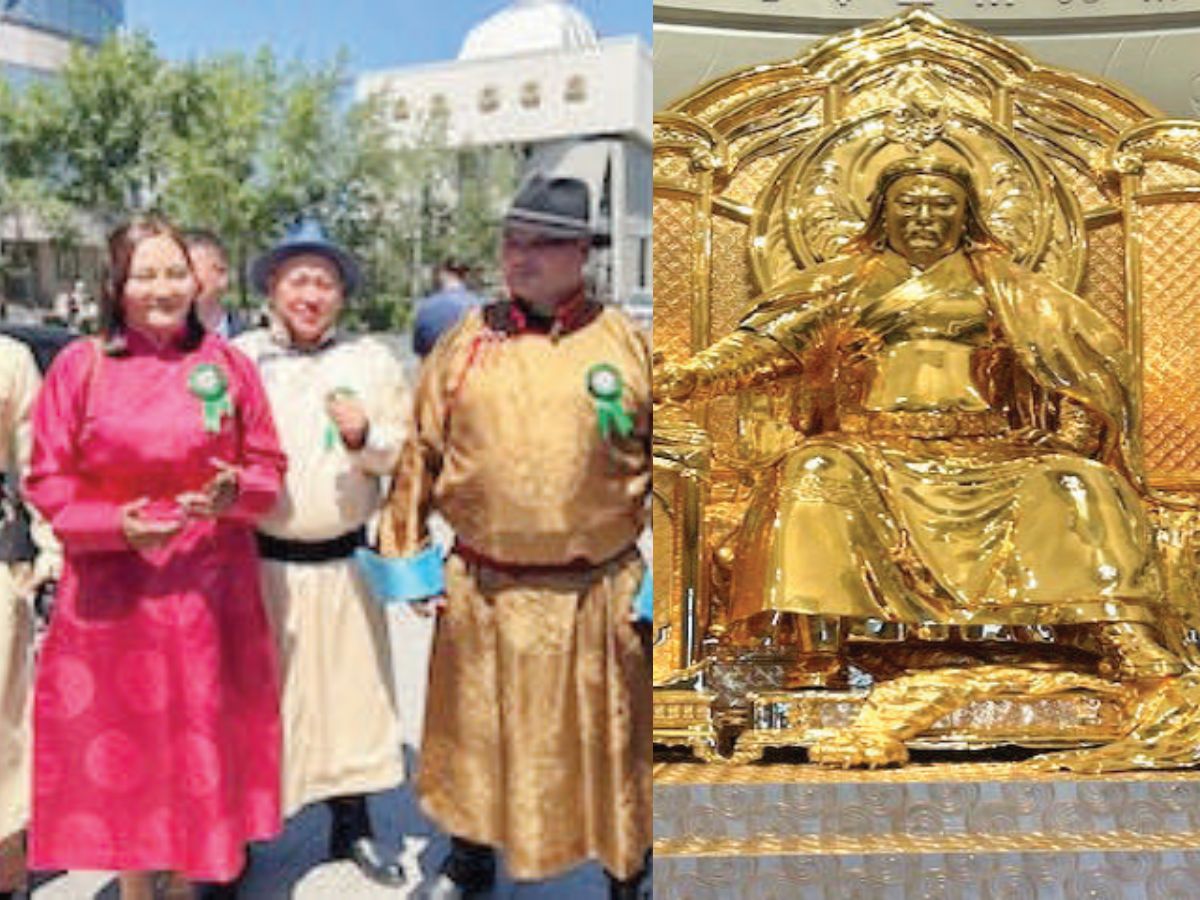
The top floor of the museum hosts a gigantic statue of Genghiz Khaan, resplendent in gold. Visitors are advised to bend their knee as they approach the massive figure, never turning their backs to it as they retreat. The effort, it seems, is to forge a distinct identity for young Mongolians—wedged between two large and powerful neighbours, Russia and China—and instil pride in their legendary leader who conquered four-fifths of the then known world. Interestingly, the statue is ringed with symbols of the different Mongol tribes, including the ancient Aryan swastika.
The Cyrillic script is still ubiquitous, although Mongolia is now reverting to its old top down letters, introduced in the13th-century by a captured Uyghur scribe. Religion too is thriving. The ancient halls of the Ganden monastery reverberate once again with the sonorous hum of Buddhist prayers and a massive new monastery has been constructed, to which India too has gifted a large, gilded statue.
Yet the steppes still hold their secrets. The lost city of Karakorum, which once drew the world’s greatest thinkers, artists and craftsmen, lies buried on the Mongolian plains. Although the remains of the legendary city—described by Marco Polo and immortalized as Xanadu by Samuel Taylor Coleridge—have been identified, the search is still on for its untold treasures, among the last unsolved mysteries of the modern world.
-
Vinita Ranade is a writer.




