
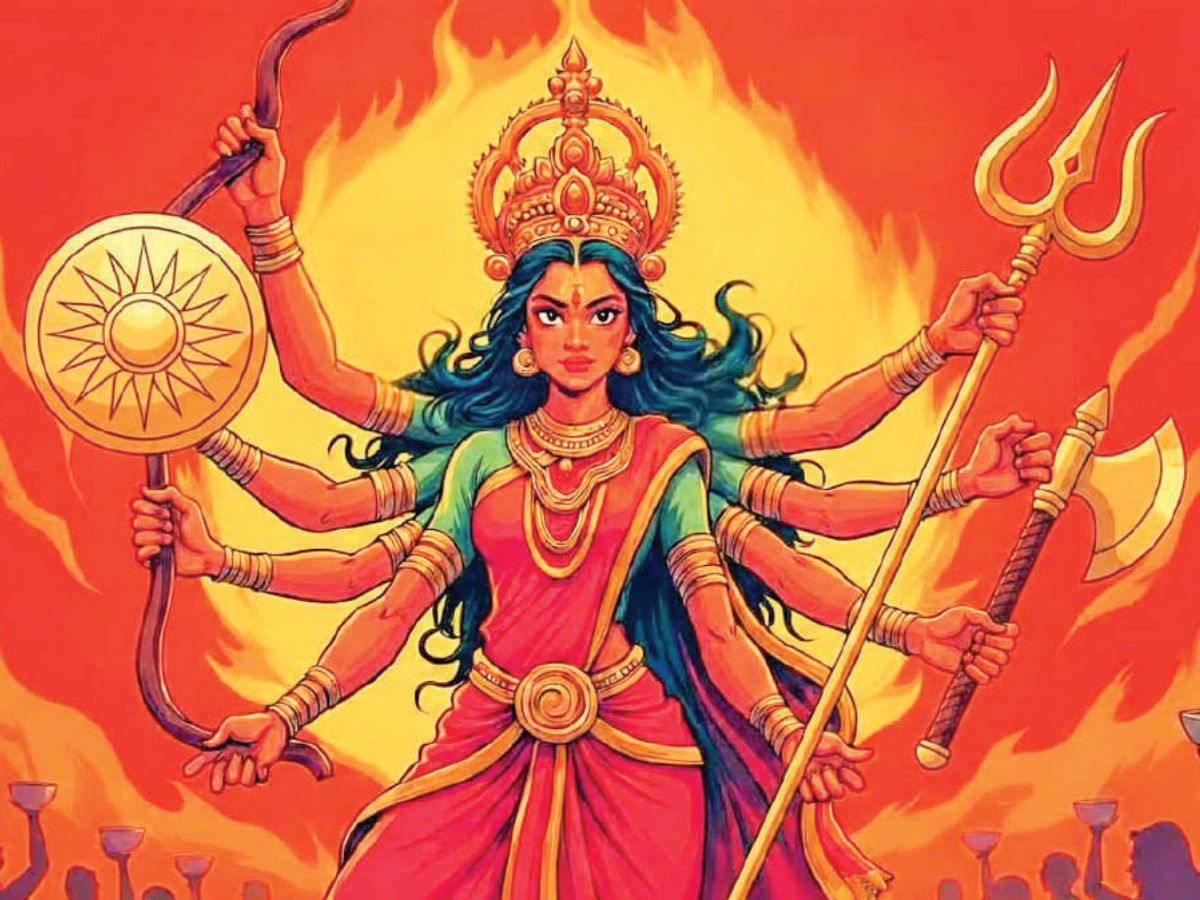
Navratri returns each year to remind us of something both simple and profound: the formless is reached only through form. The scriptures speak of the formless; we, meanwhile, often either cling to rituals or treat life as something to step over. The result is predictable: religion risks becoming an abstraction, and ordinary life is left outside its gates. But we do not live in abstractions; we live in form.
Navratri’s point is simple: what is beyond form is reached only by going through form. The task, then, is to meet life as it comes, without shortcuts or avoidance. In these nine nights, the real ‘vrat’ should be simple and exact: approach the Durga Saptashati with your whole heart, as a ‘sankalp’ not to remain as you currently are.
Scripture as a living entity, not a museum piece
The Durga Saptashati is often treated as a chronicle of gods and demons, somewhere between earth and heaven. Read only as a story of gods and demons, it serves little purpose. Scripture finds its power when it addresses the human knot at the center of life. The Saptashati presents these episodes as inner, psychological events rather than dated chronicles. The events are not bound to one time and place; they keep occurring within us. The “when” is now; the “where” is the mind. If a text cannot address this inner continuity and show a way through it, it is not worth nine nights of attention.
Surath and Samadhi: the wound and the question
Fittingly, the book opens with a door to the human problem. King Surath, once secure in power, is defeated by a smaller force; returning to his capital, he finds betrayal among his own ministers. He leaves the city on the pretext of a hunt and wanders into the forest, reaching the hermitage of Sage Medha: a place in which even predators and prey seem to sit without violence.
Around the same time, a merchant named Samadhi arrives. Stripped of wealth and status, abandoned by those who once honored him, he drifts toward the same hermitage, the same unsettling peace. Both speak plainly. Surath knows his usurpers will not last; he is not a fool. Yet he aches for his people. Samadhi understands that wealth, honor, and dishonor pass; yet the humiliation will not loosen. The mind “knows,” yet the system is seized. Why does knowledge so often fail us in real life? This is the Saptashati’s central question: the daily gap between what the intellect accepts and what attachment still clings to.
Why intellect alone does not cut it
The sage does not flatter. What we ordinarily call intelligence, analysis and recall, belongs to the same natural order as instinct. He points to creatures around the hermitage: a hungry bird feeding her chicks, a doe guarding her fawn. Human cleverness, left unexamined, is just an ornate extension of the same movement: arrangement, calculation, identity-defense. One may be brilliant and yet remain bound, because brilliance itself can become part of the machinery that binds.
The text sharpens this with a homely example: the urge for sons often works like reciprocity, do good now so the fruit returns later. Much of what passes for reason is desire elaborating itself. Here, it names the binding power: Mahamaya. She is described as powerful enough to draw even the learned into delusion and the greatest into sleep-like captivity. If such a power can seize the highest, pride in one’s concepts is misplaced. Yet the same power that weaves attachment can, when rightly related to, enable liberation. The hinge is not how many ideas we hold, but our relation to the power that conditions them.
Hence, the text rejects the mind’s lazy claim, “I already know.” That mind is shaped by tendencies, fears, and inherited reflexes. In moments that matter (insult, loss, desire), slogans slip and habit seizes the controls. The question then is sharper: what is your relation to what is happening, here and now?
Shakti as the door to Shiva
Devotion is not for bypassing but for relating; right relationship requires understanding. You cannot relate to the center directly; you relate to it through its expression. Call Shiva the center and Shakti the expression, the fact of life as it unfolds: work, kinship, effort, rest, beauty, decay. Whenever these forms are bypassed in pursuit of an abstract Absolute, both are lost: the world, and the Truth we imagined we were chasing.
Accordingly, the text does not give Surath a doctrine. It asks him to watch attachment as it works, not as an idea. Nor does it tell Samadhi to chant that honor and dishonor are illusions. It asks him to feel the ache as ache and to see the hunger that rises with it. When a form is seen clearly, it reveals its true center. Truth is beyond attributes and shape, yet we live in thoughts, feelings, time, and body. To bypass form in the name of the formless is to bypass our own condition, turning religion into a mask.
“Not once upon a time”: the event that keeps occurring
The scripture warns us not to take a symbol for chronicle. The battles do not unfold on a distant heavenly field; they picture the inner contest that does not cease. Clinging to the vehicle and forgetting the journey makes scripture lifeless; hence the stress on continuity. The king’s hurt and the merchant’s sting are not ancient curiosities; they are today’s weather in the mind. What is being described did not happen “then” and “there,” it happens “now” and “here.” Only by refusing the refuge of distance does the reader lose the alibi of time and meet the issue honestly.
The same insistence echoes in the refrain that honors the Mother “in all beings.” It underlines that everything you can see or sense: thought, emotion, body, world, is within Her scope.
The reach of Mahamaya
Mahamaya is not a small force; the text says she can draw even the great into delusion, and the whole cycle of birth and death moves in her play. This is not a story to admire from a distance but a warning: ideas will not protect you. The same power that makes the world appear also unsettles your judgment. Yet she is not only the one who binds. When your stance changes, the same power becomes a way out: what blocked you begins to open. Seeing, therefore, is central. Seeing here does not mean collecting more concepts; it means the dropping of evasions so that “what is” can appear. When “what is” appears, much of Mahamaya’s tyranny ends: not because the external changes at once, but because the bind was never merely external.
The text also pictures what follows when the binding forces are overcome: the world clears. Rivers clear; smoke thins; order returns. Read plainly, it is a caution against exploiting the very Nature you live in, the Mother whom tradition asks us to honor.
Jivanmukti, correctly understood
All this gathers in a single word: Jivan-mukti, liberation while bodily alive. It is life freed of bondage. Sweetness and bitterness continue, but compulsion drops; one moves through events without being owned by them. Dharma does not ask us to suppress our feelings; it asks for clarity that neither clings nor cuts away.
The point of the Saptashati, stated without embroidery
Not spectacle, but sobriety. Not mythology as mere entertainment, but scripture as a living means to liberation. The text begins with a king and a merchant because it wants to begin with the reader. Loss, insult, attachment: these are not there to decorate a tale; they are there to strip it of alibis. The sage exposes the limits of cleverness and the cost of bypass. The Devi offers not an exit but a different relation to life: when forms are seen clearly, they stop ruling you; when Shakti is rightly honored, the heart rests in Shiva.
Acharya Prashant, a philosopher and teacher of global wisdom literature, is the founder of the PrashantAdvait Foundation and a bestselling author who brings timeless wisdom to urgent modern questions.




