
The global gig economy employs nearly 200 million people through digital platform-based companies like Uber, Food Panda, Zomato, Oyo and others. It’s also important to note that a significant amount of gig work silently happens on social media platforms like WhatsApp, WeChat, and Facebook. That’s where the gig economy gets linked to public unrest whenever there’s a social media ban.
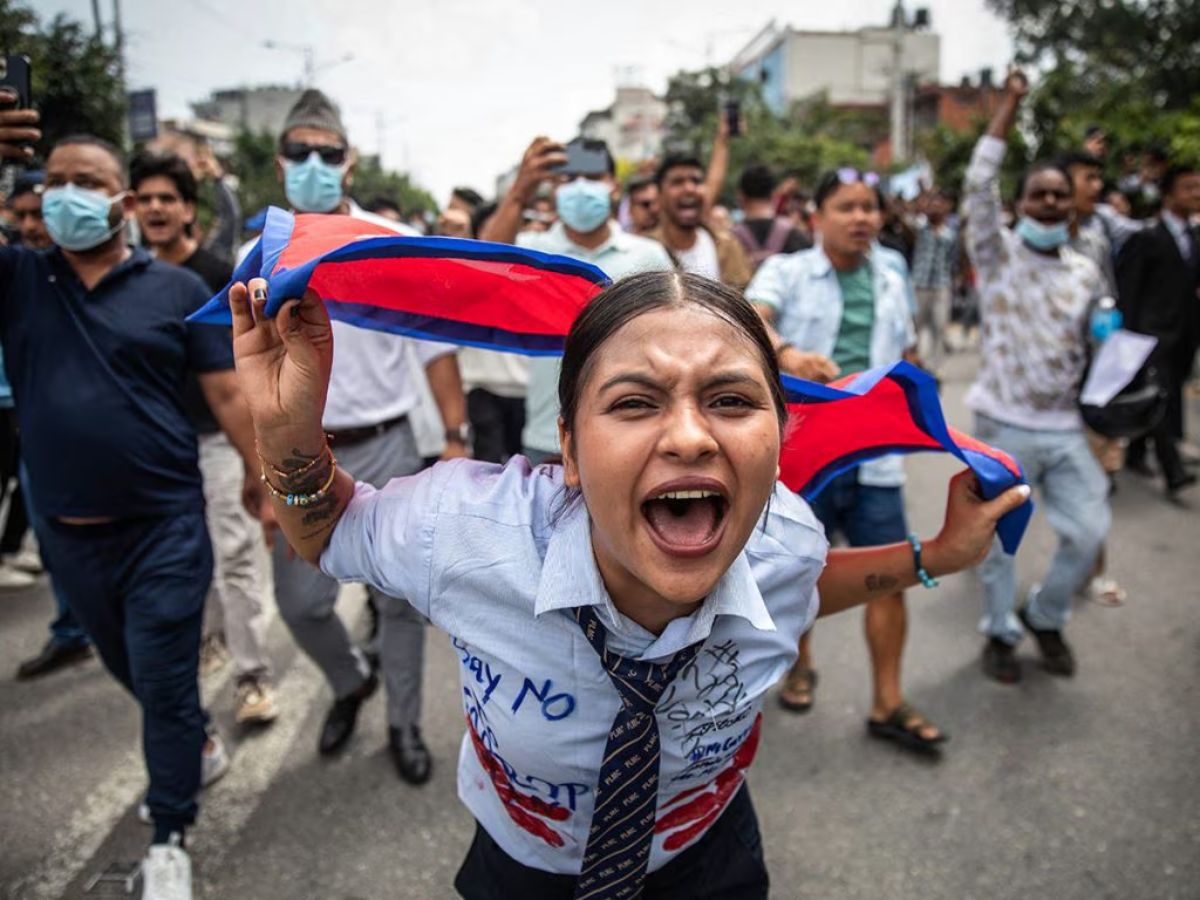
So, when Nepal banned 26 social media platforms on September 4 after a week’s ultimatum, it was not just about freedom of speech and press freedom. It was also about a loss of livelihood and jobs—particularly in a country where 6.7 percent of the national GDP comes from tourism, i.e. over two billion USD. This means the protests were also indicative of how the gig job sector has silently taken root in the country.
The tourism industry in the Himalayan nation was among the first to capitalize on the growing social media reach, according to the Nepal Economic Forum.
“For us, social media used to be a very popular tool for communication. That’s now gone, and it’s a nightmare-like situation,” Jiban Ghimire, managing director of Shangri-La Nepal Trek, told the New York Times after the protests erupted. “No communication, no business.”
Strangely, while the social media ban is identified as the trigger for the protests, and analysts have eagerly discussed how algorithms impacted public sentiment and caused social unrest, there’s an absolute lack of analysis on how the social media-based gig economy could actually be a significant reason.
This lack of identification and understanding of the gig economy in developing countries like Nepal will handicap lawmakers and disable them from futuristic policymaking. It’s therefore important to understand how the gig economy is burgeoning in South Asia with the increasing reach of social media.
Unorganized sector, gig economy and public sentiment
The “gig economy” or “sharing economy”—also referred to as the peer-to-peer, “collaborative-consumption,” or “on-demand” economy—is defined by non-permanent and flexible freelancing jobs, largely facilitated by online platforms that connect service providers and consumers. It can be called a “third front,” as it is not only transforming the way we work but also significantly impacting the way we live across the world.
The gig economy is largely unorganized or semi-organized, meaning gig workers are mostly daily wagers relying on digital spaces for finding jobs or providing services. Many operate from home-based enterprises and lack employer-provided social security. In many cases, they are self-employed through social media—as with small-time tour operators and individual tourist guides.
When social media stopped working, the tourism industry was the first to be hit in picturesque Nepal. With tourism impacted, allied unorganized jobs—such as those in cafes, eateries, and transport—were also disrupted. While the ban’s impact on tourism has been widely reported, many associated effects have gone unnoticed.
Nata Travel and Adventures Pvt. Ltd, a Kathmandu-based travel agency, noted in a blog post on September 6 that the impact of the ban was “immediate and profound.”
“Eighty percent of our bookings used to come from Instagram DMs or TikTok videos,” said a representative from a Thamel-based trekking company, according to the post. Thamel is a commercial neighbourhood in Kathmandu.
Thus, when Nepali policymakers reflect on the protests and the impact of the social media ban, they cannot stop at just policy innovation or control over Facebook, Instagram, WeChat, and TikTok. They need to understand how social media is propelling a gig economy in families and neighbourhoods across Nepal. They must go beyond tourism and work on this holistically, including making laws more friendly toward the growth of their gig economy.
As Sara Pradhan wrote for the Nepal Economic Forum in an article last year:
“As new jobs and opportunities emerge, the government needs to modify and amend laws that don’t hinder employment opportunities or innovation and that keep up with the changing business landscape. Nepal can also learn by looking at its neighbouring countries, India and Bangladesh, and their laws surrounding the gig economy such as the legal classification of workers, job benefits and mandates to ensure workers are not being exploited, and other issues.”
Venus Upadhayaya is a MOFA 2025 Taiwan Fellow and a Visiting Scholar at National Chung Hsing University, Taichung in Central Taiwan. Her doctoral research work is on ‘Perspectives on the Unorganized Sector.’




