New analysis warns humanity exceeds earth’s limits while inner emptiness fuels unchecked consumption.
The inner emptiness behind global consumption
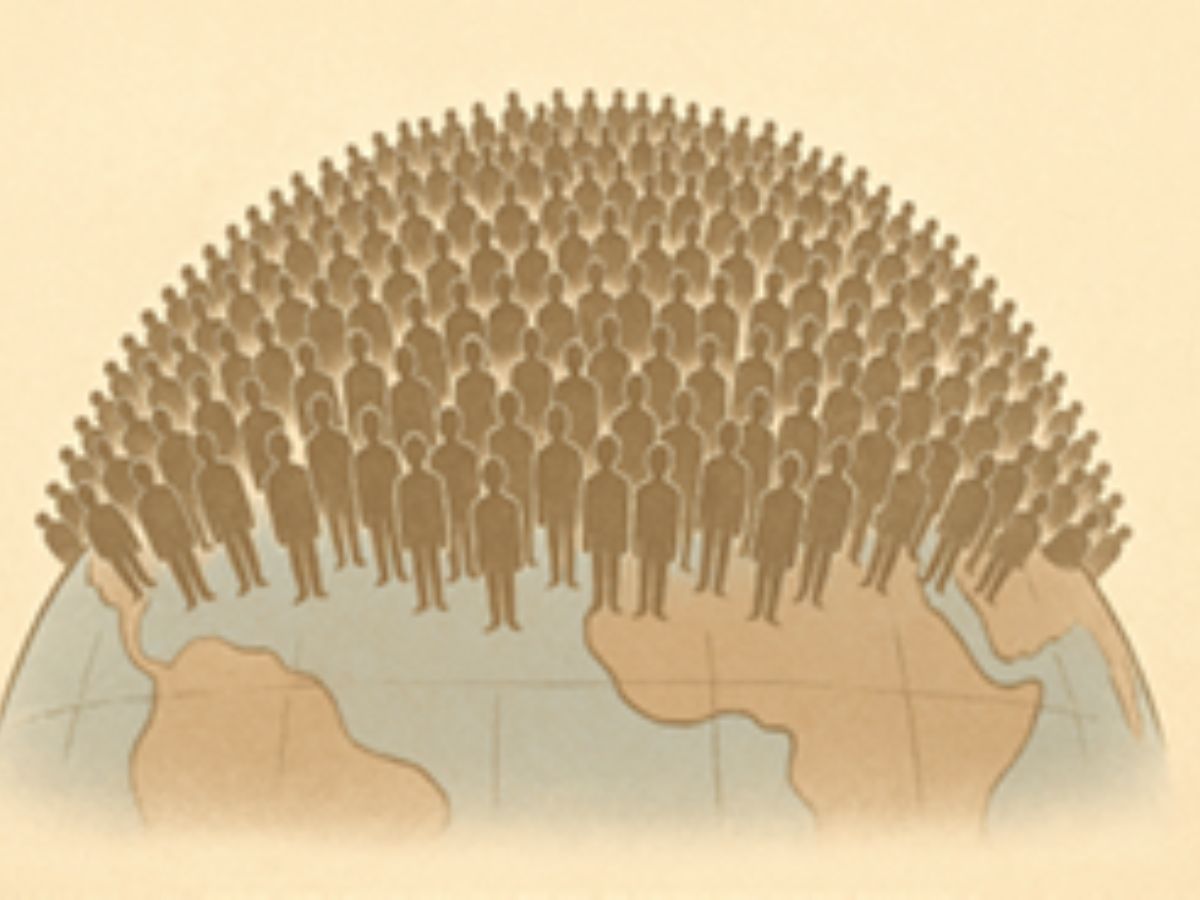
If everyone on the planet lived like the average American, humanity would need six Earths. Even now, we already consume the equivalent of 1.7 each year, using in twelve months what the planet takes nineteen to regenerate. This is not a forecast but a measurement. The Earth’s overpopulation is no longer opinion; it is an established fact. The debate ended long ago. What continues is denial, distraction, and delay.
At the root of this crisis lies a deeper falsehood: the belief that outer accumulation can fill the inner void. To face that lie, two movements are required: an honest look at planetary facts to strip the lie of its arguments, and an honest willingness to examine one’s inner mischief. This article attempts both: the planetary facts first, and then the inner acknowledgement.
The Global Footprint Network, using UN data, calculates how many Earths would be required if everyone adopted various national lifestyles. If all lived like Americans, we would need 5.1 Earths; like Europeans, 2.9; even at middle-income Indian levels, the figure crosses two. Global consumption at that rate could sustain only three to four billion people. We stand at 8.2 billion. Arithmetic does not negotiate.
Overpopulation does not mean people pressed shoulder to shoulder. It means human demand exceeds the planet’s capacity to renew. The common objection, “only five percent of land is densely populated; look at all the empty space,” confuses standing room with carrying capacity. The so-called empty ninety-five percent includes deserts, mountains, tundra, forests, and wetlands: systems that absorb carbon, regulate climate, and sustain life. They include agricultural land that feeds the dense five percent. Convert them to settlement, and the biosphere collapses faster. Emptiness is not spare capacity; it is life support.
Two terms define the equation. Biocapacity is what Earth can renew in a year: forests regrowing, fish stocks replenishing, soil healing, carbon absorbed. Ecological footprint is what humanity consumes: food, water, land, energy, and waste. When footprint exceeds biocapacity, we enter ecological overshoot. Humanity crossed that line in the early 1970s and has remained beyond it since.
The Stockholm Resilience Centre identifies nine planetary boundaries that define a safe operating space for civilisation. Six have already been breached: climate change, biosphere collapse through extinction, deforestation, nitrogen-phosphorus pollution, the spread of synthetic chemicals, and freshwater disruption. Each violation arises from the same pressure: more people consuming more resources and producing more waste than nature can absorb. Even if consumption were modest and equalised, eight billion humans would still exceed the Earth’s support capacity.
We are already witnessing what overshoot means in lived reality. July 2023 was the hottest month ever recorded, with global sea surface temperatures breaking every known record. Antarctic sea ice reached its lowest winter extent since measurements began. Wildfires raged across Canada, the Mediterranean, and Hawaii simultaneously, releasing more carbon than some industrial nations. This is not climate “change” in a gradual sense; it is climate breakdown.
Among all limits, freshwater is the hardest. Energy policy can be debated, but aquifers that empty faster than they refill cannot be persuaded. Two billion people already live in regions of extreme scarcity. The Ogallala aquifer in the United States, the Indo-Gangetic basin, and the North China Plain are all declining at rates that cannot be sustained; what took millennia to accumulate is being drained in decades. Rivers such as the Colorado, Ganges, and Nile now struggle to reach the sea. This is not a distribution problem but a quantity problem magnified by population. One cannot distribute something that doesn’t exist.
Global water withdrawals have tripled since 1960, while per-capita availability has dropped by more than half. Agriculture uses up around seventy percent of all freshwater, and most of it goes to feed animals instead of human nourishment. Even as businesses talk about recycling and efficiency, groundwater depletion continues unhindered. Experts say that by 2040, forty percent of the world’s population would live in areas with very little water. Civilization is quietly drinking its own foundations dry.
Many place their hope in renewable energy, yet the numbers offer little comfort. To sustain 8.2 billion people at Western living standards, renewable deployment would need to increase twentyfold. Mining for lithium, cobalt, nickel, and copper would have to expand by several hundred percent, and the land required for solar and wind installations would be vast. Even then, renewables cannot fully replace aviation, shipping, fertiliser production, or heavy industry. Technology is not a way out of overshoot; it is a slower way in. Water and energy together define the walls of the room we have built, and we are pressing against both.
This is not merely a physical predicament but a spiritual one. The more a mind feels internally insufficient, the more it tries to compensate through external expansion. When the inner space is unexamined, the outer space is devoured. Humanity builds turbines and reactors because it cannot still itself for even a moment. The real energy crisis is not outside; it is the unrest within.
To feed today’s population, half of Earth’s habitable land has been converted to agriculture. Eighty percent of all agricultural land is used for livestock food, to satiate mankind’s demand for meat. Fertiliser use has risen eightfold since 1960; insect populations have fallen seventy percent in fifty years; a million species are at risk of extinction. Forty percent of global land is already degraded, and topsoil that once took centuries to form is vanishing within years. In the oceans, ninety percent of fish stocks are depleted or collapsing.
One statistic reveals the scale of this displacement most starkly: ninety-six percent of the planet’s mammal biomass now consists of humans and livestock, leaving only four percent as wild animals. This is not a natural distribution but an ecological takeover. Where humans expand, wildlife recedes. The disappearance is not incidental to overpopulation; it is its signature, written across every continent and sea.
The extinction of species is not only the loss of biodiversity; it is the extinction of humility. Each vanished creature removes a mirror that once reminded man of his smallness. In the Advaitic sense, life does not exist in hierarchies but as one continuum of consciousness. To annihilate the “lower” forms is to wound the very fabric of the self. Man kills the forest, yet the forest was part of him. He empties the ocean, yet the ocean was within him. The violence we inflict upon nature is only the external expression of the violence we carry within.
Nature is not alone in failing; human systems are fracturing too. Over 1.2 billion people live in slums, and more than half of humanity lacks safe sanitation. Traffic, pollution, and sewage loads have gone over design limitations in megacities in Asia, Africa, and Latin America. Housing shortages and power outages are not design mistakes but signs that a species has outgrown its habitat. When a system damages its own foundation, it has gone beyond its limit, and we have certainly crossed ours.
In many big cities, glass buildings, freeways, and industrial zones, the very signs of development, are now monuments to excess. They promise prosperity but deliver exhaustion. Humanity is producing more, moving faster, and feeling emptier. Every crisis, whether economic or ecological, is now intertwined with a crisis of meaning. The outer systems collapse because the inner order has collapsed first.
The data is not hidden. The reports are public, the measurements precise, the conclusions unambiguous. The question is no longer what is happening, but why we cannot stop.
If the evidence is so clear, why does denial persist? Because to accept it is to accept defeat of the ego’s fundamental premise: I can fill up my inner void through material consumption. The modern mind suffers a compulsive addiction to the fantasy of endless growth. Billionaires urging more births follow their ego’s premise, not the hard science. Politicians promising expansion count votes, not aquifers. Consumers chasing purchases measure satisfaction in carbon, not consciousness.
Overpopulation is not merely a policy failure; it is a failure of consciousness. A species that cannot see where its hunger comes from will consume its own home. A civilisation that defines success through accumulation will accumulate until nothing remains. The forests shrink, the aquifers fall, the soils erode, the oceans empty, the rivers dry, the species die, the climate destabilises, and the slums expand. These are not warnings of the future; they are descriptions of the present. The Earth has already answered the question of overpopulation. We just refuse to listen.
Policies can help limit damage: they can make sure that education and health care are available, encourage smaller families, and tax excessive consumption. But policy without inner change becomes coercion that looks like planning. Overpopulation and overconsumption both come from the same root: an inner emptiness that tries to fill itself by getting more material possessions or having more children. A mind ruled by fear produces children to guard against mortality; a mind ruled by ego acquires objects to cover its hollowness. Neither fear nor ego can be legislated away.
Where inner clarity begins, the numbers change. Where people are educated and free, fertility falls naturally; where minds are less afraid, consumption slows. Education may teach people to have fewer children, but only wisdom frees them from the fear that demanded many in the first place. Only a mind that has faced its own emptiness and seen through its cravings can live within limits, not as deprivation but as liberation.
To live wisely is not to renounce life but to relate meaningfully with existence. The mind that sees its own boundlessness no longer seeks infinite expansion outside. Knowing itself, it knows enough. In that knowing, greed loses its glamour and growth its hypnosis. The outer crisis begins to subside only when the inner hunger ends.
The Earth can offer no more. The question is whether the inner void will stop snatching from her.
Acharya Prashant, Teacher, Founder of the PrashantAdvait Foundation, and author on wisdom literature.
