India Art Fair 2026 unveils its most ambitious edition, blending art, design and discourse.
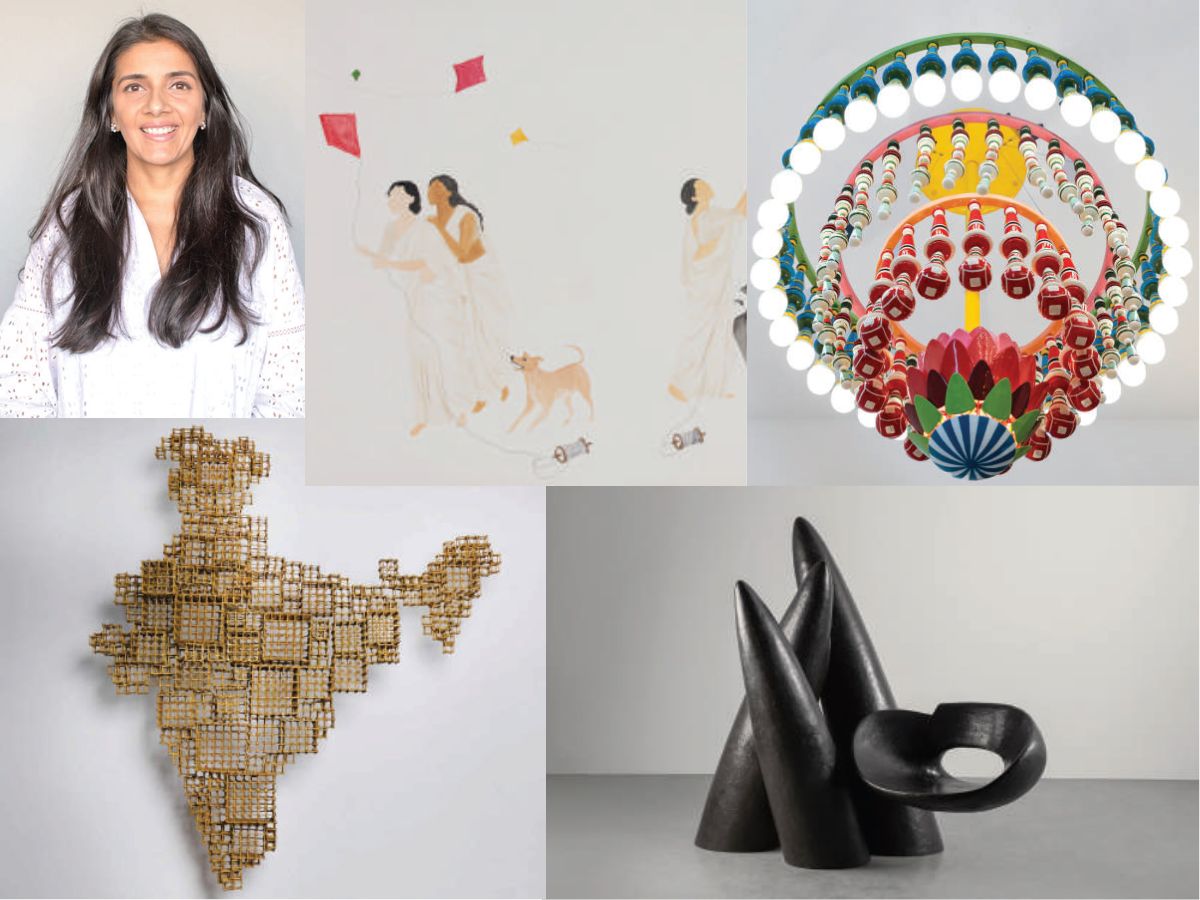
Jaya Asokan, Fair Director, Portrait © India Art Fair | Jayati Bose (Pic Courtesy: LATITUDE 28) | Dhruv Agarwal, Bloom 2020 Channaptna toys made of soft ivory wood wax lacquer rings pipe stainless steel Meena enamel LED glass, Limited edition of 5 unique pieces | Castle Benjamin Baccarani courtesy of Carpenters Workshop Gallery | Castle Benjamin Baccarani courtesy of Carpenters Workshop Gallery
India Art Fair 2026, in partnership with BMW India, is currently hosting its most expansive edition yet at the NSIC Exhibition Grounds. Its17th edition is showcasing 135 exhibitors, with the work of major international artists like Olaffur Eliasson, Anish Kapoor, Judy Chicago and Michelangelo Pistolleto, among others. A vibrant Talks Programme, supported by JSW, brings together leading artists, designers, gallerists, museum directors, patrons and market specialists including Dr. Tristram Hunt, Prof. Alberto Cavalli, Dr. Alexandra Munroe, Aindrea Emelife, Dr. Amin Jaffer and Ibrahim Mahama. There are also city-wide presentations as part of India Art Fair parallel programming which include exhibitions at the Kiran Nadar Museum of Art and the National Gallery of Modern Art, and the first-ever solo exhibition in India by Ai Weiwei, presented by Nature Morte. On the occasion, Jaya Asokan, Fair Director, India Art Fair, spoke to The Sunday Guardian about what to look forward to this year. Excerpts from an edited interview:
Q. What is new at IAF this year?
Jaya Asokan (JA): This year marks 10 years of partnership with presenting partner BMW India and five years of The Future Is Born of Art Commission. For 2026, the commission is being realised in a bold new format by winning artist Afrah Shafiq on the fair’s facade. Afrah’s work titled, A Giant Sampler, takes the form of a large-scale textile sampler, drawing from embroidery traditions across cultures, from Mexican toads to Egyptian Mamluk motifs, alongside Indian references such as the Kasuti deer and the mango. Visitors can scan motifs via a dedicated app, activating layered histories rooted in oral traditions and material memory.
Our Rising To Challenge talks programme, supported by JSW, brings together leading voices from art and culture for timely and thought-provoking discussions, with a particular emphasis on South Asian art and culture in the world today. Spanning key issues across art, design, architecture, and beyond, the programme brings together perspectives from institutions, market experts, philanthropists, and creatives, anchored by the guiding prompt: What Makes Art Happen?
Performance art also takes centre stage this year. Breakfast in a Blizzard, curated by HH Art Spaces, foregrounds acts of hosting, feeding, and gathering as metaphors for connection in fractured times. Through experimental sound, gesture, and spoken word, the programme reflects how contemporary performance moves fluidly across disciplines while remaining deeply social.
The fair also sees the return of an expanded Design section, showcasing practices that push the boundaries of design, craft, and contemporary form. Featuring 14 eminent design studios and two design galleries from India, this marks the first year that design galleries are formally included within the section. This year, India Art Fair places a renewed focus on building discourse around design exclusively, beyond the Talks Programme. In this context, the fair has collaborated with Border & Fall to curate the OPEN Design Talks series, a dedicated platform for critical conversations on design, materiality and process.
This year’s Design presentation brings together returning studios Ashiesh Shah, Aspura, Chanakya School of Craft, DeMuro Das, Gunjan Gupta, Rooshad Shroff, Studio Renn, Vikram Goyal, alongside Galerie Maria Wettergren, Kunal Maniar, Kohelika Kohli Karkhana, Morii Designs and SHED, who are participating at the fair for the first time – underscoring India Art Fair’s role in introducing new voices to the region’s design landscape.
The Design section also features a special institutional collaboration between the French Institute’s residency programme and the Mumbai-based design gallery Æquō, inviting French designer Marie Gastini to explore a crosscultural dialogue between traditional Indian textile techniques and contemporary scenography.
Galerie Maria Wettergren is presenting a solo presentation by Indian designer Dhruv Agarwal, recipient of India’s Best Design Award in 2021 for his celebrated chandelier Bloom. The presentation brings together this work alongside others that reflect the designer’s engagement with craft, nostalgia and childlike curiosity. Among the works presented by Ashiesh Shah is World Map, created using the ancient Indian metal craft of Dhokra (Dokra). Employing intricate waxcasting techniques, the work reflects on the political moment and the fragility of belonging.
The AMA Artist Award, a prestigious annual initiative by Angus Montgomery Arts (AMA) supporting early- to mid-career North American artists, will also be presented at the fair. This year’s winner, Umar Rashid, is known for blending real and imagined histories to interrogate narratives of colonial power, identity and influence. His showcase includes new paintings exploring colonial histories of India, and he will also participate as a panellist in the Talks Programme, contributing to conversations on decentring dominant narratives and embracing unconventional ways of thinking.
In addition, ART India Magazine will announce its 30 Under 30 awardees at the fair, offering audiences the opportunity to engage with the practices of 30 emerging artists under the age of 30.
Q. What are you personally looking most forward to?
JA: What I’m most excited about this year is the range of ways artists are engaging with perception, memory, and the politics of space – often through material choices that feel both intimate and monumental.
At neugerriemschneider’s presentation of Olafur Eliasson, a major spherical glass sculpture anchors the booth, shifting from black to red depending on the viewer’s position. Paired with a series of watercolours, the presentation invites a slow, bodily encounter with perception, transformation, and the act of looking at itself.
In the Focus section, Bharti Kher’s presentation brings together a large-scale painting, salon-style drawings, and one to two monumental sculptures. Her work, long associated with material transformation and symbolic vocabularies, continues to expand its emotional and spatial register, offering moments of stillness alongside striking physical presence.
I’m also particularly looking forward to the work of Shreni, one of our Artistsin-Residence this year. Her audio-reactive installation, Stand Here, Forget, works with speculative ecologies and unseen urban infrastructures, imagining the city as a memory system – one that constantly remembers and erases. It’s a quietly powerful meditation on how urban life is shaped by absence as much as accumulation.
Another Focus highlight is Girjesh Kumar Singh, whose figurative sculptures are made using bricks salvaged from demolished homes. His works restore human presence to ruined architecture, bearing witness to erased histories while foregrounding fragility, loss and resilience through material itself.
In the Design section, SHED’s presentation is developed through iterative material research and hands-on production, the furniture and objects emphasise slow formulation over fixed outcomes, revealing a practice shaped by repetition, intuition and time.
Beyond the fairgrounds, the Pentad pavilion – presented at the Jaquar Pavilion Park as part of ADFF:STIR Mumbai – offers an ambitious architectural proposition. Reimagining parliament as an open, participatory civic space, the award-winning structure stages five global modes of assembly through a reconfigurable form, prompting reflection on how we gather, deliberate and coexist.
Finally, within the Talks Programme, I’m especially drawn to Introspecting Collective Histories, a conversation that brings together artists, activists and historians to examine race, class, caste, and gender through lived experience and resistance. It’s a reminder that dialogue itself – who speaks, who listens, and how audiences are shaped – is central to how culture moves forward.
Noor Anand Chawla pens lifestyle articles for various publications and her blog www.nooranandchawla.com
