Film chronicles Rajasthan village’s eco-feminist transformation and earns IFFI Panorama selection.
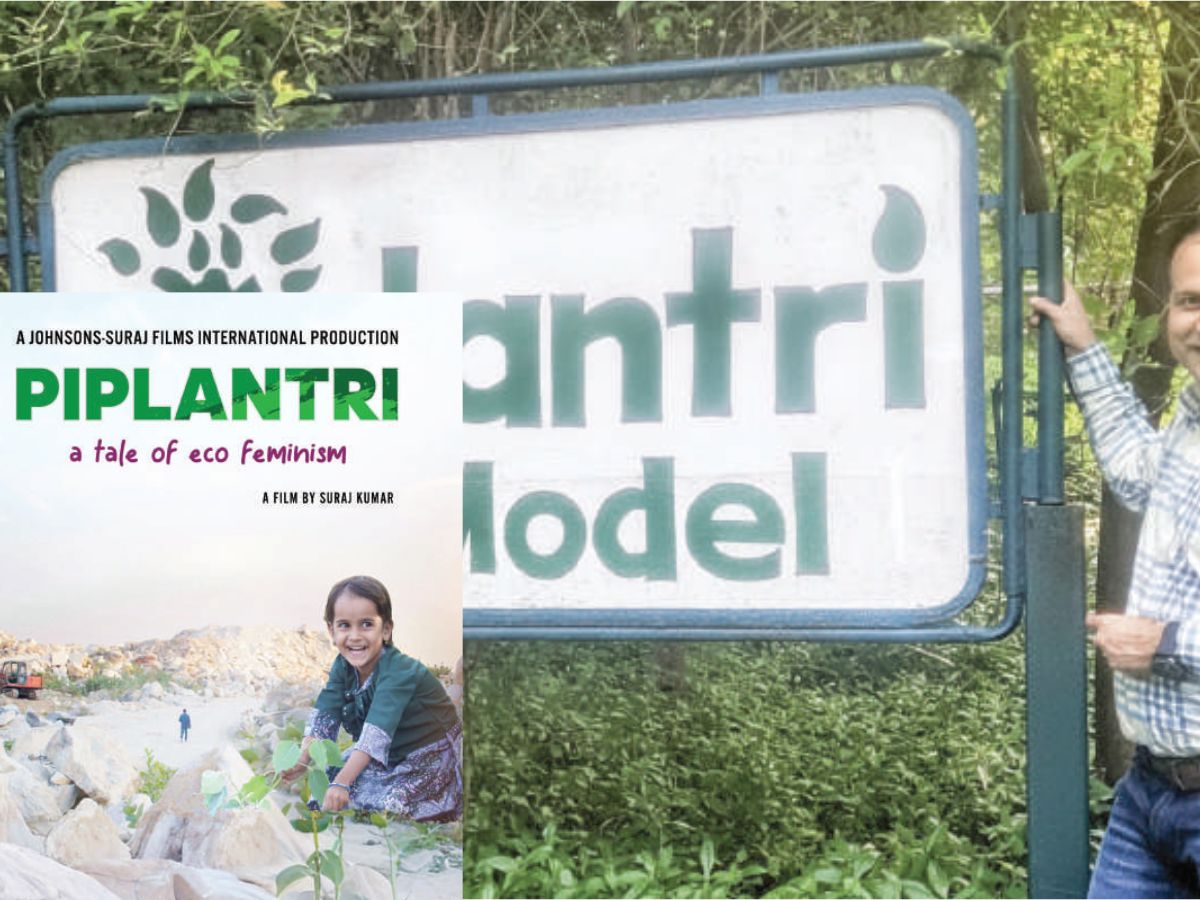
Filmmaker Suraj Kumar in Piplantri. Rajasthan
Like every year, one of the major attractions at the International Film Festival of India (IFFI) is the Indian Panorama Section, known for showcasing outstanding films across Indian languages. Over the years, this segment has emerged as a favourite among younger audiences eager to explore the vast cultural, linguistic, and thematic diversity of Indian cinema. This year, one of the most compelling titles in the line-up is ‘Piplantri: A Tale of Eco-Feminism,’ directed by Suraj Kumar—whose earlier work includes acclaimed biopics on Gurudev Rabindranath Tagore and Sri Aurobindo.
‘Piplantri: A Tale of Eco-Feminism’ chronicles the remarkable real-life transformation of Piplantri, a village in Rajasthan that turned ecological crisis into a shining model of environmental revival and women’s empowerment. The movement was initiated by former sarpanch Shyam Sunder Paliwal following the heart-breaking death of his daughter due to dehydration. In her memory, he introduced a visionary practice: planting 111 trees to celebrate the birth of every girl child. The community supplements this act with a financial safety fund in the girl’s name, while parents pledge to educate her and refrain from early marriage. Over time, this initiative has led to large-scale afforestation, rising groundwater levels, and new economic opportunities—particularly for women who now run thriving aloe-vera and other eco-based ventures. Former President Ram Nath Kovind bestowed him with a Padma Shri Award for his remarkable efforts in 2021.
Suraj Kumar’s feature documentary captures this extraordinary journey with sensitivity, restraint, and emotional depth. “The story of Piplantri today has given us hope that we are more than capable of reversing the global warming trends,” Kumar says. “But the main challenge is to be fully committed to the task, taking inspiration from Padma Shri Shyam Sunder Paliwal.” Speaking about the significance of being selected for the India Panorama Section, he adds, “The only way forward for independent filmmakers is through film festivals. All we need is an opportunity to put the spotlight on important subjects impacting us. IFFI, with its India Panorama Section, is playing a great role in supporting independent cinema in India.”
Kumar’s storytelling is both intimate and expansive—he seamlessly weaves together the experiences of girls, mothers, activists, and villagers into a broader narrative of ecological hope. “I don’t like to employ melodrama to tell my stories,” Kumar notes. “Instead, my endeavour is to rely on grounded visuals, honest voices, and quiet moments that allow the audience to feel the heartbeat of Piplantri.” His eye for visual poetry is evident as the camera lingers over landscapes, saplings, and day-to-day life, while his uncomplicated approach to interviews in the film reveals the warmth, dignity, and courage of the villagers.
The film, selected for its World Premiere in the Indian Panorama (Non-Feature) section at the 56th IFFI, will be screened at INOX 2 on 24th November 2025 at 9:30 AM. Produced by Dr. Garima Singh, the documentary goes beyond storytelling—it becomes a testament to a village’s shared dream of ecological harmony.
Shot across the villages of Piplantri Panchayat in Rajasthan’s Rajsamand district, the documentary offers a riveting account of how a community ravaged by marble mining and water scarcity reinvented itself. Today, Piplantri stands as a global model of eco-feminism—where the birth of a girl is celebrated with trees, and where every tree is nurtured as a living symbol of hope. The village’s annual Environment Festival, where families tie rakhi threads to trees, underscores this unique bond between nature and human life.
“Piplantri is not just a documentary—it is a living example of how vision, empathy, and community spirit can heal the planet,” says director Kumar. “What moved me most was how the birth of every girl here becomes a celebration of life itself.” Producer Dr. Garima Singh echoes this sentiment: “This film celebrates the women of Piplantri and their deep connection with nature. Their story embodies resilience and renewal. The selection at IFFI acknowledges the power of local stories to inspire global conversations on sustainability and gender equality.”
Padma Shri Shyam Sundar Paliwal, the force behind the movement, reflects on the journey: “Piplantri’s story began with pain but grew into green hope. Every tree planted for a girl carries a blessing for the earth and our daughters. Through this film, I hope the world understands that true development means living in balance—with nature and each other.”
Produced under the banner of Johnsons-Suraj Films International (JSFI), Piplantri: A Tale of Eco-Feminism represents India’s growing contribution to global ecological cinema. With its world premiere at IFFI Goa, the film promises to leave audiences with a renewed faith in the possibilities of collective action, sustainable development, and the power of culture in environmental storytelling.
