
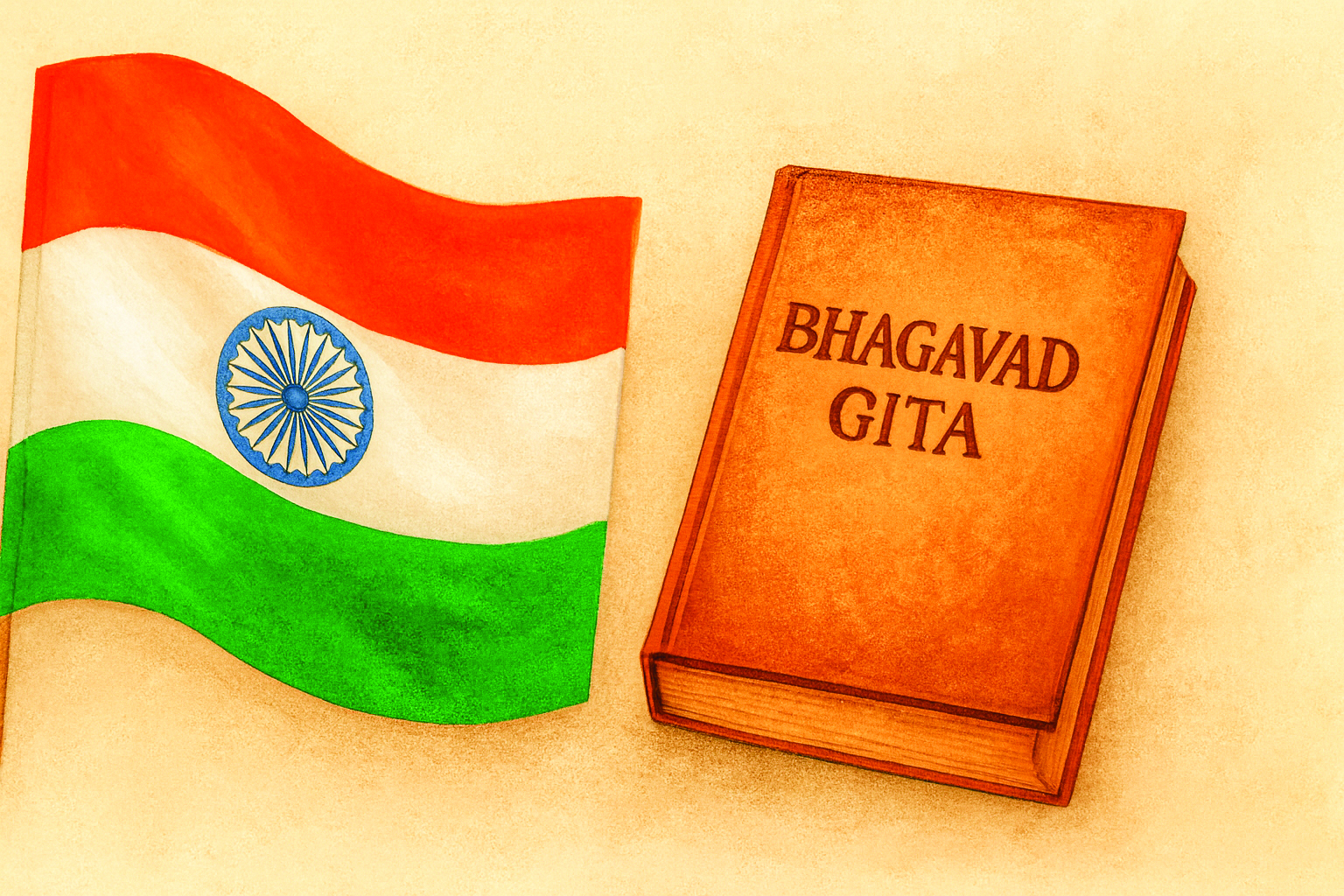
As the nation observed both Independence Day and Janmashtami, two occasions deeply woven into our historical and cultural fabric, there was much to celebrate: the courage of our freedom fighters, the unity of our people, the freedoms hard won, and the timeless inspiration of the Gita’s teachings that continue to guide and uplift us.
Yet even amid that celebration, it was worth pausing to reflect: India’s political freedom of 1947 remains incomplete without the Gita’s call for inner liberation. True independence demands both spiritual freedom and liberty of thought. This year’s rare occurrence of Independence Day and Janmashtami on consecutive days carried a deeper symbolism: the nation’s well-being and true religiosity are inseparable.
Independence came first, Janmashtami followed. It was a sign: outer freedom is easier and comes earlier; inner liberation is harder, yet far more important. This rare coincidence was not accidental. As there was no gap between Independence Day and Janmashtami, there was no real gap between the nation’s well-being and true religiosity. It was as if time itself was speaking to us, reminding us that political freedom and inner freedom must stand together.
Breaking the Chains Outside and Inside
Independence Day marked freedom from foreign rule; Janmashtami reminded us of Krishna’s call to break free from the compulsions of the mind. Both freedoms are essential, and one without the other is incomplete.
Independence Day reminded us of one oppressor, the British, and they were outside us. Janmashtami confronted us with six oppressors, the ‘shad-ripu’ of lust, anger, greed, delusion, pride, and envy, and all of them are within.
The Inner Enemies We Ignore
Political independence ended external domination but did not free us from the slavery of greed, fear, and ignorance. Without conquering these inner enemies, even rights and freedoms can be misused to deepen bondage.
Across the world we saw this: where inner liberation is absent but outer freedoms abound, people often act recklessly in the name of free will. The Gita tells us that true freedom is action rooted in clarity, not in compulsion. When inner liberation is absent, outer freedom can even turn dangerous. A person enslaved by fear, greed, or delusion will misuse his rights to tighten his own chains.
The Battle Within Precedes the Battle Outside
On the battlefield of Kurukshetra, Krishna did not tell Arjuna to escape the fight, nor to fight out of anger. He called for action free of bondage, that is liberation. Without it, even a politically free nation cannot achieve its potential.
Before the eighteen days of battle came eighteen chapters of the Gita: scripture before weapon, knowledge before action. Arjuna was not paralyzed by the enemy outside but by his fear and attachment within. Krishna first gave him clarity, then asked him to fight. Knowledge must precede action; otherwise, even the bravest warrior falters.
The Cost of Forgetting the Gita: When Inner Wisdom is Lost
Liberty of thought is inseparable from spiritual liberation. You cannot be inwardly free yet outwardly a slave to borrowed ideas. Nor can you think freely if you are bound by fear, prejudice, or unexamined belief. Liberation and liberty go hand in hand. Nations fall when they forget the Gita’s message. We had the numbers, the resources, and even the world’s highest philosophy, and yet we lost our freedom. That can happen only when the inner message is ignored.
How else could a vast nation with immense resources be subdued by small islands from thousands of miles away, without modern technologies of power and communication? Such a fall is possible only when people of the nation forget the inner strength that their highest wisdom gives them.
Unity as National Strength
We are all Indians, yet when we divide by caste, religion, ideology, region, or language, we turn compatriots into outsiders — and outsiders can easily turn into enemies. This weakens us from within.
History shows that when a people stay busy dividing themselves into insiders and outsiders, they invite domination from outside powers. A nation fractured within becomes easy prey to outside forces.
When Religion Becomes Superstition
When religion degenerates into superstition and blind ritual, it weakens the nation. Where dharma falls, the nation falls. We must return to the Gita’s essence: self-knowledge and truth. India suffered subjugation because we mistook dharma for mere ritual and blind belief. When true dharma, the path of knowledge and self-enquiry, is lost, national strength collapses with it. Dharma takes you inward; chasing outer directions is not dharma at all.
Subjugation Begins Within
In 1947 we broke political chains. Today we must break the inner ones: consumerism, sectarianism, and blind imitation. Without that, freedom is just a shell.
A people who ignore the enemies in their own hearts, narrow identities, and beliefs while focusing only on external foes risk repeating the conditions that once led to their subjugation. If we remain careless toward these inner enemies, history will recreate the very conditions for foreign domination.
Subjugation never comes by accident; it begins when people abandon self-knowledge and fall to their inner foes.
Inner Swaraj: The Call of the Gita
National independence without spiritual clarity risks collapse from within. Political freedom without self-governance of the mind leads to conflict, corruption, and misuse of rights. The Gita holds us answerable not only for our actions but also for our thoughts and motives.
We must strive for inner swaraj by dissolving false identifications, living in truth, and acting from understanding rather than compulsion. Look into the mirror. See what beliefs, prejudices, and fears govern you, and ask where they come from and how much truth lies in them. Truth alone is strength. One who stands with truth can be harmed physically but never defeated.
The real celebration of Independence Day and Janmashtami lies not in hoisting flags or performing rituals, but in looking within to see what really governs us and freeing ourselves through truth.
From Emotion to Awakening: The Gita’s Call for True Patriotism
Let patriotism be more than emotion; let it be a rise in awareness. Let us unite the Gita’s liberation with the Constitution’s liberty. Only when political swaraj is rooted in spiritual liberation will India’s freedom be secure.
The true celebration of both days was the union of outer and inner freedom. To be free citizens in a free land, but also free beings in the mind—that is complete independence.
Krishna’s Gita is not a book of escape but a manual for fearless, wise engagement with life. If we live it, the independence won on the battlefield of history will be safeguarded on the battlefield of life. May every citizen live with wisdom, discernment, and truth. Only then will both the nation and the individual truly rise.
Acharya Prashant, a philosopher and teacher of global wisdom literature, is the founder of the PrashantAdvait Foundation. A bestselling author who brings timeless wisdom to urgent modern questions, he has been recognized for his contributions to thought and ethics—with honours from PETA (‘Most Influential Vegan’), the Green Society of India (‘Environmental Leadership’), and the IIT Delhi Alumni Association (‘National Development’).




