
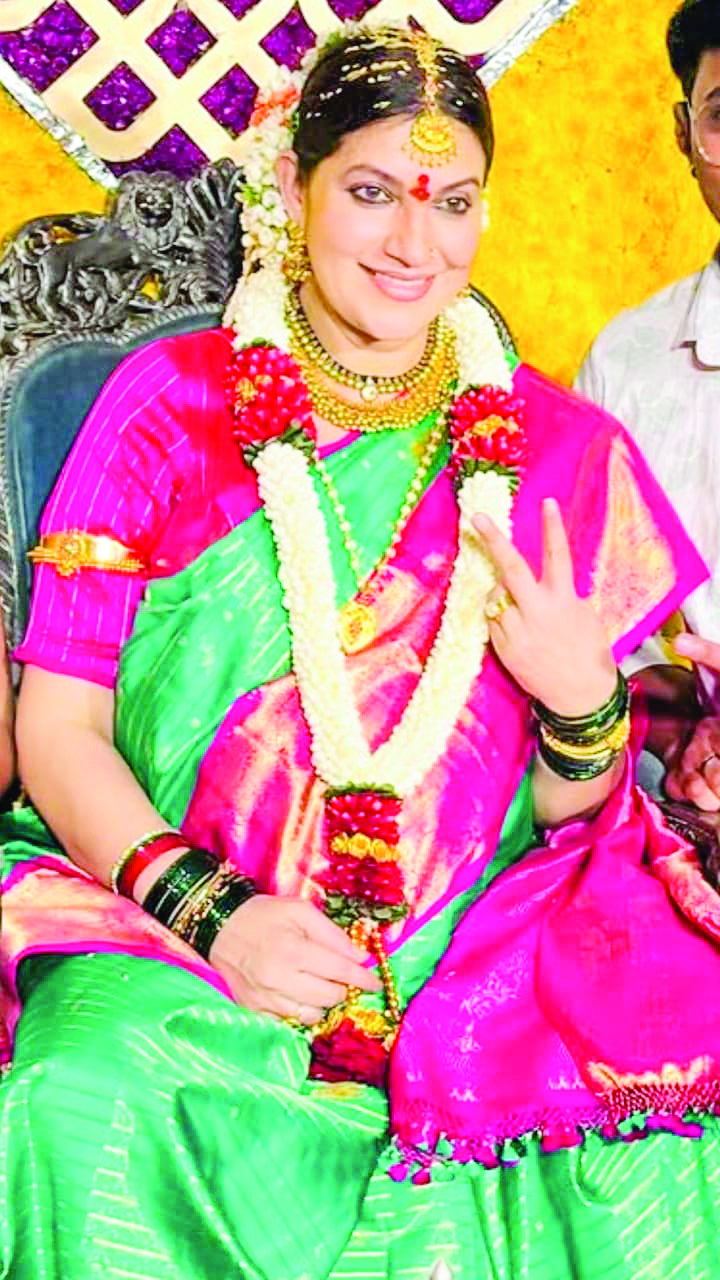
Actor Bhavana Ramanna recently announced the latest and perhaps the most challenging role of her life. She’s going to be a mother. A single unwed mother. Of course, it hit the news cycle of an always-sensationhungry public. But the real news is that far from being stigmatised, her peers and fans are showering her with congratulations.
I found her announcement on Facebook endearingly frank, and it resonated with her fans and peers in the world of dance and film. The traditional ‘seemantha’ (baby shower) in the seventh month was a colourful and grand celebration. It also highlighted the landmark Assisted Reproductive Technology (Regulation) Act, 2021, which revolutionised reproductive rights in India.
Any woman who is above the age of twenty-one years and is a citizen of India, regardless of their marital status, is eligible for IVF treatment on the same basis as married couples. Not everyone cheered for her, though. She had to face outrageous comments about her.
Why didn’t she get married when she was younger? Why didn’t she adopt a child, and the most offensive of all, had she been celibate all her life? “Would anyone ask a man such questions?” she demanded to know. In a free-wheeling conversation, Bhavana came across as frank and outspoken by nature. She declared to me, “I didn’t claim to be celibate; I have said openly that I had a relationship, but it didn’t work out for me. I didn’t hide it, but I didn’t publicise it. I am not answerable to anyone.”
Bhavana has twice won the Karnataka State Film Award for Best Actress and once for Best Supporting Actress, and acted in several award-winning films. She’s also dabbled in politics. This puts her in a position of considerable clout and gives her a platform to speak from. She’s cognisant of this while admitting that her decision to opt for IVF was deeply personal. “I am not doing it for anyone else. It’s a personal choice.”
She’s the oldest of three siblings; her younger sister and brother are both married. “I really wanted to be in a relationship, and more so, after my brother got married, I did feel I would also like to be settled. But I couldn’t find the right partner.” Her problem is her detachment, I discover. “ I have never been a possessive person. And the person I was seeing at one time felt that I wasn’t with him (in the relationship)”, she confides. She believes “ You can’t be an artist when you become small.”
Over the last eight years, she felt the maternal urge very strongly and at one point, she “became desperate to be a mother”. She was looking for a relationship just to conceive a child, but a reality check made her pause and examine if her motives were right. She also contemplated having a child with someone she knew. But she rejected the idea as it could lead to complications in the future. “I didn’t want to be a burden on anyone.
At the same time, I started researching Devadasis and found it beautiful the way they led their life as artists. They were completely dedicated to the art. I found those stories inspiring.” “I am a believer in proper family and proper parenting because I have had that. I had a fairy tale childhood. I was the chair of the Bal Bhavan and interacted with over a thousand children and their parents. I began to understand parenting responsibilities more, especially for working parents. But I couldn’t give up on my desire to be a mother.
The thought wouldn’t let go.” She opens up about her emotional tumult. “People who get married and have children when they are young can’t even imagine what women go through as they enter their mid30s. The urge for stability, a partner and motherhood is heightened, and when these needs aren’t met, life seems hopeless.” As she reached 40, she had to hurry up. “I couldn’t wait for anyone to give me a go-ahead or not. There was no time left to discuss or research. That’s when I banged on the door of an IVF centre.” Initially, doctors hung up on her because she was unmarried, but she then found a doctor who gave her a lot of confidence. She didn’t inform her family until the day she got inseminated and was met with complete support from her father and siblings, and the whole clan of elders in small towns. She informed each of them out of choice, she says.
“I don’t need anyone’s permission, even if my family had opposed it, I would have gone ahead. But it’s nice to have their support for me and my twins.” And while she didn’t intend to do so, her openness about her choice is inspiring other single women to fulfil their desire to bear children through IVF. Will she go back to her film career, I ask. “I am not going to quit anything, not films, nor dancing.”
In answer to what roles she expects, she laughs and says, “They have offered me a mother’s role for the last 20 years. Now I am sure there will be more such roles.” She did play a mother in the Malayalam film ‘Otta’. She accepted it because it was a different role, with a strong character rather than the usual insipid mother roles. Bhavana feels strongly that local films should showcase the reality of mature women; films romanticise younger women, and that’s the reason men are not sensitised to the reallife issues of women.
“As an artist, I feel we have not made good films for years and haven’t prepared men to know what the woman who is living with them is going through.” What the Female Gaze spots: Time was when people drew inspiration from the narratives in films. But now it’s time for the industry to play catch-up with reality. More women are quietly asserting the right to live on their own terms, brooking no opposition in their paths. Sandhya Mendonca, author, biographer, and publisher at Raintree Media, offers a distinct female gaze of the world in this column.




