Festival impresario Sanjoy K. Roy recounts a lifetime of intimate ghostly encounters.
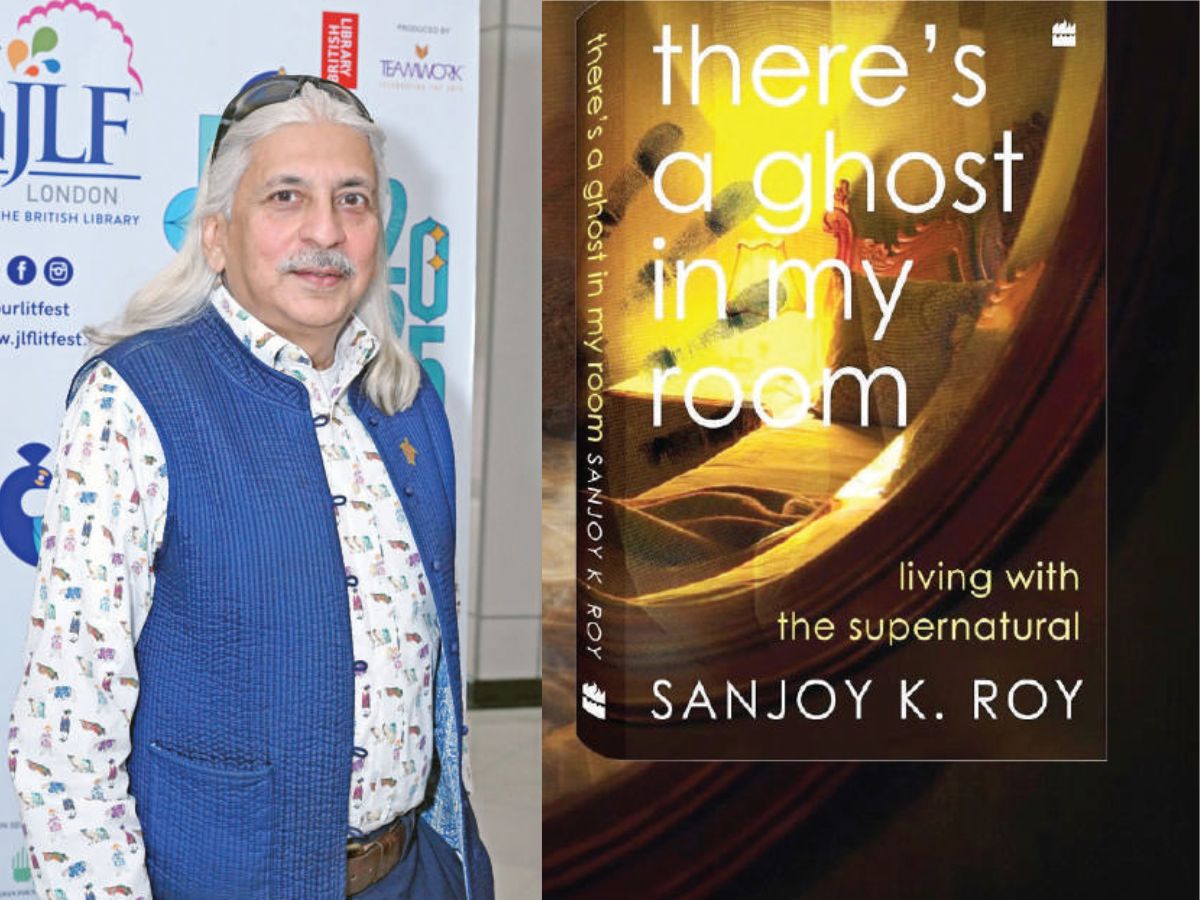
Sanjoy K. Roy, Managing Director, Teamwork Arts
‘Many a night, I was jolted awake with the sense of an ominous presence looming above me…’ It is not the opening line of a gothic novel from Victorian England or Edgar Allan Poe’s dilapidated mansions. Nor is it the confession of a professional medium. It is the lived memory of Sanjoy K. Roy—arts impresario, festival curator, doyen of global cultural diplomacy—whose unputdownable memoir There’s a Ghost in My Room invites readers into a life where boardrooms and banquet halls coexist with spirits and shadows. But it is more than a catalogue of spectral encounters. It is a deeply personal chronicle of instinct, inheritance, fear and faith.
Roy, Managing Director of Teamwork Arts, has built an enviable career producing over thirty performing arts, visual arts and literary festivals across forty cities worldwide. Among them is the globally celebrated Jaipur Literature Festival, often described as the world’s largest literary gathering. A founder-trustee of Salaam Baalak Trust and a respected voice in India’s cultural policy space, Roy inhabits a world of ideas, strategy and meticulous planning.
Yet behind the public persona lies a private reality he can no longer ignore. “The first spirit I encountered,” Roy recalls, “haunted our ancestral house in Calcutta; I was five then.” It is an image that could belong to any Indian childhood steeped in old houses and older stories—long corridors, shuttered windows, and the persistent echo of something unseen. But for Roy, the presence was neither metaphor nor imagination.
A few years later, the otherworldly returned—this time in his parents’ sprawling bungalow in Lutyens’ Delhi. Over the decades that followed, Roy, his wife Puneeta, and their circle of family and friends would encounter “a variety of apparitions, spectres and phantoms in diverse locations both in India and abroad.”
Some spirits, he says, are benign—mischievous, almost playful. Others are “lost, disturbed souls—angrier and in need of placation.”
“I am neither mystic nor sceptic, neither soothsayer nor steeped in the occult,” Roy writes. “But the supernatural and the otherworldly are realities for me.” That refusal to adopt an extreme position—neither evangelist nor debunker—gives the memoir its distinctive tone. Roy does not seek to convert the reader. He invites them to listen.
For Roy, the supernatural is not a series of isolated incidents but part of a larger framework of intuition and instinct. “The universe is an enigma,” he reflects. “We know very little about the world outside and even less about our own abilities to communicate with the other world; but it is a reality, as is the notion of sixth sense or instinct.”
It is instinct, he insists, that has guided most of his major life decisions—from choosing collaborators to turning down what appeared to be “a once-in-a-lifetime opportunity.” “In most cases,” he notes with understated satisfaction, “these decisions have stood me in good stead.”
Over the years, the paranormal has blended seamlessly into his domestic life, “enhanced by Puneeta’s own experimentation with the occult and her understanding of healing energies.” Together, they have “seen, sensed and interacted with otherworldly forces,” encountering “spirits, spooks, eerie presences, an oppressive feeling of dread, a premonition,” and, intriguingly, moments of inexplicable protection.
“I have been protected from many a danger by the unknown,” he writes—an admission that lingers long after the sentence ends.
Perhaps the most unsettling aspect of Roy’s account is its banality of setting. The supernatural does not confine itself to crumbling castles or ancient ruins. “Spooks don’t necessarily jump out at you in the most expected of places,” he observes. “I haven’t chanced upon a ghost or a ghoul in the Valley of the Kings or Queens, in the Pyramids of Giza, at the Temple of Thebes or the caves of Cappadocia.”
Instead, the apparitions appear in “a vacant plot of land, on a tree outside the bedroom window, at home or on a riverbank.” It is this ordinariness that makes his stories resonate. The ghost is not a tourist attraction; it is a neighbour. It is the quiet presence at the edge of vision, the sudden chill in a familiar room.
“While I pretend to take these in my supposedly cool stride,” Roy admits with wry candour, “I still jump out of my skin in terror when faced with an unexpected and uninvited apparition.” There is humour here, and humility. Roy does not cast himself as fearless. He is startled, shaken, sometimes afraid—much like any reader might be.
“My stories are my reality,” he says carefully, “or certainly an interpretation of events that Puneeta and I and our larger circle of family and friends have experienced.” That distinction—between reality and interpretation—anchors the memoir in reflective honesty.
Roy’s memoir raises unsettling questions: Are we alone in our own homes? Does consciousness extend beyond death? Are instinct and intuition merely neurological shortcuts—or whispers from another dimension?
As Roy sees it, there may well be “a dimension parallel to ours, one that is teeming with spirits and souls.”
In an age dominated by algorithms and artificial intelligence, such a proposition feels almost rebellious. Roy’s life—rooted in logistics, contracts and international travel—unfolds alongside inexplicable moments that defy rational frameworks.
He lives today in Gurgaon with his family, moving between global festivals and private reckonings. The ghosts, it seems, have not left him. They have simply become part of the architecture of his existence.
In the end, There’s a Ghost in My Room is not merely about apparitions. It is about the permeability of worlds—between the seen and unseen, the rational and intuitive, the public and the deeply personal. It is about the courage it takes for a man known for orchestrating grand cultural spectacles to quietly admit that sometimes, in the stillness of night, something stands at the edge of his bed.
And he has learned, over time, not just to fear it—but to listen.
