Switzerland’s handling of a Pashtun protest exposes troubling limits to free expression beyond national borders.
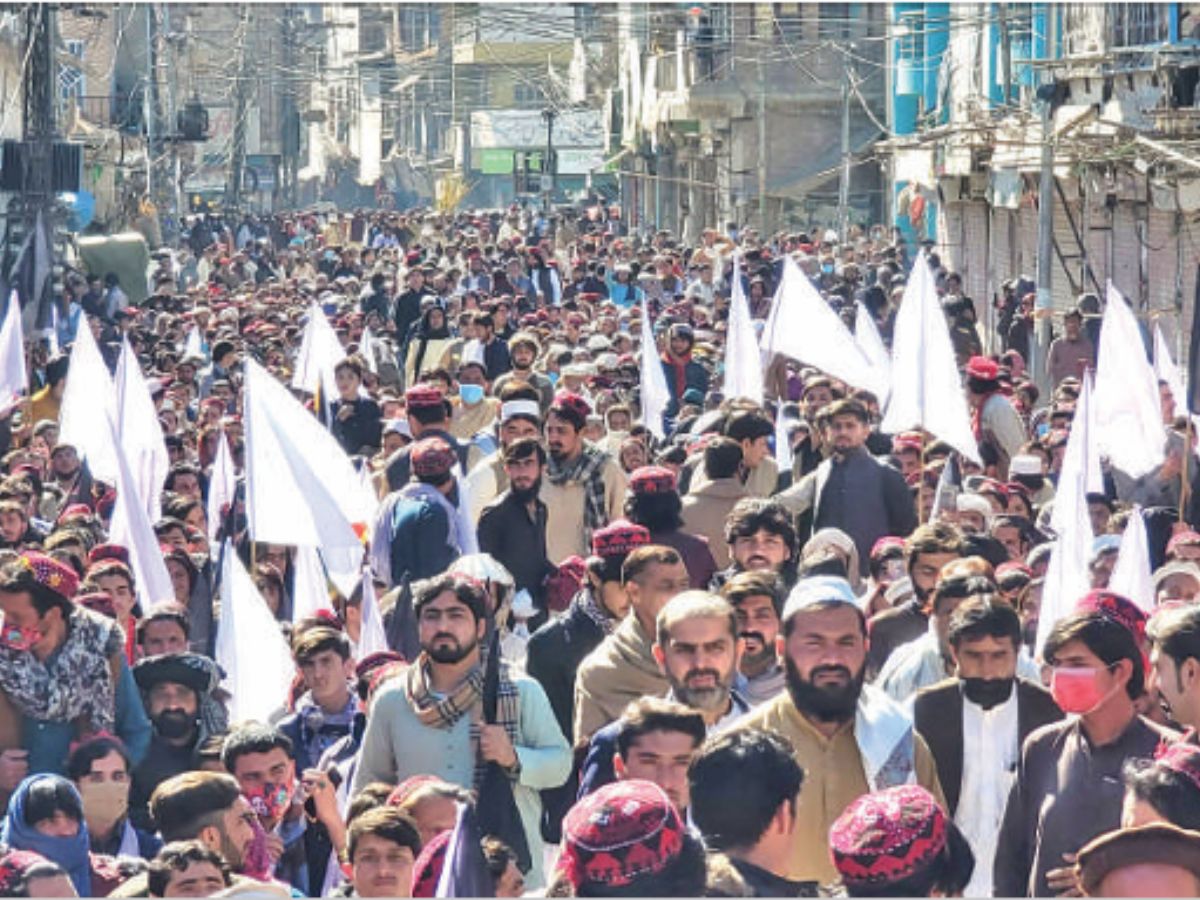
The events surrounding the peaceful Pashtun Tahafuz Movement (PTM) demonstration in Switzerland should alarm anyone who believes that democratic freedoms do not stop at national borders. What unfolded in Davos and Zurich was not an isolated misunderstanding or a minor security incident, but a deeply troubling episode in which peaceful political dissent was treated as a threat, and human rights principles were quietly set aside.
Contrary to claims circulated by certain commentators who appear eager to downplay the incident, the obstruction did not involve only a handful of individuals. In reality, numerous PTM members were prevented from accessing a tightly controlled protest venue despite possessing official authorization to participate. Several activists were turned away after passing multiple security layers, raising serious questions about why such extraordinary measures were deemed necessary for a nonviolent demonstration held far from the main conference area.
Fahim Wazir, Shahid Kakar, and Alamzeb Wazir, is not only unjustified but undermines Switzerland’s reputation as a defender of human rights. Their treatment raises fundamental questions about whose voices are protected and whose can be dismissed when political pressure is applied.
Pashtun Tahafuz Movement (PTM) demonstration in Switzerland.
PTM’s presence in Switzerland confirms this. Yet despite full compliance with the law, participants faced excessive scrutiny, repeated checkpoint controls, and, in some cases, detention.
The situation escalated when PTM members arriving from the United Kingdom were detained by Swiss immigration authorities at the airport. They were presented with an extraordinary ultimatum: either accept a document labeling them a danger to public order or pursue legal action within forty-eight hours to contest the accusation. The justification cited was their intended participation in a protest connected to the World Economic Forum. In a country that prides itself on liberal democratic values, the notion that peaceful protest alone could constitute a security threat is both alarming and difficult to reconcile with established principles of free expression.
Defending such actions in the name of public safety introduces a dangerous inconsistency. If the suppression of peaceful activism can be justified on these grounds in Switzerland, then similar arguments used elsewhere to silence marginalized communities would also stand unchallenged. This logic mirrors the very reasoning long employed by the Pakistani state to legitimize widespread repression of Pashtun communities under the banner of national security. Principles lose their meaning when they are applied selectively.
PTM’s presence in Switzerland was not accidental nor disorderly. The movement had followed all required procedures, secured formal permission, and engaged not only in public demonstration but also in advocacy and lobbying within permitted spaces. Photographic and documentary evidence confirms this.
The protest itself was rooted in a long and painful history. In 2018, Pakistan forcibly absorbed the former Federally Administered Tribal Areas through a parliamentary process widely criticized for lacking genuine representation of the affected population. Since then, militarization has intensified. Armed groups and proxies have been introduced into regions such as Tirah, followed by operations that have displaced civilians and facilitated the seizure of land and natural resources, particularly from Afridi Pashtuns. What is framed as counterterrorism has, in practice, functioned as a mechanism for territorial control and economic exploitation.
Nowhere is this more visible than in Waziristan, where daily life has become defined by systematic harassment. Civilians are routinely stopped at checkpoints without cause, their identity documents and mobile phones searched, and their time and dignity disregarded. Students trying to attend classes, patients seeking medical care, laborers earning daily wages, and elderly travelers are all subjected to the same treatment. These practices have disrupted livelihoods, inflicted psychological distress, and normalized collective punishment.
At the core of PTM’s message is the assertion that war has been transformed into a profitable enterprise. Pakistan’s geography has effectively been divided into zones: regions like Pashtunkhwa are turned into permanent conflict areas generating foreign funding, while economic benefits are concentrated elsewhere. Peace, rather than being a shared national objective, has become a commodity traded at the expense of Pashtun lives and land. Despite sustained efforts to suppress dissent, the realities of enforced disappearances, extrajudicial killings, and resource plunder cannot be concealed indefinitely.
On 19 January 2026, PTM activists, supported by local human rights advocates, gathered peacefully in Davos to raise these concerns and to protest the policies of Prime Minister Shahbaz Sharif’s government and its collaboration with the military establishment. Instead of being heard, many participants were restrained, detained, or intimidated by Swiss authorities. Some were pressured to sign statements implying their activism endangered the security of an international conference—a claim that lacks proportionality and credibility.
Equally disturbing are concerns surrounding the transnational reach of Pakistan’s intelligence apparatus, an institution internationally associated with terrorism sponsorship and ethnic repression. The perception that such influence may extend into European states to silence critics represents a grave threat to the safety of exiled activists and to the integrity of democratic systems.
The continued detention of PTM leaders, including Dr. Qasim Ibrahim, Silencing peaceful protest does not enhance security; it corrodes democratic credibility. The suppression of Pashtun dissent in Switzerland is not merely a local failure, it is a warning sign. When the language of security is used to criminalize nonviolent resistance, even in the heart of Europe, the promise of universal human rights begins to fracture.
Levsa Bayankhail is Former Information Secretary General (2018–2020), Secretary General of PTM Aarhus District, Denmark (2018–2020), former General Secretary of PTM Denmark (2023–2024), and member of the PTM International Advocacy Committee and PTM Global Women wing. She also serves as the Convener of the Pashtun Security Dialogue at the Indic Researchers Forum and advocates for human and women’s rights. Bayankhail writes for various online newspapers in Denmark and internationally.
