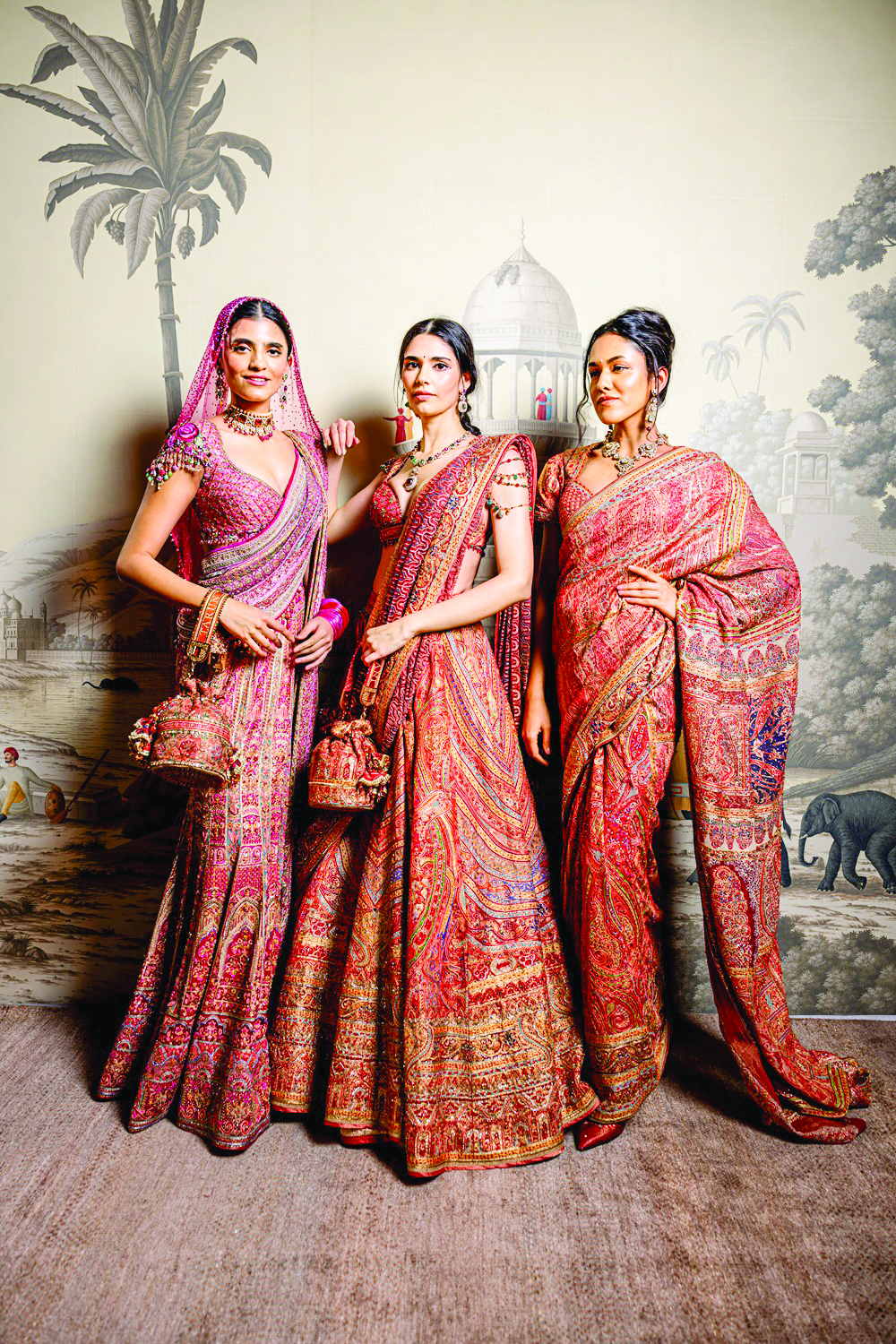
Few names dominate the Indian haute couture landscape like Tarun Tahiliani’s does. The prolific designer has numerous accolades to his name, and this year marks an important milestone in his career – 30 years since the launch of his eponymous brand. To kick off celebrations, he recently presented an exclusive bridal couture collection at The Oberoi, New Delhi, as part of FDCI India Couture Week 2025.
“This collection marks 30 years of our brand and is a quiet celebration of craft, emotion and elegance, brought to life in collaboration with The Oberoi as they celebrate 60 years of timeless Indian hospitality,” says Tahiliani. Titled ‘Quintessence’, the collection embodies the spirit of quiet luxury that stands the test of time. “What endures is never loud. It lingers like a memory – measured, luminous and true. In its quiet, you meet yourself.”
These words reflect Tahiliani’s design philosophy, which he describes as, “A celebration of timeless craft, precision and emotion. Rooted in the meaning of the word itself, which is the most refined essence, this collection is the soul of couture, expressed with clarity, grace and restraint. This is luxury that whispers, enveloping the senses and awakening something deeper – an effortless lightness, a quiet joy in simply being.”
The perfect partner to mark this occasion was The Oberoi, New Delhi, which is also celebrating the milestone of 60 years in Indian hospitality. For the designer, the hotel became both a muse and collaborator for this bridal showcase. “With its architectural grace, serene interiors and deep-rooted legacy, the hotel was an integral partner in shaping the atmosphere of Quintessence. Its spaces provided the perfect canvas for my vision: calm, refined and elemental. This creative partnership is a quiet but powerful celebration of legacy, evolution, and elegance,” explains the designer.
On show were a variety of sculpted yet fluid silhouettes including lehengas, saris, dresses, gowns and more for the women, and bandhgalas, sherwanis, suits and more for the men. “Our drapes echo the softness of memory, sculpted in form, while the structure exudes quiet confidence. Our embroideries are delicate, embellished with pearls, crystals and resham threads stitched with care and intention. Every detail is meaningful and there is no excess. Quintessence reimagines India’s rich heritage through a modern lens as being refined, soulful and deeply personal,” says Tahiliani. The collection seeks to attract brides and grooms who want to feel light, present and entirely themselves. In his words, its fashion that is, “Adorned, not overwhelmed. Held, not hidden.”
For the special showcase, Tahiliani collaborated with renowned British company de Gournay, known for their exquisite hand-painted wallcoverings. They created a bespoke suite of ‘Early Views of India’ panels, hand-painted on ivory Indian tea paper. Working as artworks they served to transform the venue into an immersive tableau of India’s visual heritage. One of the brand’s custom-painted silk panels was also interpreted by Tahiliani as a one-of-akind couture jacket to show the merger of fashion and decorative art in a celebration of bespoke craft. Sumant Jayakrishnan designed the set, having understood the brief well as the brand’s long-time collaborator and scenographer.
Tahiliani lauds his effort with: “His thoughtful spatial design echoed the collection’s quiet elegance and immersive spirit. He captured the spirit of Quintessence, which is something that brings us back to what truly endures in a world of noise. It is elegance with purpose, craft honed over decades and beauty that is eternal.”
Born in Bombay in 1962 to a Navy Admiral and the first female engineer in Maharashtra, Tahiliani studied at The Doon School in Dehradun and St. Stephens College in Delhi. While pursuing an MBA from The Wharton School of Business, he met his wife Sailaja, who was an economics student. “My upbringing was influenced by European methods and I was academically inclined. But I had a natural inclination towards art. I drew planes and ships at first, then, as I grew older, they became detailed figures of wedding processions with accessories. Inspiration was everywhere – from the vision of my mother in resplendent saris to habits the nuns at his school wore, the attire of Koli fisherwomen of Bombay to global museums and art which expanded my worldview,” he says.
Having returned from the States, Tahiliani joined the family business of oil-field equipment. However, to satisfy his creative calling, he co-founded Ensemble in 1987 with his wife Sailaja, a multi-brand fashion boutique that introduced luxury retail to Mumbai. On display were the works of four Indian and one American designer, as well as Tahiliani’s own label, Ahilian. Ensemble grew by leaps and bounds, becoming a coveted platform for some of the best designers at the time, while shaping the way Indian women perceived fashion and clothing. “With the success of Ensemble, my vision grew larger, along with my desire to create something that would bring craft, culture and community together in Indian fashion. I knew this would be possible only with formal training,” he recalls.
In 1990, therefore, he enrolled in the Fashion Institute of Technology (FIT) in New York City and earned an associate degree. It was in September of 1994, that he held his first solo show, at the Dorchester Hotel in London where British fashion editor, Isabella Blow, referred to him as the ‘Karl Lagerfeld of India’. Building his design philosophy, he attempted to capture the spirit of a new India, which had moved away from anglicised schools, clubs and military establishments. While his style continued to reflect a particular Indianness, his structured designs broke away from tradition.
These creative endeavours led to Tahiliani, along with six other designers and a businessman, co-founding the Fashion Design Council of India (FDCI). Tahiliani was also the first Indian designer to showcase at Milan Fashion Week, which is where he discovered his love of luxury prêt. Over the last two decades, his work has been shown in New York, London, Tokyo, Dubai, Singapore and Karachi. Summarising his journey so far, Tahiliani says, “I learnt more about India through design, because it was the first real Indian language I was trained in, taught by the craftsmen who practiced it.”
Noor Anand Chawla pens lifestyle articles for various publications and her blog www. nooranandchawla.com.
