Technology can process information. It cannot live life on our behalf, love for us, understand for us, or grow for us.
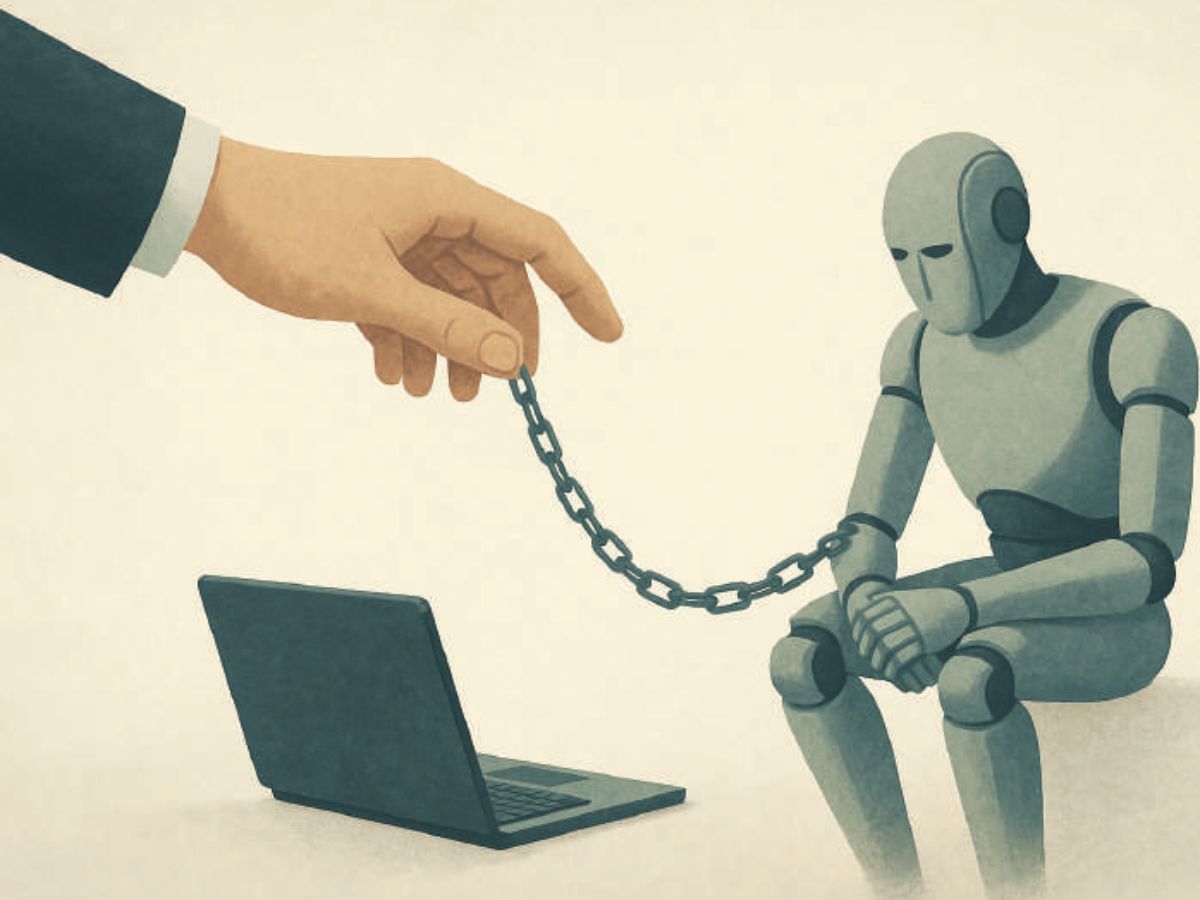
In the past few decades, humanity has seen remarkable technological advancement. Behind these developments are people of sharp intellect, working with skill and precision. Yet, as technology becomes more powerful, society seems to be dividing into two groups: those who create and understand these systems, and those who depend on them so much that even simple tasks are being done by machines. Studies now indicate declining attention spans and cognitive ability. The human brain, like any part of the body, becomes dysfunctional if not used. Many people who have lived in the same city for years cannot reach even familiar places without navigation assistance. Our ability to navigate and think independently is no longer being exercised. We are increasingly placing ourselves in the hands of technology, but technology in itself cannot guide or clarify the inner world of a human being.
We first outsourced knowledge-seeking to search engines. Even then, one needed discretion; one had to choose among many possibilities. Now, with artificial intelligence, we are outsourcing not just information but thinking and decision-making itself. Technology is a wonderful tool, but it functions on data, and data is generated by human beings. If we are ignorant, prejudiced, or fragmented within, our machines will reflect the same. It is garbage in, garbage out. So, while we celebrate technological progress, we must remember a simple truth: technology only helps us do more of what we already want to do. Economics, science, and mathematics, no matter how advanced they become, will ultimately serve the tendencies that already exist in the human mind. Those who look to the future with blind optimism, believing that advancement in knowledge and technology guarantees a better world, are placing hope where it cannot hold. More powerful technology becomes dangerous when it is used by people who lack clarity. In such cases, it is actually safer not to have that technology at all. We do not allow children to operate weapons. We do not allow them to run kitchen machines unsupervised. They will find ways to get hurt. Foolishness, like evolution, progresses. There is no system so foolproof that it cannot be misused by an unprepared mind.
Today, the survival of the entire planet, including every species and ecosystem, is under threat. This crisis is recent in the timeline of human awareness. Fifty years ago, we were not speaking of climate collapse. Now it overshadows every serious discussion of the future. How did this happen so quickly? The answer lies partly in technological power. We have not suddenly become more wicked. Humanity has always carried the same emotional tumult, the same tendencies. What has changed is our capacity to actualize our impulses on a massive scale. Our intellectual evolution has outpaced our inner evolution. We are a species only forty to eighty thousand years old, a blink in evolutionary time. Our instincts are still close to the jungle. We remain driven by the impulses of survival, possession, and assertion. Wisdom, however, is a matter of millions of years, if it is achievable at all. So here we are: a still-raw, animalistic mind, holding machines, missiles, and digital systems of extraordinary sophistication.
Only around fifty thousand years ago, we were learning rudimentary language, living off leaves, fruits, and occasionally a small animal if we could manage to catch one. That same creature still lives within us. But now that creature has access to intercontinental ballistic missiles. Nations routinely parade their latest destructive technologies, the way children flaunt new toys before one another. The only difference is that these toys are not toys; they are instruments of mass destruction. Given who we are internally, the maximum we deserved was harmless toys. Unfortunately, what we have is real destructive power, externally in the form of weaponry and industrial machinery, and internally in the form of excess entitlement. And when you have destructive power, you do not merely harm the other; you harm yourself. This is evident in deforestation, the extinction of species, the poisoning of oceans, and the climate crisis. It is equally evident in the erosion of our inner potential, our capacity to think, attend, and understand.
Humanity today has unprecedented freedom, wealth, comfort, and access. Even societies without democratic governance offer more personal freedom than the most generous monarchs of history ever provided. Per capita income worldwide is higher than at any time before. Life expectancy has risen dramatically. Diseases that devastated populations for centuries have been largely eliminated. We have access to knowledge at our fingertips. Food from any country can be brought to our doorstep. We travel across continents in hours. The common individual has power that emperors once could not dream of. But what have we done to deserve this? We are like heirs who inherit a vast fortune without earning any of it. A smartphone is a deeply sophisticated computing device. How many centuries would it take any of us, individually, to assemble one? And yet, we feel entitled to replace it every year. We have received everything and struggled for nothing. And when struggle disappears, inner growth stalls. We become inwardly stunted, small versions of the human possibility.
Externally, we are a thousand times more empowered than our ancestors. But are we internally a thousand times stronger, wiser, more grounded? On the contrary, it is quite possible that they were sturdier humans internally. We are collapsing from within, even as the external world dazzles us. The lights outside blind us to the darkness within. The sophistication of our surroundings convinces us that we must be equally sophisticated internally. That is the deception. A sudden financial windfall can make a person believe he has become someone extraordinary. The external privilege convinces the inner ego of superiority. But if the inner self has not matured, the privilege becomes corrupting. Therefore, the asymmetry must be corrected. We must grow internally to deserve what we already possess externally. Otherwise, when people have the power to vote but lack the maturity to choose wisely, the result is the kind of governments we end up with. And when we have the freedom to act without the understanding needed to guide our actions, we create damage to both the environment and our civilisation. The imbalance is fatal.
So what is to be done? The solution is not to reduce what we have externally, because that is neither practical nor desirable. The real work is to develop the inner self so that it matches the scale of our external power and privilege. This requires exercising one’s own discretion and awareness, one’s own Vivek. The internet can offer information, but inner clarity cannot be outsourced. Tools may assist us, yet we must not surrender our own consciousness to them. You are the one who thinks, chooses, and experiences. If you do not exercise your capacity to choose, you do not grow. Without inner growth, there is no difference between a human being and a stone. Technology can process information, but it cannot live life on our behalf. It cannot love for us, understand for us, or grow for us. To remember one’s ability for discretion is the essence of wisdom. If we neglect this inner development, our outer power will remain unearned, misused, and ultimately self-destructive. If we mature inwardly, then technology becomes a servant rather than a master, a means of liberation rather than destruction. The age we live in demands such maturity. A machine may operate faster, but even the machine rests on human consciousness. It is human beings who write its code, along with all our intelligence, biases, and confusions. If thinking, understanding, and knowing are handed over to machines, it becomes equivalent to outsourcing love itself. One cannot delegate the intimate work of living. So remember: The ego always has a choice, and through conscious choice it elevates itself. Without this inner effort, there is no elevation, and without elevation, there is no difference between living as a human and existing as a stone.
Acharya Prashant is a teacher, founder of PrashantAdvait Foundation, and author on wisdom literature.
