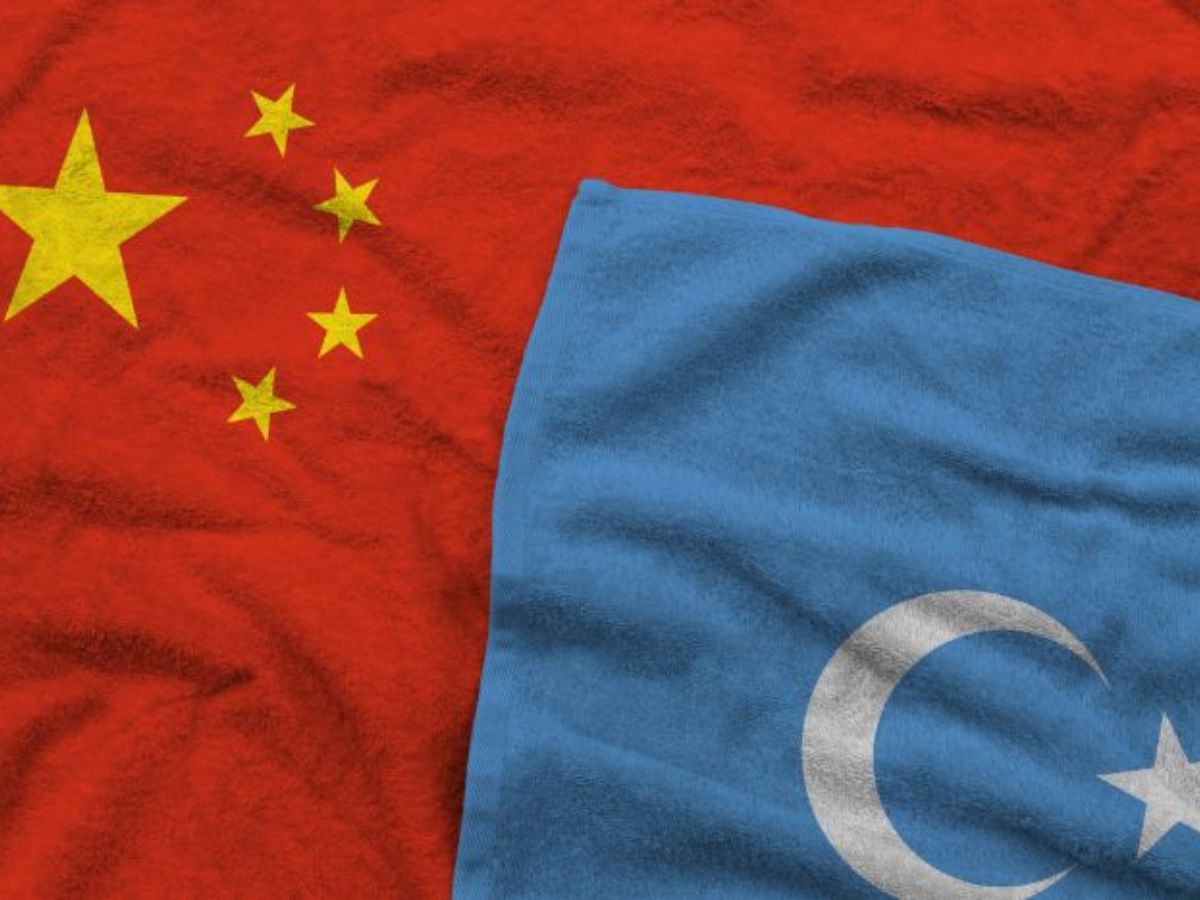
How a Banned Emblem Became the Centre of Uyghur Defiance. (Image:RAC)
When Uyghur demonstrators gathered across European capitals on 12 November this year, the most visible object was neither a placard nor a slogan. It was a piece of cloth: light blue, carrying a white crescent and star, known to Uyghurs as the Kök Bayraq. Beijing outlaws it domestically, insisting it represents separatism. Yet beyond China’s borders, the same image has grown into one of the most persistent expressions of Uyghur endurance in the face of repression in Xinjiang.
Its journey from an outlawed emblem inside China to a global protest fixture mirrors the broader trajectory of the Uyghur cause itself: a struggle that Beijing has tried to contain within the borders of Xinjiang, but which now circulates across parliaments, city squares and diaspora communities worldwide.
The Kök Bayraq’s origins lie in the brief First East Turkestan Republic, proclaimed in Kashgar on 12 November 1933. Though short-lived, the republic established symbols, institutions and narratives that have retained an emotional charge for many Uyghurs. A second East Turkestan Republic emerged in 1944 before being absorbed into the new People’s Republic of China in 1949. The dates and imagery endured even as Beijing tightened political control over the region.
Following the mass detention drive that began in 2017—when up to a million or more Uyghurs and other Turkic Muslims were swept into “re-education” centres—the Chinese authorities criminalised a wide range of expressions tied to Uyghur identity. The blue flag became a particular target. Mere possession could lead to investigation; images of it online were scrubbed; and families were questioned about contacts abroad. For many Uyghurs, the ban itself became a kind of confirmation: the state recognised the symbol’s emotional power even as it moved to crush it.
Exile transformed the flag’s meaning. In Istanbul, where tens of thousands of Uyghurs have settled, the Kök Bayraq drapes balconies and appears at community events. In Washington, Uyghur organisations display it during congressional briefings. In Stockholm, protestors often carry it outside the Chinese embassy. Children born far from Xinjiang grow up recognising the blue banner not from local history lessons but from weekend rallies, vigils for detainees and remembrance days.
For many in the diaspora, the flag is not an abstract nationalist token. It stands for relatives whose whereabouts are unknown, villages renamed by the state, demolished shrines, shuttered bookstores and the quiet disappearance of neighbours into camps. Its widespread use abroad, especially on 12 November, gives Uyghur communities a calendar and a public space in which to tell their story.
China’s effort to control the flag’s global presence has yielded mixed results. Chinese embassies regularly lodge complaints with host governments over Uyghur demonstrations, arguing that the imagery promotes separatism. Diplomats have pressured activists, contacted local organisers and warned politicians against appearing at events where the Kök Bayraq is displayed. In some cases, families inside Xinjiang receive warnings soon after relatives abroad participate in protests.
Yet these tactics have had limited impact on public opinion. In several Western cities, local politicians now attend Uyghur rallies as a matter of course. Their presence—and the visibility of the blue flag—signals that China’s attempt to keep the issue contained has faltered. In effect, every diplomatic complaint amplifies the very symbol Beijing wants to suppress.
Uyghur communities are dispersed—Turkey, Central Asia, Europe, Australia, North America—and not always politically aligned. Some emphasise human rights and cultural preservation; others call for independence. But the flag serves as a shared touchstone across these differences. Community organisers say that even Uyghurs who avoid political activism will often carry the blue flag during memorial vigils for detainees or missing relatives.
It also provides a visual anchor for advocacy campaigns. Groups such as the World Uyghur Congress and the East Turkistan Government in Exile use it in petitions, parliamentary briefings and legal filings. Social media posts calling attention to forced separations, mass detentions or demolished mosques often attach the flag as a marker of identity—an object that ties individual stories to a wider narrative.
For Beijing, the flag is proof of separatist intent; for Uyghurs, its suppression is evidence of attempts to redefine or erase their identity. This tension sits at the heart of the Xinjiang crisis. China maintains that its policies have brought stability and development to the region. Yet the persistence of the blue flag abroad shows that the state’s most ambitious efforts—mass surveillance, political education, restrictions on language and religion—have not extinguished Uyghur collective memory.
Indeed, the flag now circulates in places Chinese authorities cannot fully control: in diaspora homes, at university events, in exhibitions, and across encrypted channels that document missing persons and demolished cultural sites. Its presence at global protests signals that the attempt to regulate Uyghur identity inside Xinjiang has created a transnational story that Beijing struggles to counter.
Every 12 November, Uyghur groups gather to commemorate the proclamation of the first East Turkestan Republic. These events are not celebrations of territorial control—no diaspora group commands it—but acts of remembrance in the face of pressure. For many participants, the day is less about past statehood than about refusing silence. The Kök Bayraq, held aloft by older exiles and by children who have never seen Xinjiang, embodies that choice.
In an era when China’s global reach is broader than ever, the journey of a small blue flag from a suppressed memory inside Xinjiang to a global marker of Uyghur endurance is a reminder that symbols can outlive the institutions that first carried them. Beijing may control the physical landscape of Xinjiang, but it has not captured its story. The blue flag’s spread across continents suggests that narrative still has many authors—and none of them are ready to let it fade.
(Ashu Mann is an Associate Fellow at the Centre for Land Warfare Studies. He was awarded the Vice Chief of the Army Staff Commendation card on Army Day 2025. He is pursuing a PhD in Defence and Strategic Studies. His research focuses include the India-China territorial dispute, great power rivalry, and Chinese foreign policy.)
