
There is a particular kind of dishonesty that does not originate in malice. It originates in fear, specifically the fear of being seen as ignorant. When this fear becomes cultural rather than individual, it produces something more consequential than the occasional lie: a civilisation that has learned to ‘perform’ knowledge rather than pursue it, to display competence rather than build it, to arrive at the summit and hope that no one checks the label.
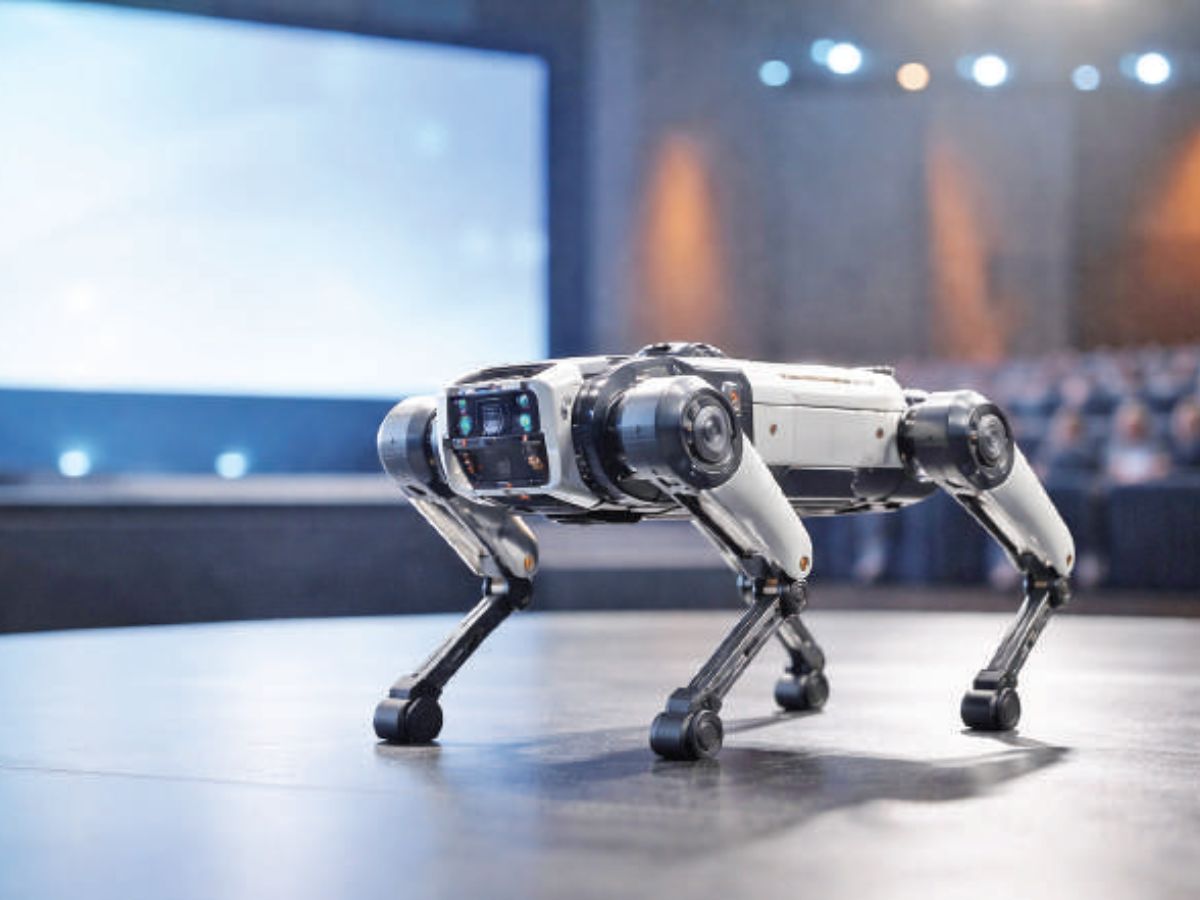
At a national artificial intelligence summit held in the capital this week, an institution presented a commercially available robotic dog, manufactured in China and purchasable by anyone for a modest sum, as an indigenous innovation developed at its own centre of excellence, part of a declared investment of hundreds of crore rupees in AI. Social media users identified the device within hours. The robot remained Chinese, the embarrassment became ours. What is worth examining is not the institution’s dishonesty but the environment that made this the rational choice. The incentive at a national summit was not to build something; it was to appear to have built something. The episode was not an aberration; it was a logical outcome. And logical outcomes have deep roots.
The Soil That Grew This
To understand why this keeps happening, one has to go further back than policy failures or funding gaps. India has one of the oldest and most penetrating intellectual traditions on earth, and not merely in the philosophical sense. Brahmagupta’s conceptualisation of zero as a number with its own mathematical identity is among humanity’s greatest intellectual inventions. Wootz steel, produced in South India and exported for centuries, was so sophisticated that Damascus blades derived from it, and Europe, despite sustained attempts to reverse-engineer the process, could never replicate it. The iron pillar at Mehrauli has stood for sixteen centuries without corroding, a standing testimony to material knowledge of the deepest order. Nalanda and Takshashila were not merely schools but large-scale multi-disciplinary knowledge ecosystems drawing students internationally. And in the modern era, Chandrayaan-3’s soft landing near the lunar south pole was a feat no other nation had accomplished.
This is the civilisation we are coming from. It is not one that lacked the capacity for original thought. What it has lost is the cultural permission to pursue original thought. The rigour produced by the sages was transmitted to ordinary life not as a method, but as a conclusion. The sage arrived at clarity through decades of ruthless inquiry, using the mind to its absolute limit before transcending it. India, loving its sages with genuine devotion, attempted to imitate the destination rather than understand the journey. If the sage had gone beyond the restless, acquisitive mind, the mind itself must be the obstacle. Drop the mind, and peace follows. This conclusion was catastrophically mistaken.
There are three levels worth distinguishing: the savage who does not use the mind, the simpleton who uses it partially, the sage who has used it fully and gone beyond. When a culture attempts to leap from the second to the third without undergoing the discipline of full inquiry, it risks sliding backward rather than transcending. Logic became suspect, rationality became foreign and questioning became disrespect. The intellect, without which no innovation is possible, was demoted below gut feeling, inherited belief, and devotional surrender. This is the soil from which the borrowed robot grew; not a conspiracy, not a single institution’s failure, but the accumulated weight of a civilisation that found a way to make the avoidance of hard inquiry look like wisdom.
The numbers, when one finally looks at them, do not introduce a new argument. They merely put a scale on the one already made. India spends approximately 0.65 percent of its GDP on research and development, against the United States at 3.45 percent, South Korea at 5 percent, and Israel at 6.3 percent. China spends 2.68 percent, but of a GDP five times larger, making the per-capita gap closer to eighteen times than the four the headline figures suggest. India sits at less than a third of the global average of 2 percent. China filed 1.8 million patent applications in 2024, nearly half the global total; India does not appear in the top twenty per million people. A patent here takes fifty-eight months to grant, against twenty-one in the United States. India ranks 38th in the Global Innovation Index 2025, while China has entered the top ten.
And in the domain that should most embody original thinking, India recorded 2,737 research paper retractions in 2023 alone, many driven by fake peer review and outright plagiarism. Even IIT faculty have seen papers retracted for duplication. The appearance of achievement is protected here; the substance of it is not.
The Mirror and What It Shows
A person who moves abroad and contributes to foundational research at a leading university is not a different person from the one who might display a borrowed robot at home. He is the same person in a different environment, one that permits him to say “I do not know” without social consequence, one that measures him by the quality of his questions rather than the confidence of his answers. The same intelligence, freed from the architecture of performance, does what intelligence naturally does when left alone: it inquires.
The ego that cannot bear being ignorant is not unique to any culture. But the architecture that systematically reinforces it is particularly well-developed here, from the family that makes every examination result a matter of collective honour, to the institution that rewards visible output over patient work, to the national showcase that offers a stage for spectacle before asking for substance. The child trained to produce the right answer rather than ask the honest question does not become a fearless inquirer upon entering a university. She becomes a skilled performer of inquiry, fluent in the language of innovation, wearing the posture of discovery, without the sustained inner work that any of these actually require.
This pattern is not confined to institutions or summits alone. The film industry has spent decades lifting melodies from abroad and labelling them as original, with a dedicated website chronicling musical plagiarism at industrial scale and one compilation documenting nearly a hundred films bearing marked resemblance to foreign originals. The word ‘inspired’ became a respectable euphemism for outright borrowing, and the culture developed no serious shame around it.
Consider too what has happened in the automobile market: a foreign manufacturer found success here only after deliberately compromising its original model, reducing dimensions, softening safety standards, and adding glossy lights on the outside. The car now sells. We chose the version that impressed over the version that performed. Go to any small town and the same hierarchy is visible: no libraries, but dozens of banquet halls. The wedding industry is larger than the education industry. What unites all of it is the same hunger: not to be, but to appear to be.
Jugaad, celebrated as frugal ingenuity, deserves a more honest description. It is the engineering of appearances by a mind unwilling to endure the slow humiliation of real learning and commit to root-level work. Why build foundations when you believe your real home lies elsewhere?
Western science emerged from philosophy, from a tradition of restless questioning that refused final answers on authority; that discomfort became its engine. China, despite its political constraints, has treated scientific development as a civilisational project requiring institutional patience, and its private sector accounts for over 77 percent of total R&D spending, meaning the commitment lives in enterprise itself. India’s private sector contributes only around 37 percent of an already meagre total, in the absence of a culture that treats the failed experiment as a necessary step rather than a cause for shame.
What India shares with neither tradition is the institutionalised permission not to know. But there is a second trap, equally debilitating: the belief that innovation is unnecessary because wisdom was already possessed in full. A civilisation that tells itself that the ancients already contained all the answers, and that every modern discovery was anticipated in mythology, from flying chariots to ancient wireless transmission, has found a more flattering reason to avoid the same hard work. Both postures, the inferiority that copies and the arrogance that does not bother, produce the same outcome: nothing genuinely new.
Summits will improve their screening, and budgets may rise, but these corrections address the temperature of the room while leaving the fire untouched. What must change is the inner posture toward inquiry itself, beginning where the distortion was first installed: in how a child is taught to relate to what she does not know. If uncertainty and genuine inquiry are met with shame and disdain, she will spend her life hiding them rather than resolving them. If the borrowed and renamed receives the same applause as the genuinely built, the borrowed and renamed is what the culture will keep producing, at every level, on every stage.
The borrowed robot at the national summit was not an anomaly to be screened out. It was a mirror, and mirrors have rarely been rewarded here. The one aspect India has lacked in rewarding is honest reflection; the one product it has never stopped buying is colour, gloss, and the means to appear other than what one is. A mirror shows you what you are trying to avoid. That is precisely why it stays on the shelf while the lights and the labels and the renamed robots keep moving.
The question is not whether the next summit will be verified more carefully. The question is whether the next child will be allowed to say, “I do not know,” without fear. The capacity is not absent. It was present when Brahmagupta named zero, when the iron pillar was cast, and when Chandrayaan-3 touched the lunar south pole. It returns whenever the mind is permitted to work honestly and with the spirit of true enquiry. That is all innovation has ever required. What we build next will depend entirely on whether we are finally willing to look honestly.
Acharya Prashant is a teacher and author whose work centres on self-inquiry and its application to contemporary life.




