When one of the world’s keenest scientific minds warns that Parkinson’s is approaching pandemic proportions, you better sit up and take notice.
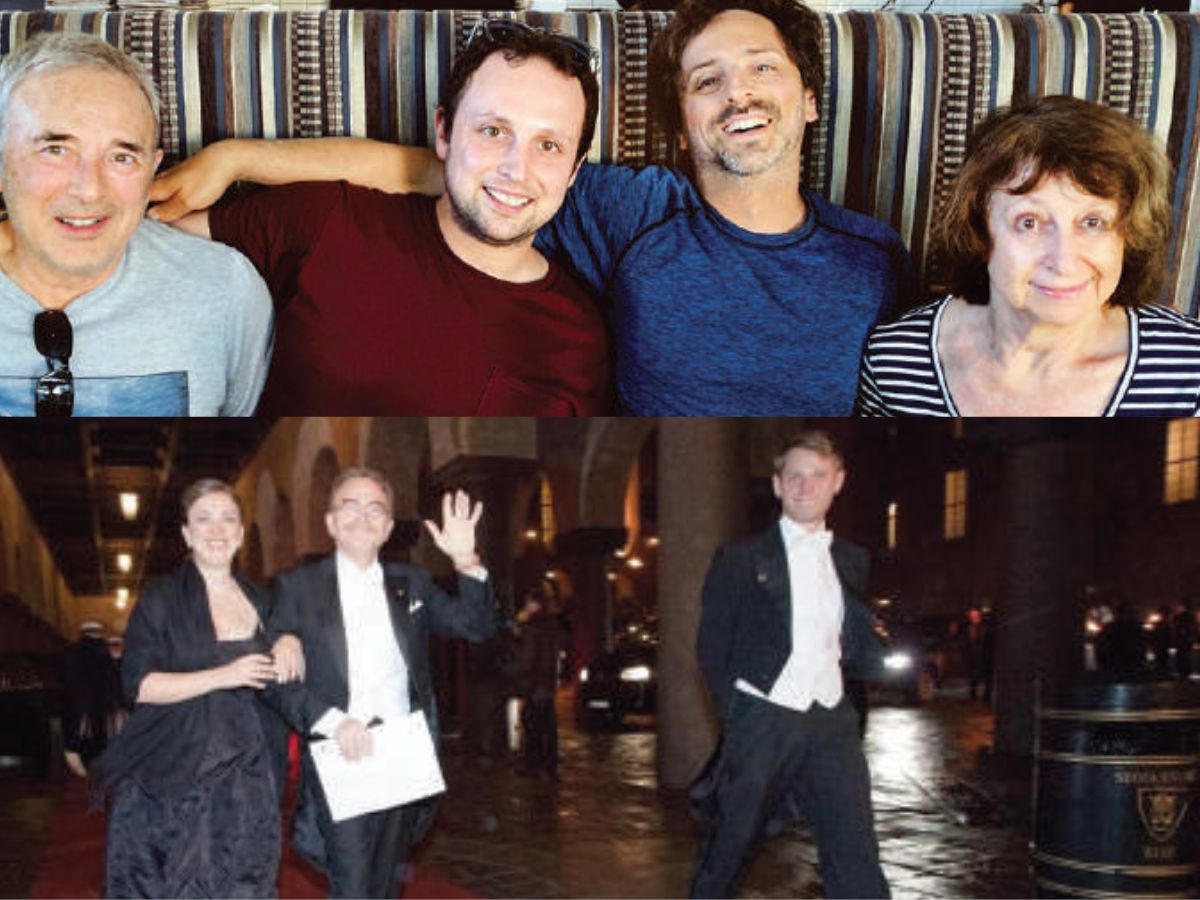
Sergey Brin (third from left), with his mother, Eugenia Brin, brother Sam and father Michael Brin. The co-founder of Google has donated over a billion dollars for Parkinson’s research | Prof Randy Schekman and his wife Nancy arriving at the Nobel Prize awards ceremony on 10.12.2013. Photo by Helena Paulin-Strömberg for Nobel Media AB
The chief guest at the recent Infosys Prize 2025 awards ceremony was Nobel Laureate Randy Schekman (a bonafide winner, please note). The keynote speech was both hopeful and fearful, covering breakthroughs in molecular biology and genome editing (like for sickle cell anaemia) and the growing crisis of neurodegenerative diseases, focusing on Parkinson’s. Schekman called the brain “the great frontier in biology” because of its immense complexity and its role in defining human nature. With tens of billions of brain cells and trillions of nerve terminals, the selective communication between nerve cells defines human identity, informing all processes of thought and emotion.
According to Schekman, Parkinson’s disease is growing in severity around the world, rising at a greater rate than Alzheimer’s disease. He offers the following points as reasons for this trend. He estimates that 80% of Parkinson’s patients arise from some sporadic process, which he suggests is likely due to an environmental toxin. The spread is described as “like a pandemic” that “obeys no boundaries”. He specifically estimates that China will have over half of the new cases diagnosed in the next decade, which he believes is not just a result of better diagnosis. He warned that while China may be particularly bad at controlling these toxins, other countries will be severely affected. While genetic studies show there are about 20 different gene mutations that cause familial forms of the disease, these account for only a minor fraction of all patients worldwide.
What makes this environmental toxin theory so compelling is the extraordinary vulnerability of the dopaminergic neurons affected by Parkinson’s. Professor Schekman was stark in his assessment: these brain cells are “poised on the edge of death,” requiring enormous energy to sustain their forest of nearly a million nerve terminals. “Any little insult,” he warned, “is likely to propel them over the boundary into death.” This makes them exquisitely sensitive to environmental toxins, precisely the kind of pollutants that proliferate in poorly planned urban environments. Each dopaminergic neuron has a staggering complexity, with close to a million nerve terminals making connections to another brain tissue called the striatum. It is this communication that performs all of our executive functions and movement functions—everything that becomes compromised in Parkinson’s patients.
The disease announces itself long before the tremors begin. Precursor symptoms, which can persist for years, include a progressive loss of smell and REM sleep disorder, where patients lose control of their movements during sleep. Within five years, 80% of those people progress to Parkinson’s. These are the body’s early warning signals that something in our environment is slowly poisoning our most vulnerable brain cells.
The most poignant part of Professor Schekman’s speech was the honest and searing depiction of the travails of his late wife Nancy Walls, a nurse. They were married for 44 years and had two children. Nancy became ill with Parkinson’s when she was just 48 years old. “Her neurologist said it could be Parkinson’s,” Schekman recalled. “She said, how will I know?” The doctor gave her a pill that is basically a replacement for dopamine. Schekman said he’ll never forget the afternoon she called his office to report that having taken the pill, all of the symptoms were gone within two hours. “This was the good and the bad news,” he said quietly.
She received deep brain stimulation through electrodes implanted bilaterally into the mid brain to control motor functions. This worked well in relieving aches and pains restoring her movement. Unfortunately, within a year, she started to develop symptoms of dementia. As a nurse, she knew that once dementia set in, it would only worsen. At the Nobel ceremony in 2013, Nancy suffered from dementia quite seriously. She had to be sustained and nurtured by family members. She lost her ability to communicate because she would forget what she wanted to say. She became catatonic. Schekman asked her neurologists, “What can I do to prepare myself for the next stage?”, but their answers were ‘always wrong’. She required fulltime care, would often fall due to pathologically low blood pressure, and some time after, she died in the middle of the night. “No one ever told me this is the frustration of people who care for those who have these serious disorders.” His evident pain at the memory brought lumps to throats and tears to the eyes of many in the audience.
Nancy’s illness significantly influenced Schekman’s later research and philanthropic efforts, and he established fellowships and research programmes in her honour. Eugenia Brin, a NASA scientist, suffered from advanced Parkinson’s, and her son Sergey Brin, the co-founder of Google, carries a genetic mutation for the disease. Sergey asked Schekman to develop an international basic research programme which led to the setting up of ‘Aligning Science Across Parkinson’s’ (ASAP). For the past seven years, the Sergey Brin Family Foundation has committed over a billion dollars to fund teams of investigators who collaborate for a common purpose across institutions around the world. Michael J. Fox, diagnosed with Parkinson’s at just 29 years, has made it his life’s mission to find a cure and his foundation also supports the research.
The best minds are at work in finding a solution, and it’s the collaborative work of teams that will lead to success, Schekman believes. There are 35 teams in 163 laboratories around the world, with early-career investigators, with many women leading these efforts. Schekman concluded with confidence that the programme has identified targets that the pharmaceutical industry will embrace, leading to breakthroughs and more effective cures within five years.
Just a few days after hearing Schekman’s talk, I moderated a panel discussion for ArtMantram on The Conscious City: Ecology, Wellbeing & Urban Futures. The speakers included Dr. Issaac Mathai, Founder, Soukya Holistic Health Centre, Dr. Vivek Benegal, Professor of Psychiatry, NIMHANS; Padma Shri Anita Reddy, social activist and founder of Dwaraka, and Naresh Narasimhan, urbanist and architect. Each of them spoke about the alarming effects of mindless urbanism and its impact on physical and mental wellbeing. The timing of these two events—separated by mere days—was uncanny. With a Nobel Laureate warning that 80% of Parkinson’s cases likely stem from environmental toxins, and India’s leading experts on urban health describing the toxic environments we’re creating in our cities. The connection is impossible to ignore. The question is no longer if we can afford ecologically sound cities. It is if we can afford to ignore the need to build them.
Sandhya Mendonca, author, biographer, podcaster, and publisher at Raintree Media, offers a distinct female gaze of the world in this column.
