
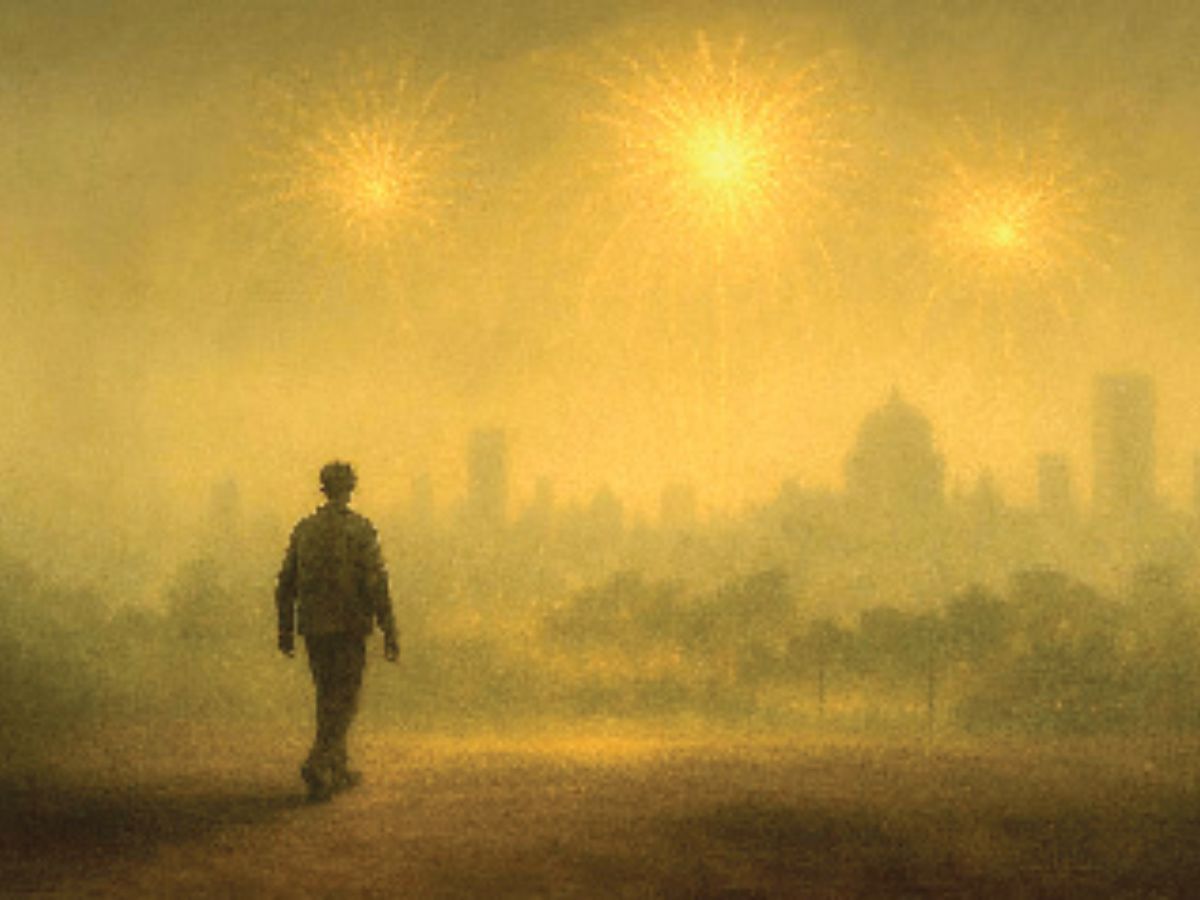
Post Diwali day, Delhi NCR woke to a haze thicker than dawn itself. Through the night, the sky flashed with firecrackers. In the morning, sunlight had vanished, replaced by a yellow-grey fog. The air quality index hovered between 300 and 350: “Severe,” even “Hazardous.” Each burst of light had left behind another layer of poison. We called it celebration. It was, in truth, collective suffocation. These numbers are not mere statistics; they measure how much poison we are willing to breathe before we begin to notice. What was once shocking has become ordinary. The smoke that hides the sun also hides our sense. Every year, we repeat the same cycle: bursting, blaming, forgetting and then pretending surprise when the air turns unbreathable. But this is not merely a failure of administration or policy. It is a physical expression of the haze within us: a thick cloud of confusion, misplaced priorities, and political blame games that cost us our lives every winter. And nothing will change until we recognise our fundamental mistake: believing that the inner and the outer are separate, as if the one who breathes and the air being breathed were unrelated.
A Deeper Malaise
Consider a small scene: children bursting crackers on dry grass while a bystander tries, in vain, to stop them. That helplessness: a single citizen acting, then withdrawing when the system overwhelms individual effort says everything about the scale of the problem. It is not merely that the impulse to celebrate exists; it is that a social machinery teaches celebration without care. Social media amplifies this numbness. Each year, selfies with piles of crackers or boasts of “defending tradition” turn pollution into performance. Spectacle gives confidence to the careless and silences quieter calls for responsibility. The air is choking, but the real suffocation lies elsewhere: in our consciousness. A person who can live comfortably amid poison has not adapted; he has desensitized. That such scenes repeat every year should awaken not embarrassment alone but introspection. Why must a news headline or a visibility index tell us what our lungs already know? The question is not about Delhi’s air alone; it is about our capacity to notice when life itself is being dimmed.
A Crisis of Dignity
Delhi today is losing more than visibility; it is losing years of life. According to a report by the Energy Policy Institute at the University of Chicago (EPIC), every resident of Delhi is breathing away around twelve years of life expectancy because of air pollution. The World Health Organization (WHO) prescribes an annual PM 2.5 limit of 5 μg/m³, while Delhi’s average is about 100 μg/m³, twenty times higher. We know these numbers. They appear in headlines, circulate on social media, and then vanish into the next trend. But what can numbers do when self-respect has faded? Someone who truly values life cannot accept slow death by air. To die merely because one is breathing, what could be more humiliating? An estimated two million Indians die every year from air pollution, as reported in the Global Burden of Disease Study and other health assessments. But when life itself is not revered, such loss becomes arithmetic. “There are so many of us,” we say. “A few less won’t matter.” Our tragedy lies not only in our lungs but in our hearts. We mistake ego for dignity. Ego shouts and defends; dignity is quiet but refuses to live wrongly. A society swollen with ego yet drained of selfrespect will keep poisoning its own air and calling it normal. The same illusion marks our relationship with nature. We bow to rivers and mountains, yet we keep wounding them without pause. Twothirds of India’s untreated sewage flows into the Ganga, and about sixty per cent of Delhi’s waste enters the Yamuna, according to CPCB and NMCG reports. Still, we gather on their banks, standing ankle-deep in foam, offering prayers to the setting sun. How can worship and neglect coexist so easily? We proclaim devotion through spectacle because the inward connection has thinned. Rivers stay clean even in nations that never deify them. We call them “Mother,” yet let them die under our waste. This is not lack of faith; it is faith misplaced. Until we recover the dignity to say, “My life matters, this air matters, this river matters,” no reform will take root. The smog over Delhi is not just pollution; it is a mirror reflecting the loss of our self-respect.
Not a Policy Problem, but a People Problem
Every genuine concern begins with the simplest word: I. What I call myself, this body and mind, depends not only on thoughts and emotions but also on the air I breathe and the water I drink. When the mind is disturbed, we say, “I’m not okay.” When the body is in pain, we say the same. But what happens when the air itself turns toxic? When each breath carries microscopic poison? Then too, we are not okay. To see pollution only as a policy failure is to miss its root. It is not merely an environmental crisis; it is a human one. The same I that must be examined through self-inquiry must also be examined through the world it creates outside itself. Spirituality that meditates in a closed room but ignores the air that sustains it is incomplete. The inner and the outer are not two domains; they are one continuous field of existence. Of course, policies and technology matter. Cleaner fuels, crop management, industrial controls, these are essential. But they can only work when people care enough to follow them. What good are rules if minds remain indifferent?
The Root Is Not Industrial, It Is Spiritual
India’s pollution is not the price of prosperity. Our per-capita income is modest; our industrial growth uneven. Yet 94 of the world’s 100 most polluted cities are Indian, according to the IQAir Global Air Report 2024. Can this be the footprint of wealth? Clearly not. This pollution is not the smoke of factories alone; it is the smoke of confusion, the outer display of inner disorder. The air is dirty because the mind is cluttered. The streets are littered because the heart is indifferent. When a man spits on the road, it is not a civic lapse; it is a reflection of his relationship with himself. The environment does not decay because of machines; it decays because of minds that have lost sanctity. Real growth isn’t measured by money or concrete. It is measured by awareness, by how consciously we live. A culture obsessed with expansion but blind to inner clarity will mistake greed for progress. No GDP curve can clean the sky until this understanding dawns.
Awareness as the Cure
Before measuring the air’s toxicity, we should measure the quality of the human being who breathes it. Before tracking the sea’s rise or groundwater’s fall, we should examine the level of awareness in the human mind. Only then will any measurement matter. We count tigers but rarely ask how much violence remains in the one who kills them. We plant trees but ignore the greed that felled the forests. How long can rivers stay clean if the mind that dirties them remains unchanged? Around us thrives a global industry of environmentalism—projects, reports, funds—yet the Earth keeps gasping. Activism multiplies, but awareness does not. What begins within can never be replaced by what happens outside. Until the mind that exploits is transformed, every act of restoration will remain partial and temporary. The planet mirrors us: it breathes as we breathe, suffers as we live. We must not scatter our energy across countless small gestures that leave the system untouched. If we mean to change civic culture, our efforts must be coordinated—aimed at shifting norms, markets, and values—not merely at quiet acts that soothe our conscience. Speak truth, but not to feed your ego. Restrain destructive acts when you can, advise with humility, and contribute your energy to sustained collective campaigns rather than brief confrontational wins. The air in Delhi today is thick with warning, but also with possibility. For if pollution is the outer symptom of inner blindness, then clarity itself is the cure. When clarity deepens, restraint follows. And when restraint deepens, the Earth begins to heal. The first step toward cleaner skies is not in the factory or the field; it is in the mind that decides how to live.




