‘And now, here we are—the 28th of December, the last Sunday of the month, the last column of the year, and, as it turns out, the last column before I take a small sabbatical. Not a farewell, mind you. Just a gentle stepping away, a quiet retreat into the garden to gather my thoughts, perhaps plant a few ideas, let them grow.’
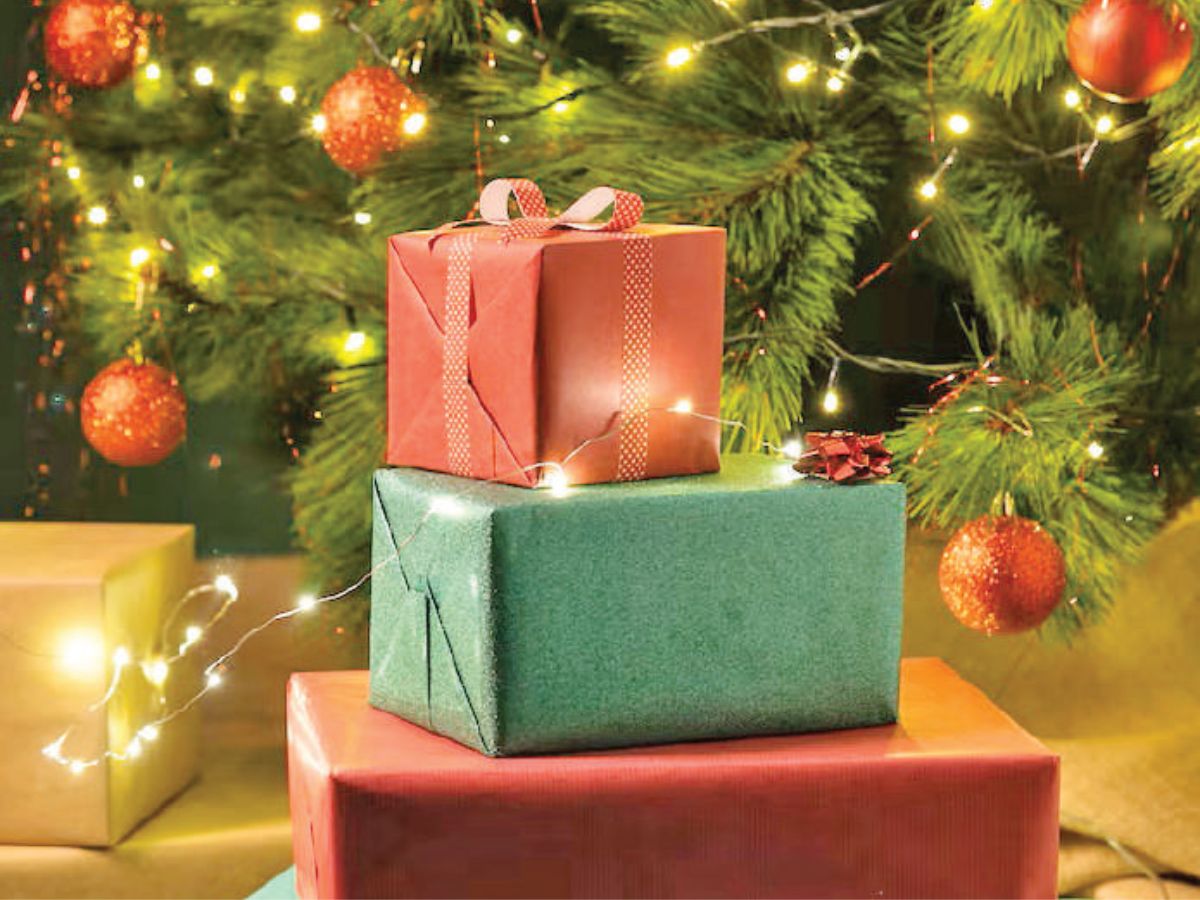
Christmas gifts.
Christmas has a way of tiptoeing into one’s home long before the twenty-fifth actually arrives. A sprig of green here, a glimmer of red there, and suddenly the house feels as though it has exhaled. Delhi may not boast of snow-dusted rooftops or log cabins, tucked away behind whispering pines, but we do what we can—and quite cheerfully at that. In our part of the world, we fashion our own winter wonderlands, sometimes with a little imagination, sometimes with entirely artificial fireplaces that hum faintly in the background. They don’t crackle, they don’t spit embers, and they certainly don’t smell of oak or cedar, yet they cast a sort of mellow glow that—oddly enough—feels authentic in its own way. A contraption, pretending to be a fireplace, somehow, finds its place in the heart...
The pine-scented candles come out next, their aroma filling the room with that crisp, woodland freshness one associates with Scandinavian forests or an Alpine lodge. Never mind that the closest look-alike pine tree outside my window, is rather a tired-looking one, that sways half-heartedly, whenever the wind decides to show up. These things don’t matter. Christmas is half atmosphere, half imagination, and if one can pull together a bit of both, well—one is already halfway there.
This year, the 25th arrived with its usual flourish, and our table looked like a diplomatic summit between two culinary nations that have never quite agreed on anything. On one side, the traditional Christmas fare: roast chicken, beautifully bronzed, accompanied by mashed potatoes so creamy, they could have floated off the plate, a modest pool of gravy, and—naturally—cranberry sauce, defiantly ruby on white china. Next to it sat the pudding, that dense, rich, unapologetically heavy creature that makes no concessions and accepts no substitutes. You don’t negotiate with Christmas pudding; you simply respect it, and take your spoonful like a good citizen.
On the other side, however, sat our beloved rajma chawal—steaming, comforting, and as familiar as an old woollen jumper. There was raita, there was a small salad doing its best to look important, and there were warm rolls stacked obligingly so, that everyone felt included. My mother, stalwart vegetarian that she is, presided over her part of the table like a benevolent monarch, entirely unbothered by the roast chicken just inches away. A technically mismatched meal, yes. But deliciously mismatched—and sometimes the charm lies precisely there. Life rarely arrives in coordinated sets; why should the table?!
The Christmas glasses my Maasi had gifted me many, many, years ago, made their annual appearance, their journey from California long behind them; these colourful tumblers brought out each December with a familiarity that needs no ceremony. One can pour anything into them—warm milk, banana shake, morning juice… Somehow everything tastes mildly festive when drunk from a glass wearing its Yuletide attire. The green-and-red tablecloths came out as well, and before long, the house seemed to hum with its own little orchestra of colour and warmth.
And then, as always happens after Christmas, when the glow softens and the ribbons are unknotted, I find myself thinking about forgiveness.
People say it all the time, almost casually, as though it were a line from a children’s play: “I forgive, but I do not forget.” I beg your pardon—but how?! How does one forgive while clutching to the memory like a turtle tucking its head deep into its shell, carrying its hardened bitterness wherever it goes?! How does one forgive while preserving the sting, the slight, the sharp little wound?! If one has not forgotten, has one truly forgiven—or merely postponed the next argument?
The elephant, of course, is famed for its memory, and heaven knows many of us take it far too seriously. We catalogue, archive, record every offence down to the last syllable, and then insist that we have moved on. We haven’t. We are simply storing our grievances like squirrels storing nuts, waiting for the right season to retrieve them...
But Christmas, if it stands for anything at all, stands for a kind of opening—of home, of heart, of one’s stubborn grip on old injuries. It is charity of spirit as much as charity of purse. It is generosity, hospitality, magnanimity—all the qualities we speak of far more easily than we practise. And so I find myself sitting here, after Christmas, wondering whether we have got it backwards. Forgetting may be impossible, yes. The mind remembers what it must. But forgiveness without some gentle softening of memory—without allowing the old wound to scab, to blur, to fade—feels rather like watering a garden and refusing to believe anything will bloom.
What, then, is forgiveness? A polite nod? A truce? A strategic retreat? Or is it something deeper—an internal loosening, the sort of gentle letting-go that allows life to move forward rather than circle endlessly around the same old fire? One can’t claim to forgive while keeping a tally sheet tucked into one’s pocket. Life isn’t an accounts book. Nor should one’s heart be.
As I sit amidst the last of the wrapping paper, the lingering aroma of pine, and the slight chime of those Christmas glasses being put back where they belong, I think of the year that has gone by—and the ten years before it. Nearly 10 years of writing this column, of speaking to you every month, of rambling slightly here and there (in a refined manner, one hopes), of trying to make sense of things with a warm table lamp beside me.
And now, here we are—the 28th of December, the last Sunday of the month, the last column of the year, and, as it turns out, the last column before I take a small sabbatical. Not a farewell, mind you. Just a gentle stepping away, a quiet retreat into the garden to gather my thoughts, perhaps plant a few ideas, let them grow, let myself grow. Columns are like seasons; they need rest too.
I shall miss this ritual—the swish of the pen, the gathering of anecdotes, the tiny parade of idioms marching across the page. I shall miss wondering whether the readers smiled at the right spots. I shall miss, most of all, the warmth that comes from knowing that somewhere, in some home, my words found a corner to settle in.
But for now, I set down my pen with the scent of pine still hovering gently in the air. Christmas may be over, but its spirit lingers, as all good things do. And if one must say goodbye, let it be with a little warmth, a little gratitude, and a promise tucked quietly into the pocket…
And yes, I shall see you next Christmas…
