Ukraine turns to cultural diplomacy, forging Indian ties as its war with Russia rages on.
As the war in Ukraine rages into its fourth year, the country’s most powerful weapon outside the battlefield is culture. This was the clear message from Volodymyr Sheiko, Director General of the Ukrainian Institute, during his recent visit to India.
Speaking with quiet intensity, Sheiko outlined Ukraine’s deepening efforts to forge cultural connections with India, not as a temporary outreach during troubled times, but as a long-term strategic and civilizational investment.
“This visit,” Sheiko said in an exclusive conversation with The Sunday Guardian, “is not just about diplomacy or visibility—it’s about building bridges through art, memory, and people.”
Sheiko’s visit comes at a crucial time: the Ukrainian Institute is in active discussions with Indian cultural bodies to host India’s first-ever Ukrainian Cultural Festival later this year. This initiative will mark a milestone in Ukraine–India relations, showcasing Ukrainian culture across multiple artistic disciplines and cities.
“India is not just another country for us. It’s on our list of priority nations for cultural diplomacy,” Sheiko explained. “Our ambition is to tell the Ukrainian story not only as one of war, but as one of deep cultural heritage, resilience, and creativity.”
In Delhi and Mumbai, Sheiko and his team met with major institutions including the Indian Council for Cultural Relations (ICCR) and the India Habitat Centre (IHC). Talks with other public and private institutions are also underway, though not all names were shared due to the preliminary nature of the discussions—and the political sensitivities surrounding Ukraine’s global outreach.
For Sheiko, culture is not a luxury in wartime—it is a form of resistance. “Practicing culture helps Ukrainians survive. It is how we endure grief and rebuild identity in real time,” he said. “Our artists—filmmakers, poets, theatremakers—are documenting this war not just for the present, but for the collective memory of the future.”
He added, “Trauma fades, memories fade. But art remains. Through it, we make sense of what is happening. And we leave a mark for generations.”
Indeed, much of Ukraine’s contemporary cultural production today is deeply intertwined with lived experiences of war. Yet, Sheiko is quick to point out that Ukraine is not defined by conflict alone.
“War shapes us right now, yes,” he said. “But we have always been a land of artists, thinkers, performers, and innovators. That’s the narrative we want Indian audiences to engage with.”
Sheiko’s visit wasn’t a one-off diplomatic tour; it was part of a broader strategy anchored in Kyiv’s foreign policy. The Ukrainian Institute, affiliated with the country’s Ministry of Foreign Affairs, plays a key role in shaping Ukraine’s cultural outreach globally.
“India, like Brazil, South Africa, and Nigeria, is a regional anchor—a country that shapes not just politics, but culture across the region,” Sheiko said.
He believes Ukraine and India share more than just growing political warmth—they share cultural commonalities too.
“There are surprising parallels,” he said. “In textiles, food, design, and folk traditions—our craftspeople, our visual languages, even our communal rhythms feel familiar.”
Importantly, Sheiko is not just looking at cultural elites in metropolitan cities. “India’s cultural vibrancy exists far beyond Delhi or Mumbai,” he said. “Our ambition is to work across the regions—south, east, northeast—everywhere art lives.”
This isn’t Sheiko’s first visit to India. In fact, the seeds of this cultural collaboration were sown two years ago during his earlier visit for the Raisina Dialogue Conference. That trip, though exploratory, gave rise to the idea of a full-fledged cultural festival.
“Now we’re seeing even more interest from Indian institutions. Everyone we met expressed genuine curiosity and willingness to collaborate,” he said. “It’s not just politeness. It’s real.”
The diplomatic overtures gained symbolic momentum last year when India’s Prime Minister Narendra Modi visited Ukraine, meeting with President Volodymyr Zelenskyy in Kyiv. The visit was hailed as historic.
“For us, it was more than a political act. It was a gesture of solidarity,” Sheiko reflected. “India has remained neutral on the war, but this visit showed that Ukraine matters to India.”
The visit also resulted in the signing of a five-year cultural cooperation agreement, laying the foundation for sustained exchanges in art, performance, and academia.
As Ukraine’s cultural diplomacy grows, so does its presence in India. With a Consulate General recently inaugurated in Mumbai during the ministerial visit, Sheiko is optimistic that cultural collaborations will expand westward too.
“We hope to activate the city’s vibrant cultural scene as part of our broader India outreach,” he said. Sheiko indicated that cultural activities in Mumbai are in the pipeline. “Not everything can happen in one year, but the foundation is strong,” he added.
Sheiko is under no illusions about the challenges ahead. “Not every conversation will lead to a project. Not every proposal will get funding. But we have momentum—and we have intent.”
As the war continues to dominate international headlines, Ukraine’s cultural push serves as both defiance and invitation. It asks the world, including India, to look beyond the bombs—to see the books, the brushes, the stages, the canvases.
“Indian society deserves to know that we are not just victims. We are creators, builders, storytellers,” Sheiko said.
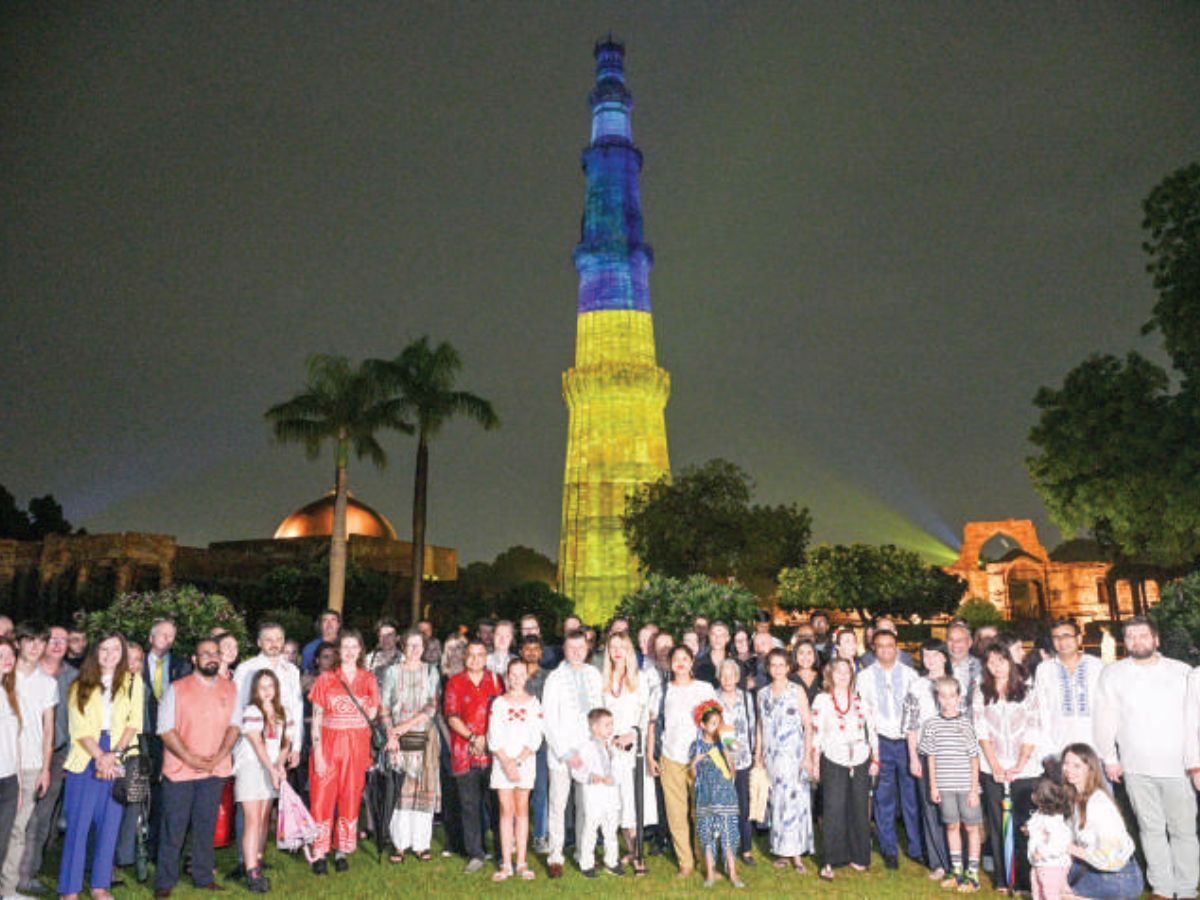
And India, with its rich cultural tapestry, appears ready to listen, as evident from the series of highly successful cultural exchanges on the occasion of Ukraine’s Independence Day (24 August) and Ukraine’s National Flag Day (23 August), which featured a special illumination of the Qutb Minar in the colors of the Ukrainian National Flag.
Also, on the eve of Ukraine’s Independence Day, the Embassy of Ukraine together with Ukrainians in India, friends from the diplomatic corps, and Indian partners created ‘Banyan of Freedom’—a living symbol of resilience beneath the eternal banyan tree, glowing in Ukraine’s blue and yellow.
On August 28, the Embassy of Ukraine, in collaboration with the Italian Embassy Cultural Centre, presented a documentary film and exhibition titled Culture vs War, which recounts the stories of veterans and their heroism on the battlefield, and the healing power of culture.
“India is not just another country for us. It’s
on our list of priority nations for cultural
diplomacy,” Sheiko explained. “Our
ambition is to tell the Ukrainian story not
only as one of war, but as one of deep cultural
heritage, resilience, and creativity.”
