
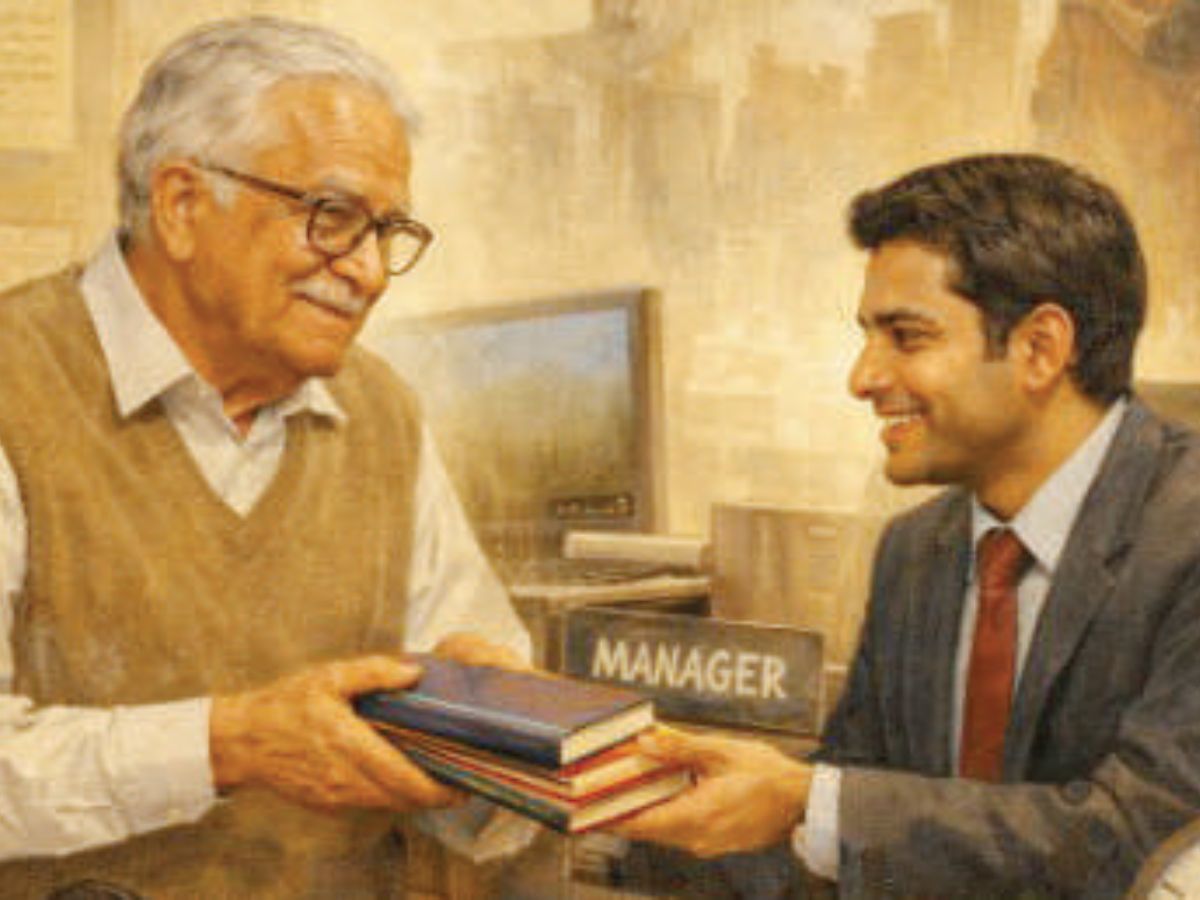
My father lived till the age of ninety-three. For most of those years, he retained a quiet dignity, a sharp memory for faces, and an unwavering sense of ritual. Among his cherished routines was a visit to his bank. It was not merely a financial errand. At least two of his annual visits were ceremonial. One was for submission of a life certificate, a document that one needs to submit to prove that he is still alive, to continue receiving one’s pension. The second was just after New Year’s Day. He liked to present the bank manager with a new diary and calendar, gifted with politeness that bordered on deference. Whether this was simple courtesy or a subtle attempt at ingratiation, I never quite knew.
I happened to accompany him on one of these visits. He carefully handed over the diary and calendar to the manager. The manager, while graciously accepting them, mentioned that he was formally handing over charge to a new manager, who was standing beside him. Without a moment’s hesitation, my father retrieved the gifts from the outgoing manager and promptly presented them to the incoming one.
The scene was both embarrassing and faintly humorous. Yet, beneath the awkwardness lay something profound. That small, reflexive act forced me to reflect deeply on my father’s behaviour and more broadly, on the psychology of aging. I haven’t stopped observing and analysing behaviour of the elderly, including many of my patients, ever since. Many of them behave in a similar manner, irrespective of their backgrounds or financial status. I am simply highlighting a few commonly observed behaviour patterns.
Insecurity About Life, Health, and Relationships
Aging is often accompanied by a quiet but persistent insecurity. It is not always articulated, but it is nearly universal. The elderly stand at a precarious intersection with diminishing health, shrinking social networks and an uncertain future. The body, once a reliable instrument, becomes unpredictable. Friends and contemporaries gradually disappear. Authority in family and society transitions to younger generations.
This insecurity often manifests as exaggerated politeness, submissiveness, or flattery, particularly toward those perceived as gatekeepers of stability. This includes doctors, bank manager, administrators, or family decision-makers.
As physicians, we must exercise caution in interpreting such behaviour. It is tempting to mistake their deference with our own importance. The elderly are not affirming the doctor’s superiority. They are just seeking reassurance, continuity, and safety. The flattery is not about the physician’s ego. It is about their own existential need.
From a biological standpoint, aging is associated with declining physiological reserve. The concept of homeostenosis (narrowing of the body’s capacity to maintain internal stability) implies that minor stressors can produce major consequences. This loss of resilience fosters uncertainty.
Erik Erikson described the final developmental stage as a conflict between ego integrity and despair. Even in those with a sense of fulfilment, the awareness of finitude cannot be ignored.
Socially aging usually entails loss of roles, professional identity, leadership, earning capacity. In many cultures, modernization has diminished the traditional authority of elders. Dependency – financial, emotional, or physical – furthers insecurity.
Viewed with this background, my father’s swift transfer of allegiance from one bank manager to another was not opportunism. It was instinctive self-preservation within a perceived power structure. The stability of his pension (his economic lifeline) depended on that institution. His gesture was a subtle reinforcement of alignment with authority.
Repetitive Questioning: The Science of Reassurance
Another common feature in elderly patients is repetitive questioning. The same query may be posed multiple times, sometimes within minutes. To the hurried clinician, this can feel exasperating. Yet, it is not obstinacy. This too has clear neurobiological underpinnings.
Aging is associated with reduced working memory capacity. Even in the absence of overt dementia, mild cognitive changes can impair encoding and retrieval of new information.
If the initial explanation was not fully encoded, due to distraction, anxiety, or sensory impairment (hearing loss or visual decline), it cannot be reliably recalled. A patient who did not clearly hear or visually register details may seek repetition not because they forgot, but because they never fully comprehended. Repetition then becomes a mechanism for reassurance and clarification. Thus, repetitive questioning is frequently a neurocognitive and affective coping strategy. It indicates vulnerability rather than resistance.
Self-Preservation and the Drift Towards Self-Centeredness
As one ages, self-preservation increasingly dominates behaviour, sometimes to a degree that appears selfish. The elderly may prioritize their own comfort, safety, and survival above collective considerations. This is neither moral failure nor character flaw. It is evolutionary logic.
With advancing age, perceived time horizons shrink. The Socioemotional Selectivity Theory suggests that when individuals perceive limited remaining time, they prioritize emotionally meaningful goals and immediate well-being over long-term or abstract ambitions. The focus shifts inward. Illness further amplifies this vigilance. From an evolutionary perspective, survival mechanisms remain active even when reproductive and generational roles have diminished. The organism is wired to persist.
This becomes particularly evident while discussing goals of care. In almost all cases of severe illness in the elderly, where families contemplate non-escalation (such as withholding intensive interventions), the individual (if cognitively aware) rarely agrees to limitation of therapy. Almost invariably, they request for “the best possible treatment.”
Observers may interpret this as denial or inability to accept mortality. More often, it is an expression of the most fundamental biological imperative – to live. The elderly person’s insistence on aggressive care is not always irrational. It reflects the enduring instinct for survival, even when prognosis is guarded.
Returning to the Anecdote
Seen through this lens, my father’s bank episode acquires clarity. His act was not comedic opportunism. It was a concise demonstration of adaptive behaviour in the face of institutional transition. The new manager represented the future custodian of his financial security. His reflex was alignment.
The embarrassment I initially felt arose from my generational lens. I interpreted his action through the framework of social etiquette. He acted through the framework of survival and continuity. Understanding this difference is central to understanding the elderly.
If we are fortunate, we too shall age. We may one day carry our own life certificates to bank counters. We may repeat questions we are certain we have not fully understood. We may align ourselves instinctively with those who control our health, finances, or care.
My two bits of advice while dealing with the elderly: do not take their flattery seriously. It is seldom about you; do not undermine their concerns. Anxiety in old age is rationally grounded in biological vulnerability; recognize that repetitive questioning reflects cognitive and emotional processing, not disrespect and finally understand that self-preservation becomes the dominant theme toward the end of life.
Patience is not merely kindness. It is insight. Empathy is not indulgence; it is a necessity in clinical practice. To understand the elderly is to recognize in them a preview of ourselves. Their behaviours, sometimes awkward, sometimes inconvenient, are profoundly human responses to the narrowing corridor of time. And perhaps, if we observe closely, they are teaching us how deeply life wishes to hold on to itself, even at ninety-three.




