
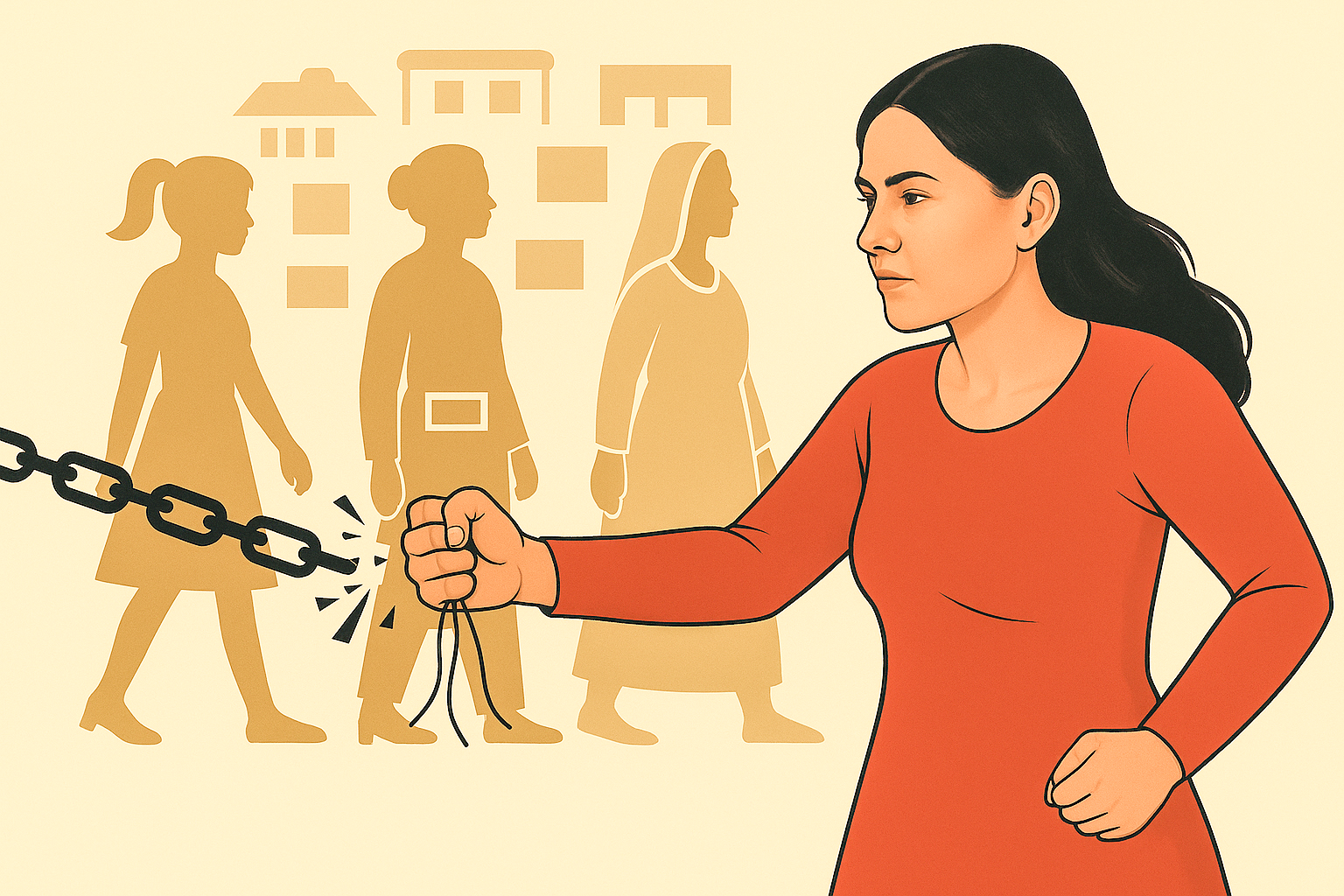
At times, the most unexpected headlines catch us off guard: a young woman’s life cut short, not by a stranger, but allegedly by her own father. Such occurrence s seem unexpected, even unthinkable. But are they really that sudden? Or have they been quietly developing for a long time before the final act? What appears to be an abrupt, violent outburst is often the result of a longsuppressed issue. These occurrences are not unique. They are part of a recurring pattern that is ingrained in families, households, and society as a whole.
Conditional Love and the Silent Trade-Off
Often, women are encouraged to be independent, but only within limits quietly set by others, like a bird trained to fly inside a cage. There are unstated terms behind this encouragement: you may grow, but only within the boundaries others have set. Daily routines, such as a father dropping her off at the stadium, a husband picking her up from work, or a brother keeping a watchful eye, reinforce these boundaries, which are disguised as love. She must play her role: the agreeable daughter, the obedient wife. And in return, the man she depends on plays his part. It’s a deal. Break the script, and the consequences begin to surface.
The arrangement feels safe until it’s tested. The moment a woman steps beyond her assigned, self-sacrificing role, the hidden terms of the contract emerge. Control appears, dressed up as care. Across the world, women are far more likely to be killed by someone close to them than by a stranger. A partner, a father, a brother— these names appear far too often in stories we read and sometimes even in lives we know. UN data shows that in close to 60 percent of all female homicides, the killer is a family member or intimate partner. It’s not a rare tragedy, it’s a long-standing pattern, quietly playing out behind familiar doors. And what do we often mistake for love? Gestures like checking her phone location or dropping her off at her destination under the pretext of safety, or declaring, ‘You don’t have to work if I’m earning enough’. Repeated across generations, such gestures can hide an old pattern: the idea that a woman is to be possessed and owned.
You Are Not the Body
This urge to own her stems from a belief passed down through generations, so normalized that we hardly recognize it. The belief is this: a woman is her body. From poetry to pop songs, from ads to daily interactions, women are usually praised not for their insight or intellect, but for their appearance: her skin, shape, hair, etc. Over time, these messages shape how a woman sees herself, how she should look, and how she should present herself. Today, women account for more than 95 percent of global cosmetics consumption.
The body is no longer just maintained; it’s segmented, marketed, and consumed. But commodification doesn’t stop at the beauty counter. Reveal your body on your own terms, and you risk shame or even punishment. From dress codes to honour killings, the message is clear: your body must be controlled, if not by the father, then by the husband, or by tradition itself. But this control doesn’t just diminish the woman, it also reduces the man to being a mere consumer: driven by desire, stripped of his humanity. Behind what is often called care or protection lies something more primal: a desire to monopolize her body. This is not about safety. It is about exclusive ownership. When a woman’s body is seen as someone’s property, the idea of her sharing it feels like a violation. This explains the ongoing obsession with modesty and virginity, and the unspoken pressure to appear ‘untouched’—a symbol of control and possession dressed up as virtue. In a society where the body is controlled, marketed, and moralized, we need to consider what true rebellion actually looks like.
Redefining Rebellion: From Quiet Compliance to Conscious Resistance
Many young women are raised to believe that staying quiet will keep them safe. They are told that speaking up might invite harm. However, even years of compliance are often insufficient to ensure protection or respect. If obedience does not shield her, what does it really offer? The answer often lies hidden in plain sight, even in symbolic gestures. Brides are often adorned with layers of metal and glass ornaments, especially on their arms, the very part of the body symbolically associated with action and resistance. These ornaments can subtly impede movement, making rebellion not only unwelcome but also painful. And yet, many embrace them unquestioningly, even asking, ‹Are these bangles looking good on me?› They remain unaware that what pleases the eye may also discourage rebellion. Historically, when physical strength defined power, men held the advantage. But that world has changed.
With machines replacing brute force, one would expect old roles to fade, but they still persist. Women are still conditioned to seek protection, even when they are fully capable of standing on their own. True rebellion begins when one stops performing a role written by others and starts living from the center of understanding. Your body is a resource. It is meant to serve consciousness, not define your identity. Freedom lies in transcending inherited conditioning, whether biological, emotional, or cultural. Of these, emotional responses are rarely questioned. Seldom do we pause to examine how deeply our feelings, too, have been scripted.
Emotions Are Primitive, Not Sacred
When a woman begins to grow inwardly, stepping into clarity and shedding emotional volatility, those around her often say, “You’re not the same.” But she’s not losing herself. She’s gaining depth. We treat emotions as sacred and beyond question. But are they truly ours? Most are physiological responses, shaped by biology, conditioning, and outside triggers. A scent, a memory, or even a hormone can trigger joy, anger, lust, or fear. This doesn’t mean that we need to reject emotion. We just need to refuse to be enslaved by it. Evolution built these emotions into us for survival.
A mother’s affection protects her child; lust ensures reproduction. But the function is primitive: to propagate DNA and sustain the species. To be human is not to justify these emotions. It is to be aware. To witness feelings without being consumed by them. There is a world of difference between sensitivity and sentimentality. Sensitivity is essential: an acute awareness of ourselves and the world. Sentimentality, on the other hand, clouds that awareness. The more sentimental you are, the less sensitive you become.
Walk Away from the Script
Even highly successful women who have graduated from prestigious universities frequently quit their jobs for personal or family-related reasons. In the absence of self-awareness, what appears to be a personal choice might actually be history reenacted in the present. Many women still internalize roles based on antiquated biological and cultural narratives. For centuries, women have lived out roles written by others, denied agency, and excluded from decisions. Repeating these roles today, even under the banner of choice, is to remain loyal to a history that never truly served them.
The longstanding bargain rewards compliance with comfort, approval, and praise. This is no blessing; it is a transaction. It is a pact that must be seen for what it is, and then broken. We must begin to question the comforts we’ve accepted at the expense of truth and choose authenticity over approval. This is where Vedanta speaks with unmatched clarity. While we often talk of challenging roles or fighting inequality, Vedanta turns our attention to the very idea of identity itself. It doesn’t tell women to become stronger versions of the roles they’ve been handed; it starts from a far more fundamental question: Are you the body at all? And if not, what meaning do gender or roles hold in the first place?
When gender identity itself is exposed as a projection, the entire framework of conformity and rebellion begins to dissolve. For many, this becomes the real moment of freedom. It’s not just about gaining strength; it’s about moving from confusion to inner clarity.
The goal is not to play a new part, but to know who you really are, so your choices aren’t shaped by fear, pressure, or habit, but by understanding. Only then does life begin: not as repetition, but as revelation. Acharya Prashant, a philosopher and teacher of global wisdom literature, is the founder of the PrashantAdvait Foundation.
A bestselling author who brings timeless wisdom to urgent modern questions, he has been recognised for his contributions to thought and ethics—with honours from PETA (‘Most Influential Vegan’), the Green Society of India (‘Environmental Leadership’), and the IIT Delhi Alumni Association (‘National Development’).




