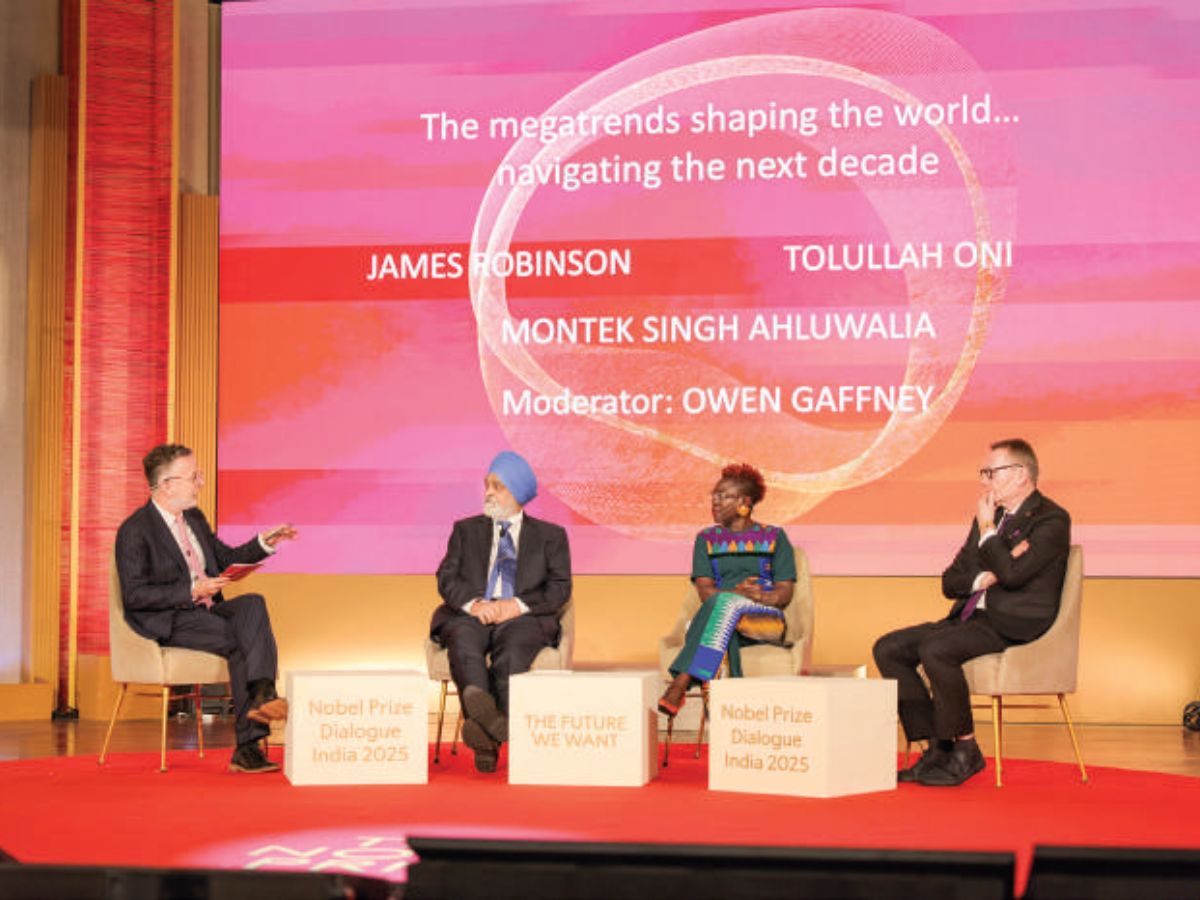
L to R - Owen Gaffney, Montek Singh Ahluwalia, Tolullah Oni, James Robinson
Dr Tolullah (Tolu) Oni treats cities as her patient. Herlinde Koelbl, the renowned German photographer who created Fascination of Science, a photo art project featuring 60 internationally renowned scientists, including Nobel Prize winners and supported by Siemens, captured something essential about Dr Oni’s journey. Talking about why Oni studied science, Koelbl noted that as a doctor, Oni felt she could help only one person or a few, but she wanted to look at the bigger picture and turned to urban health.
Born in Lagos, Dr Oni is a pan-African British public health physician and urban epidemiologist. She’s a Clinical Professor of Global Public Health and Sustainable Development at the University of Cambridge and Founder & CEO of UrbanBetter. In another interview, she described herself as having ‘a combination of sheer stubbornness, ambition, and drive, and not accepting anything other than what she wants to get done.’
That drive was evident in Bengaluru, where on a recent Monday morning, several people filed into the JN Tata auditorium on the verdant campus of the Indian Institute of Science in Bengaluru for the Nobel Prize Dialogue in partnership with Tata Trusts on the theme, ‘The Future We Want’. We had come prepared to be impressed by two Nobel laureates. We were duly impressed by David MacMillan (chemistry Nobel winner 2021) and James Robinson (economic sciences Nobel winner 2024).
An equally captivating speaker was Dr Tolu Oni. “I’m trained as a physician, I’m a doctor, and I’m trained to heal,” she began. “But actually, the vast majority of factors that influence our health lie outside of the healthcare sector. They lie in the environments where we live, where we work, where we play, where we connect.” Her revolutionary insight: she treats cities as her patients. Just as in medicine you’re taught that the body is a complex adaptive system where all parts are connected, she sees cities the same way—complex adaptive systems that can be harnessed for planetary health. By planetary health, she means the health of humans and the ecosystems we depend on, and the balance between the two.
Dr Oni began her talk with a thought-provoking premise that progress is driven by hope, not optimism. If progress is going to emerge from more inclusive institutions, she argued that cities would be the canvas of such experimentation. Future-ready cities must recognise that urban infrastructure and health infrastructure are the same. Such cities must be equipped to take synergistic action on the converging risks. Cities must also cultivate hope as a catalyst for urban transformation.
The numbers she pointed out are stark: 80% of factors shaping population health lie in transport systems, education, energy infrastructure, built environments, and food systems. Healthcare is critical, but “health doesn’t trickle down from good intentions,” she emphasised. “There is an inherent belief that we’ll just do any of these well, and health will follow. But actually, if you don’t centre and think about how the built environment can optimise health, just doing it well does not necessarily create health.”
On her first morning in Bengaluru, she went for a run carrying an air quality monitor. The results? Good air quality around the parks. She pointed out, she was measuring what’s invisible: pollution that doesn’t immediately make you sick, heat exposure that affects health weeks later. Urban planners never see the heart attacks or asthma cases their decisions create.
She presented Lancet Pathfinders’ research identifying three critical pathways: reducing air pollution, shifting diets and land use, and promoting active travel and public transport. Cities are where all three converge. “We need to break away from silos,” Dr Oni urged. “We cannot afford business as usual.” The question lingers: Are we teaching urban planners how to create health, or just training doctors to treat preventable diseases?
Her most radical proposal: treat hope as critical urban infrastructure. This includes digital tools (air quality monitors, citizen science apps), intellectual infrastructure (co-produced knowledge, locally rooted advocacy), and social infrastructure (systems enabling collective learning across cities).
In Lagos, young people equipped with these tools collected data during the city’s marathon. When roads were closed, air pollution dropped 60%. Armed with this evidence, they approached the government about Lagos’s unimplemented non-motorised transport policy and signed an MOU to co-create healthier mobility policies. Similar initiatives in Nairobi have influenced clean air policies. Young people transformed from passive citizens into active city shapers through hope grounded in data and agency. Dr Oni insists solutions must come from the communities most affected.
Pollution is suffocating Delhi, but for every Delhiite who flees to Goa or Dubai, thousands more move into the capital and other big cities every hour. Even Bengaluru’s air quality is poised to deteriorate.
We face a choice: Will we invest in the infrastructure of hope? Will we equip young people with tools to shape their cities? Young people can organise themselves and do things on their own, Dr Oni pointed out to a question from a youth in the audience.
Our cities need doctors like Tolu Oni—people who understand that health isn’t about hospitals but about the air we breathe and the streets we walk. People who see transport policy as health policy, urban planning as preventive medicine. People who combine sheer stubbornness with the vision to look at the bigger picture.
When Montek Singh Ahluwalia, renowned economist and former Deputy Chairman of the Planning Commission, questioned her choice of hope over optimism during a panel discussion, Dr Oni stood her ground. She calmly reasserted her framework - her use of hope was grounded in scholarly thought as opposed to the colloquial use of hope; it was not flippant wishful thinking but a cultivation of hope grounded in knowledge with actionable pathways. Hope, she asserted, is grounded in knowledge with actionable pathways. Being optimistic without being grounded in evidence about what is needed to achieve that future would actually do more harm and lead to despondence and hopelessness.
We need more women like Dr Oni. When a worldrenowned economist, a legend in the host country, dismissed her premise, she refused to let her light be dimmed. What struck me from the moment she walked onto the stage was her bold individualism. She wore a vibrant-hued, stylised dress, dramatic yellow earrings, and bright orange nail polish that evoked Africa. Amidst the muted colours of conference attire, she was a breath of fresh air. This assertion of identity was a reminder that expertise comes in many forms, from many places, expressed in many ways. And can be owned brilliantly in multicolours by a female scientist. Her Instagram handle says it all: ‘doctorontherun.. from acceptance of status quo. From naysayers. On the run towards a fairer, healthier world. On the run cos I can.’
Sandhya Mendonca, author, biographer, and publisher at Raintree Media, offers a distinct female gaze of the world in this column.
