Delhi Police allege a conspiracy to defame India after IYC workers staged a protest at the AI Summit in Delhi. Court hears remand, bail arguments.
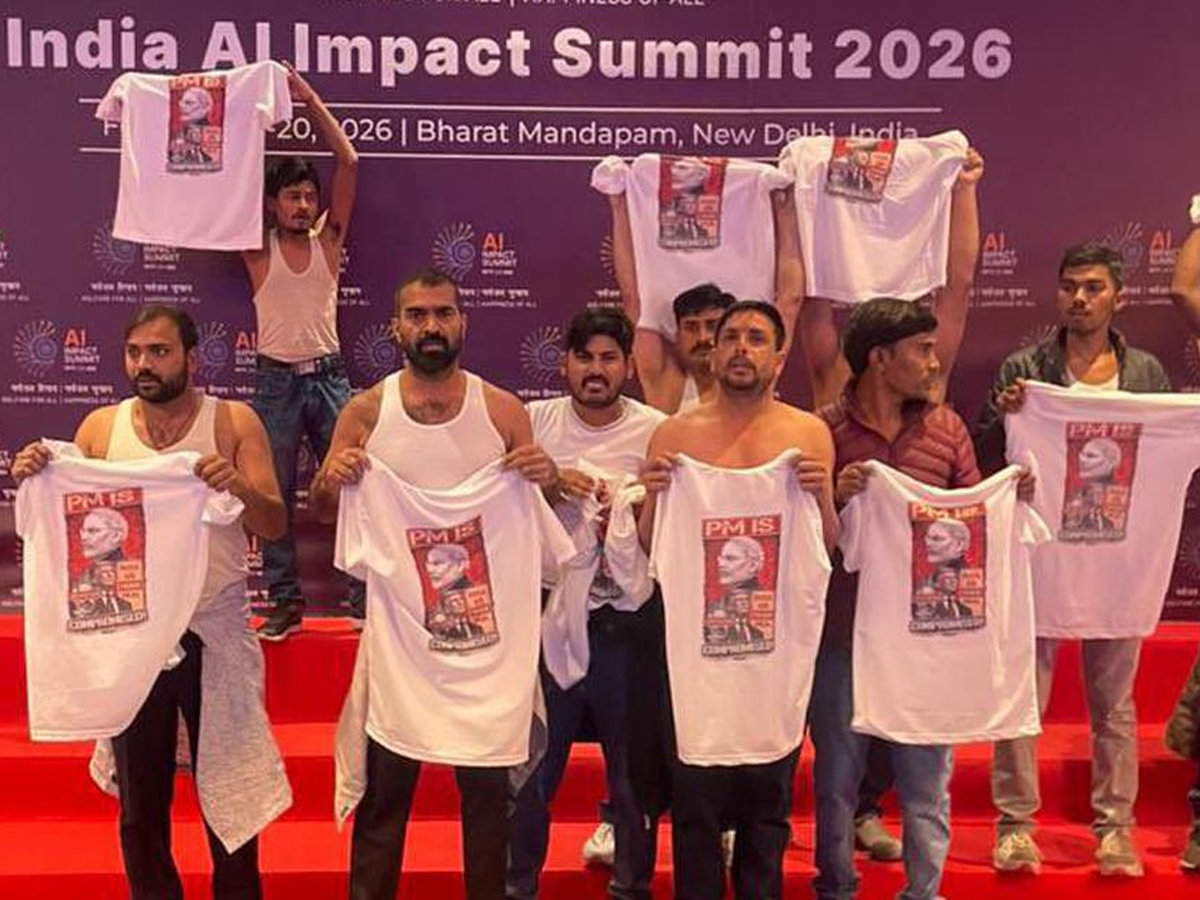
The incident occurred on Friday inside the exhibition area of the AI Impact Summit at Bharat Mandapam, a venue hosting international delegates, policymakers, and business leaders. (Photo: Social Media)
A protest at a high-profile international technology event in the national capital has escalated into a serious political and legal confrontation, with Delhi Police alleging a larger conspiracy behind the incident.
While seeking custody of four Indian Youth Congress (IYC) workers arrested for staging a shirtless protest during the AI Impact Summit, police told a Delhi court on Saturday that the demonstration was designed to damage India’s image globally. Investigators claimed the act mirrored similar protests seen in Nepal, suggesting a coordinated pattern rather than a spontaneous act of dissent.
The incident occurred on Friday inside the exhibition area of the AI Impact Summit at Bharat Mandapam, a venue hosting international delegates, policymakers, and business leaders. According to police, several individuals walked through the hall holding T-shirts with slogans critical of the government and the India-US trade deal.
Security personnel swiftly removed the protesters from the venue, triggering a political storm and leading to the arrest of four IYC members, Krishna Hari, Kundan Yadav, Ajay Kumar, and Narasimha Yadav.
Producing the accused before the Patiala House Court, Delhi Police sought five days of custodial remand, arguing that the protest went beyond peaceful dissent.
“It was a conspiracy to defame the country internationally,” police told the court, stressing that anti-national slogans were raised in front of foreign dignitaries and prominent global figures.
#WATCH | Delhi: Visuals of the four Indian Youth Congress leaders, arrested in connection with their protest at the AI Summit at Bharat Mandapam
— ANI (@ANI) February 21, 2026
They were brought to Patiala House Court. The order on their custody and bail plea has been reserved by the court.
Those arrested… pic.twitter.com/ect15nCEe8
Seeking custody, police said, “Their custody is necessary to arrest the other accused who fled. Police said that three policemen were injured and their (accused) mobile phones need to be recovered to verify whether they received funding. Four people from four different locations came together and printed T-shirts. Five days' custody is necessary to investigate the matter.”
Investigators also informed the court that some suspects escaped from the scene, strengthening the need for custodial interrogation.
Counsel for the accused strongly opposed the remand plea and moved bail applications, arguing that the arrests were politically motivated.
“The protest was peaceful; no videos showed any violence. All the alleged offences carry a punishment of up to 7 years. The accused's lawyer submitted that the FIR is nothing more than a political move. The lawyer also submitted that they are educated people and have degrees,” the defence told the court.
The lawyer further argued that the four were exercising their democratic right to protest and accused authorities of targeting them due to their political affiliation.
“There should be a reason for custody. They are young, they have careers, and political dissent shouldn't be crushed like this. It was a peaceful protest,” the defence said while seeking immediate bail.
The public prosecutor countered the defence claims by stating that the protesters wore T-shirts carrying messages against the Prime Minister and raised slogans that crossed the line from protest to provocation.
Police also informed the court that three personnel sustained injuries during the incident and that electronic devices seized from the accused could reveal funding links or coordination behind the protest.
When questioned by the court on the need for five days’ custody, the investigating officer reiterated that the case involved “a deep conspiracy” requiring sustained interrogation.
The court is expected to rule on the remand and bail pleas after hearing both sides in detail. The case has already ignited a wider debate on the limits of protest at international forums and how dissent should be handled during global events hosted by India.
As the investigation continues, the AI Summit protest has become a flashpoint in the ongoing clash between political expression and national image on the world stage.
