Ajit Pawar plane crash: Experts examine engine failure, aerodynamic stall and runway visibility theories as investigators analyse CCTV footage and black box data.
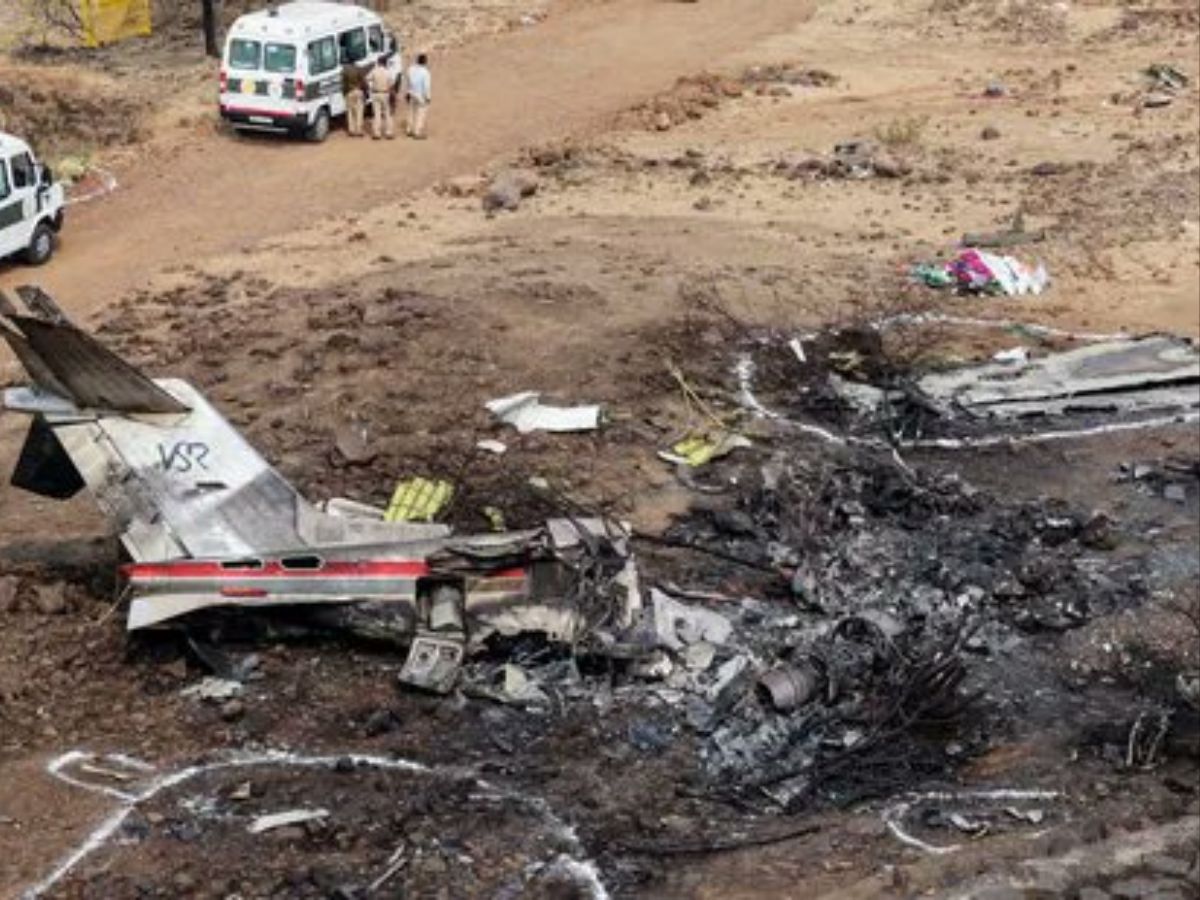
Ajit Pawar plane crash, Experts examine engine failure, aerodynamic stall and runway visibility theories [Photo: X]
The investigation into the tragic plane crash near Baramati that killed Maharashtra Deputy CM Ajit Pawar and 4 others has entered a crucial phase, with aviation experts closely examining new visual evidence and flight data.
While the final cause will emerge only after a detailed probe, newly surfaced CCTV footage showing the aircraft’s final seconds has triggered intense discussion around three possible scenarios, aerodynamic stall, engine failure, or a late visual alignment with the runway.
The ill-fated aircraft, a VT-SSK Learjet 45 business jet, crashed during its second landing attempt on Wednesday. Authorities have recovered the black box, and a three-member team from the Aircraft Accident Investigation Bureau (AAIB) is analysing the flight data recorder (FDR) and cockpit voice recorder (CVR) to determine what went wrong moments before impact.
The CCTV footage, which has circulated widely, appears to show the jet’s left wing dipping suddenly just before the crash. The aircraft also seems to bank sharply while flying at a low altitude, leaving little room for recovery.
Aviation specialists say this visual pattern points to a sudden loss of lift or thrust during a critical phase of landing, when aircraft stability depends heavily on speed, angle and pilot response.
Another possibility under scrutiny is engine failure during landing. When one engine loses power, the remaining engine can cause uneven thrust, pulling the aircraft sharply to one side and triggering a roll.
According to aviation guidelines, such a situation creates yaw and roll forces that pilots must counter using rudder and aileron inputs. However, experts note that no distress call was made between landing clearance and the crash, making a sudden engine failure less likely, though not impossible.
Mark D Martin of Martin Consulting said, “The Learjet 45 is a very fast aircraft, and it is not designed to fly well at low speeds, especially during landing. From what I have seen, it appears that the aircraft suffered an engine failure while coming into land. When one engine fails, the power from the other engine can pull the aircraft to one side.”
The FDR data will play a key role in confirming or ruling out this scenario.
A third theory focuses on runway visibility and infrastructure limitations at Baramati airport, which lacks advanced navigation aids and relies heavily on visual approaches.
Amit Singh, a safety expert, told HT, “A visual approach, by definition, means the pilot must have the runway clearly in sight. That raises a basic question: who cleared the aircraft to land in poor visibility conditions on the runway, and on what basis? In this case, it appears that sun glare during the final moments may have affected visibility, and the crew realised too late that the aircraft was not aligned with the runway.”
A pilot familiar with such operations added, “It appears to be a late viewing of the runway and trying to get to it with a large bank angle.”
A sharp banking manoeuvre at low altitude can quickly lead to loss of control, especially in high-performance jets like the Learjet 45.
One of the strongest theories under examination is an asymmetric aerodynamic stall, a dangerous condition where one wing loses lift before the other. An aerodynamic stall occurs when an aircraft’s speed drops too low or the angle of attack becomes too steep, preventing the wings from generating enough lift.
The Learjet 45 has engines mounted on its tail rather than under the wings. Experts say this design can make recovery more difficult during slow-speed manoeuvres close to the ground.
CS Randhawa, president of the Federation of Indian Pilots, explained, “The aircraft is supported by four forces: lift, weight, thrust and drag. Due to low speed, it appears to me that the aircraft crossed the critical angle of attack, thus the drag increased and the lift reduced, causing a wingtip stall. The nose dropped to the left due to this situation.
The stick shaker would have activated in this case, which would come out in the flight data recorder decoding. Also, the CVR would reveal what transpired between the pilots on the approach.”
AAIB investigators will now analyse black box data to reconstruct speed, angle of attack, engine performance and pilot inputs during the final moments. The cockpit voice recorder will also help determine whether the crew recognised the danger in time and how they attempted to respond.
Until then, aviation experts caution against drawing firm conclusions, stressing that multiple factors may have combined to cause the tragedy.
