
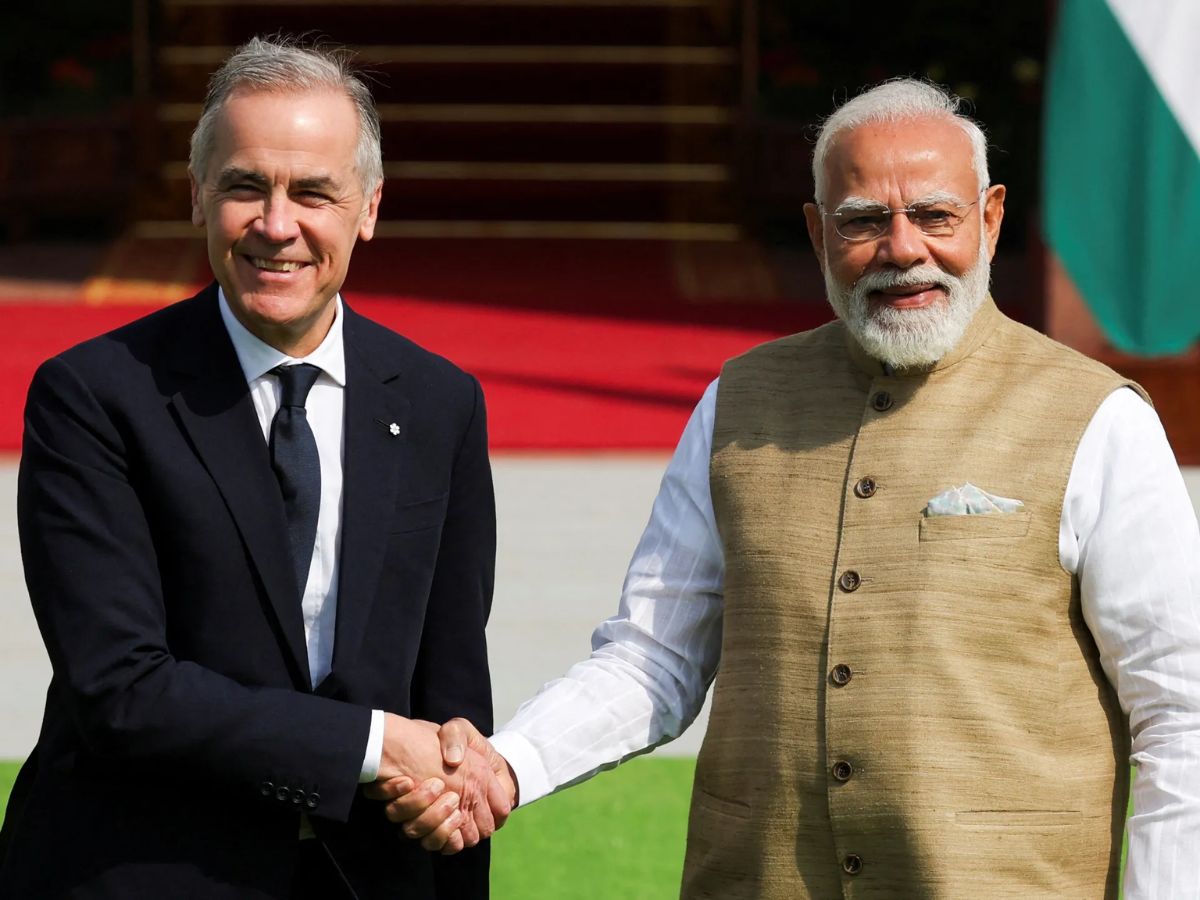
New Delhi: India and Canada on Monday unveiled what officials described as a calibrated strategic reset, formally relaunching negotiations for a Comprehensive Economic Partnership Agreement and restoring structured political and economic dialogue after years of diplomatic turmoil.
The reset follows a prolonged rupture triggered in September 2023 when former Canadian Prime Minister Justin Trudeau publicly alleged potential Indian government involvement in the killing of Hardeep Singh Nijjar in British Columbia. New Delhi rejected the allegation, leading to reciprocal diplomatic expulsions, suspension of trade talks and a sharp contraction in high-level engagement.
The joint statement issued in New Delhi makes no reference to any of the contentious issues, signaling a deliberate decision by both governments to compartmentalize unresolved disputes while rebuilding cooperation in trade, finance and the Indo-Pacific.
Ahead of the visit, The Sunday Guardian had outlined the structural pressures driving Ottawa toward a reset. The newspaper reported that the diplomatic rupture had imposed measurable economic costs on Canada, particularly in international education, where Indian students constitute the largest cohort. A sharp fall in new study permits following the deterioration in ties had significant downstream effects on universities, provincial revenues and housing-dependent urban economies. The paper also noted that trade negotiations toward an Early Progress Trade Agreement and the broader CEPA had been paused, delaying potential commercial gains.
It further argued that Canada’s heavy export dependence on the United States intensified the need to diversify trade partnerships, making normalization with India strategically urgent. The expectation, according to the report, was that Prime Minister Mark Carney’s visit would prioritize economic stabilization, restart trade architecture and restore investor confidence rather than seek public resolution of the political dispute.
Monday’s joint statement closely tracks that forecast.
At the core of the reset is the formal resumption of negotiations toward an “ambitious and mutually beneficial” Comprehensive Economic Partnership Agreement. The two sides confirmed finalization of the Terms of Reference and launch of formal negotiations, with a commitment to conclude talks by end-2026. Both governments set a quantified objective of expanding bilateral trade to CAD 70 billion, approximately Rs 4.65 lakh crore, by 2030.
To impart commercial momentum, the leaders announced four reciprocal ministerial-led trade and investment engagements, two in each country, accompanied by business delegations. The India–Canada CEO Forum will be reconstituted to provide industry inputs into CEPA negotiations and broader economic cooperation.
The reset extends into financial coordination. A Finance Ministers’ Economic and Financial Dialogue will convene officials to collaborate on payments modernization, fintech innovation, financial stability and capital markets development. Early priorities include exploring interoperability of instant payment systems and facilitating cross-border remittances and merchant payments, with India’s National Payments Corporation and Payments Canada expected to participate. The inaugural dialogue is scheduled for 2026.
Strategically, the statement situates normalization within a wider Indo-Pacific alignment. The leaders noted growing convergence between India’s Indian Ocean vision and Canada’s Indo-Pacific Strategy, emphasizing maritime safety and security, climate resilience, connectivity, digital inclusion and disaster preparedness. Canada’s interest in joining the Indian Ocean Rim Association as a Dialogue Partner was welcomed.
Prime Minister Carney expressed appreciation for India’s hospitality and reaffirmed Canada’s commitment to advancing the partnership. Both sides projected the reset as contributing to regional stability and global resilience.
Diplomatic sources indicated that both governments have calculated that economic costs of estrangement and shifting geopolitical incentives in the Indo-Pacific outweigh the benefits of continued confrontation.
The reset therefore reflects strategic pragmatism, with trade architecture, institutional dialogue and financial integration forming the backbone of renewed engagement, broadly in line with expectations articulated ahead of the visit




