India clearly belongs in the first group of AI powers, says Ashwini Vaishnaw at Davos, pushing back against IMF’s second-tier classification.
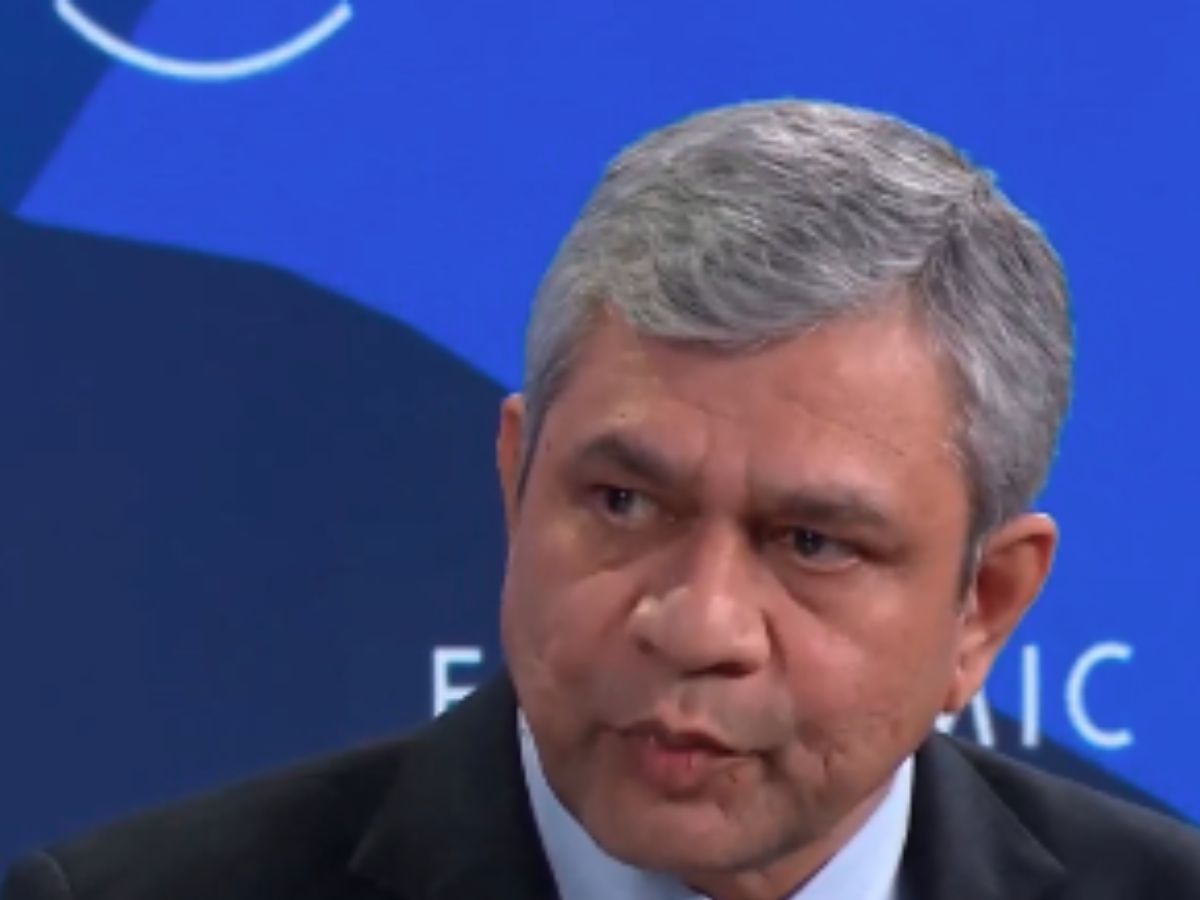
India Ranks Among Top AI Powers, Says Ashwini Vaishnaw at Davos (Source: X/ @PIB_India)
"India clearly has to be in the first group of artificial intelligence (AI) countries," Union Electronics and Information Technology Minister Ashwini Vaishnaw has asserted. "Nobody will accept that India is a second-class player in any way in terms of A.I.," Vaishnaw said.
Such statements were made by Vaishnaw while reacting to remarks made by IMF Managing Director Kristalina Georgieva at the World Economic Forum meeting at Davos.
India’s systematic approach to AI adoption: To overcome GPU scarcity, the government has established a Public-Private Partnership with 38,000 GPUs as a common compute facility, accessible to students, researchers, and startups at roughly one-third the global cost, unlike many… pic.twitter.com/mcIY4dpEZU
— PIB India (@PIB_India) January 21, 2026
In a panel discussion during the global implications of AI, Georgieva pointed out that AI is already shaping economies around the world. She mentioned that several emerging market countries are showing strong progress in AI, including Saudi Arabia, while India is also investing heavily in high-end information technology.
She added, however, that many low- and middle-income countries were "way, way behind" in the race to leverage AI. Another panelist referred to India as a fast-growing major economy and an AI player but suggested it belongs to a "second grouping" of countries that may have to align with either the U.S. or China on AI strategies.
Vaishnaw strongly countered this view, asserting that India should not be placed in any second-tier category. He explained that the country’s AI development is comprehensive and end-to-end, covering five critical layers:
Application layer
Model layer
Chip layer
Infrastructure layer
Energy layer
“We are working on all five layers, making very good progress in all five layers,” Vaishnaw said, highlighting India’s goal of scaling AI adoption across industries.
He also questioned the IMF’s assessment criteria and referred to global academic rankings. Citing Stanford University, Vaishnaw said:
India ranks third globally in AI penetration and AI preparedness.
India ranks second in AI talent.
“So I don’t think your classification in the second bouquet is right. It’s actually in the first,” he stated.
The minister stressed India’s dominance in the application layer of AI, which he described as the area where real economic returns are generated. According to Vaishnaw, India is well-positioned to become the largest supplier of AI-driven services worldwide by understanding enterprise-level needs and deploying AI solutions to improve productivity and efficiency.
He added that most AI work can be done using models with 20 to 50 billion parameters, and India already has several such models actively deployed across sectors.
On the sidelines of Davos, Vaishnaw also held bilateral meetings with technology leaders:
Joel Kaplan, Chief Global Affairs Officer, Meta – Discussions focused on protecting social media users from deepfakes and AI-generated content, with Meta briefing India on safeguards.
Arvind Krishna, CEO, IBM – Talks covered collaboration in advanced chip technologies, including 7 nm and 2 nm nodes.
Vaishnaw told reporters that Davos primarily serves as a forum for exchanging ideas, not formal trade or delegation-level meetings. He added that India engages with major economies on multiple fronts through other platforms.
Vaishnaw also highlighted that India’s economic progress under Prime Minister Narendra Modi is a major topic of discussion in Switzerland. He said the Indian delegation participates in all significant meetings at Davos to showcase how the country is combining modern technology with fair and inclusive growth, with India’s leadership role in technology emerging as a recurring theme.
