
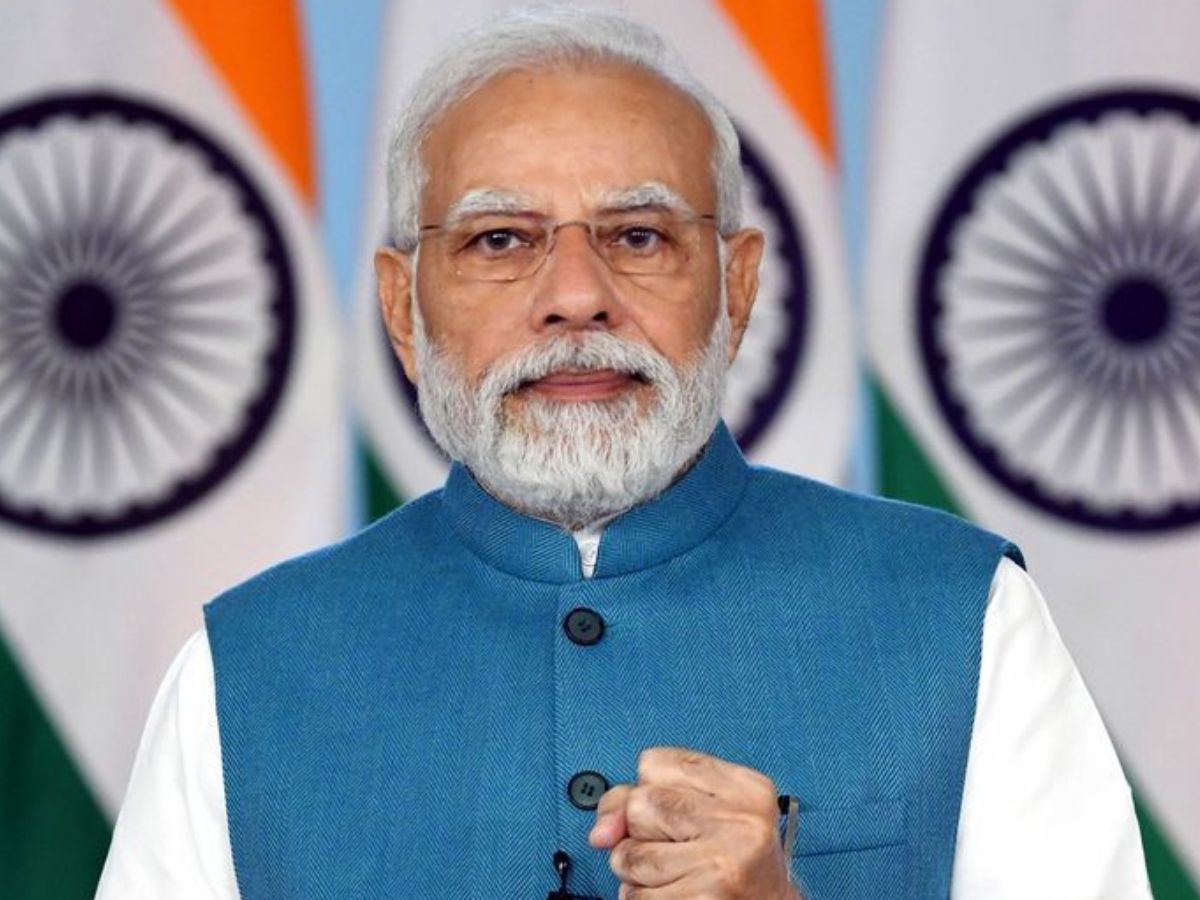
Pariksha Pe Charcha, Prime Minister Narendra Modi’s annual interaction with students ahead of board examinations, was conceived to move the national conversation on exams away from fear and pressure and towards dialogue, confidence, and life skills. Since it began in 2018, the programme has evolved into a platform where students engage directly with the country’s leadership, raising questions not just on academics but also on life, aspirations, habits, and the future.
The ninth edition of Pariksha Pe Charcha, held at the Prime Minister’s residence, followed that spirit closely. The nearly one hour long interaction was not a monologue. Students spoke for most of the session, asking a wide range of questions, while Narendra Modi responded patiently to each of them.
Several students said they had initially perceived the Prime Minister as a very serious person. That perception changed quickly once the interaction began. The atmosphere was informal and conversational, with laughter from both sides. Modi encouraged students to speak freely and offered practical and creative suggestions rather than formal lectures.
During the interaction, the Prime Minister emphasised that examinations are meant to help students understand themselves, not merely measure them through marks. He said preparation should be for life and not just for exams, repeatedly stressing the importance of communication, practice, balance, journaling, and time management as essential life skills.
One of the notable moments came when Mansi, a visually impaired student, recited a poem and spoke confidently about her presence on social media platforms such as Facebook and Twitter. Her interaction underlined how confidence, when nurtured early, allows students to express themselves without hesitation. The exchange reflected the Prime Minister’s broader emphasis on building confidence at a young age.
On ambition and aspiration, Modi told students that not dreaming is a mistake, but dreaming without effort has no value. He explained that merely saying one wants to become an astronaut achieves nothing unless the student works towards that goal by understanding what the profession involves, reading, learning, and preparing systematically. He advised students not to announce their dreams publicly until they have begun working seriously towards them, cautioning that declarations without groundwork weaken focus and seriousness.
Placing individual ambition within a national framework, the Prime Minister spoke about his vision of India becoming a developed nation by 2047, the centenary year of Independence. He said this was not just an idea but a dream he is actively working towards. To illustrate the importance of long term vision, he cited the example of Mahatma Gandhi, who returned from South Africa in 1915 with the resolve that India must gain freedom, a goal achieved 32 years later in 1947.
Modi told the students that when India reaches 2047, most of them would be around 35 to 40 years old, the most productive working age. A developed India, he said, is therefore directly linked to their own futures, making it their responsibility as much as anyone else’s to contribute to the country’s progress.
The Prime Minister also spoke about Swadeshi, urging students to consciously use made in India products in their daily lives, linking personal consumption choices to national development under the Make in India vision. Cleanliness was highlighted as a civic responsibility. If someone is littering, he advised students not to argue or fight, but to quietly pick up the waste and place it in a dustbin, spreading the message through action.
In another exchange, when a student spoke about spending a lot of time on online gaming, the Prime Minister suggested reading Panchatantra and developing one of its stories into a game, encouraging students to become creators rather than passive consumers of digital content.
Students from across the country participated in the interaction, including from Assam, Punjab, Tamil Nadu, Madhya Pradesh, Daman and Diu, Karnataka, Chhattisgarh, Goa, West Bengal, Manipur, Ladakh, Rajasthan, Uttarakhand, Tripura, and several states from the Northeastern region, which had a significant presence.
Beyond the immediate discussion on exams and habits, the interaction carried a deeper significance. For many of the students, it was a rare opportunity to engage closely and informally with the Prime Minister of India. The absence of formality and the encouragement to ask any question helped bridge the distance that often exists between authority and young minds. Such experiences are likely to have a lasting impact, strengthening confidence, reducing hesitation, and shaping how these children view leadership, institutions, and their own role in the country’s future.




