
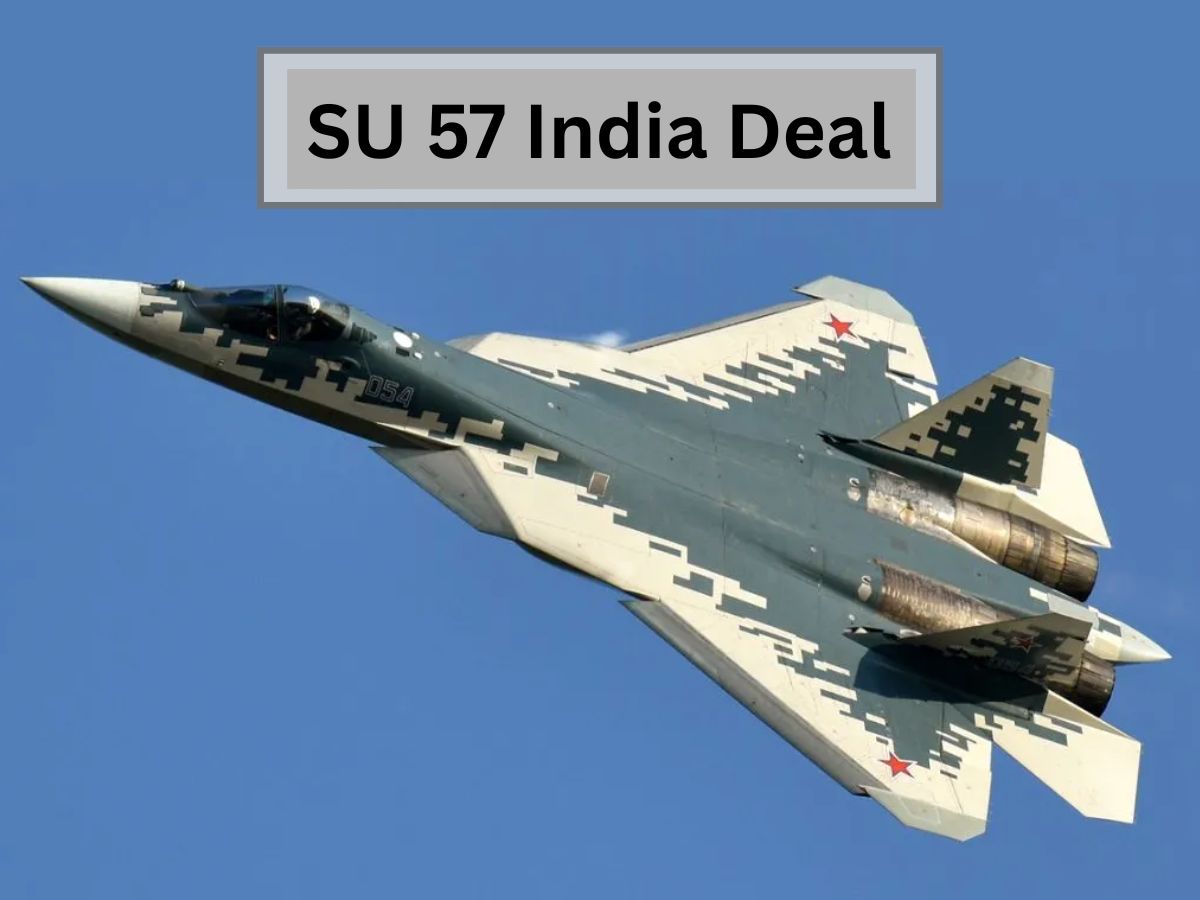
India’s air power strategy is entering a new phase as the Indian Air Force (IAF) evaluates multiple high-end fighter options. Soon after approving the purchase of 114 Rafale jets from France, the IAF has begun assessing a proposal to acquire 36–40 Sukhoi Su-57 stealth fighters from Russia.
Officials view the potential deal as a way to bridge the capability gap before India’s indigenous Advanced Medium Combat Aircraft (AMCA) becomes operational. The move highlights India’s multi-partner approach to strengthening its combat fleet amid rising regional competition.
What is the Su-57 Fighter Jet?
The Sukhoi Su-57 is Russia’s first fifth-generation stealth fighter, developed under the PAK FA programme. NATO refers to the aircraft as the “Felon.” Russia designed the jet to combine stealth characteristics with high manoeuvrability and long-range strike capability.
The Su-57 aims to compete with other fifth-generation platforms like the F-35 and China’s J-20. It serves as a multi-role aircraft capable of air superiority missions, ground attack, and electronic warfare. Russia introduced the aircraft into limited service in recent years and continues to upgrade its systems and engines.
Su-57 Fighter Jet Features
The Su-57 integrates stealth shaping, internal weapons bays, and advanced avionics to reduce radar visibility. It uses the AL-41F1 engine and plans to transition to the more advanced Izdeliye 30 engine for improved thrust and fuel efficiency.
Key features include:
- Supercruise capability without afterburners
- Thrust-vectoring engines for extreme agility
- Active electronically scanned array (AESA) radar
- Advanced electronic warfare suite
- Long-range air-to-air and precision-guided weapons
Unlike some Western stealth platforms that prioritise low observability above all else, the Su-57 balances stealth with aerodynamic performance and close-combat manoeuvrability.
Su-57 Fighter Jet India Deal
The proposed Su-57 India deal reportedly involves the procurement of 36–40 aircraft at an estimated cost of around $7 billion. The IAF sees the platform as a potential interim fifth-generation capability while the AMCA programme remains under development.
India currently does not operate a fifth-generation stealth fighter. With China expanding its J-20 fleet, defence planners are evaluating options to maintain air superiority in the region. The Su-57 could serve as a stopgap solution if negotiations progress.
However, any acquisition would require approval from the Defence Acquisition Council. Officials will assess operational performance, maintenance demands, long-term sustainability, and cost implications before taking a final call.
Sukhoi Su57 Fighter Jet Offer & Technology Transfer Pitch
Russia has offered more than a direct sale. The United Aircraft Corporation (UAC) has proposed licensed production of the export variant of the Su-57 in India. Existing facilities currently manufacturing the Su-30MKI could potentially adapt to assemble the new stealth jet.
The offer reportedly includes co-production arrangements and technology transfer elements. Engine access, avionics integration, and intellectual property rights will likely play a central role in negotiations.
Russia has also indicated its willingness to support India’s indigenous AMCA programme with technical collaboration. For New Delhi, meaningful technology sharing and domestic industrial participation will determine whether the deal aligns with its long-term self-reliance goals.
SU 57 India Deal: Rafale Expansion & FCAS
India recently cleared a major expansion of its Dassault Rafale fleet, significantly strengthening its 4.5-generation combat capability. The Rafale platform already operates within the IAF, and expanding the fleet builds on established infrastructure and logistics systems.
Simultaneously, India is exploring participation in France’s Future Combat Air System (FCAS), a sixth-generation fighter initiative. Discussions reportedly focus on advanced propulsion, stealth architecture, artificial intelligence integration, and manned-unmanned teaming.
By engaging both Russia and France, India maintains strategic flexibility while accelerating access to advanced aerospace technologies.
IAF Modernisation Plan: Stopgap or Strategic Shift?
The IAF’s modernisation strategy reflects a balancing act between immediate operational needs and long-term indigenous capability. The Su-57 could provide near-term fifth-generation exposure, while Rafale strengthens proven combat readiness. Meanwhile, the AMCA programme represents India’s ambition for a homegrown stealth fighter.
Policymakers must weigh budget priorities, geopolitical considerations, and technological benefits before finalising any agreement. If India proceeds with the Su-57, it will mark a significant step in reshaping the country’s future air combat doctrine.
For now, discussions remain exploratory. The final decision will define how India positions itself in the evolving global fifth-generation fighter landscape.




