
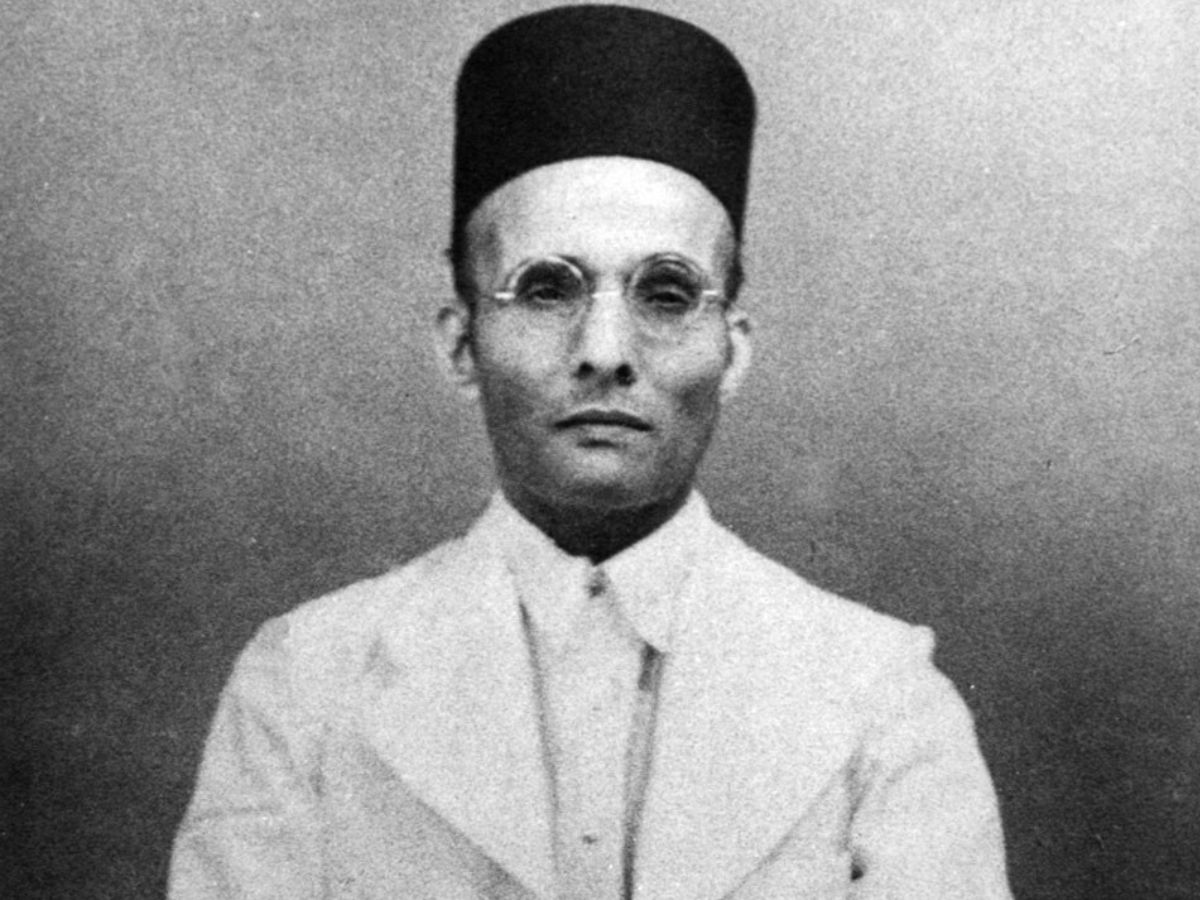
If Vinayak Damodar Savarkar had died in the Cellular Jail in 1915 – succumbing to the brutal torture, the solitary confinement, or the sheer hopelessness of Kaala Pani – there would likely be no debate today. He would be unequivocally hailed as a martyr of the highest order, mentioned in the same breath as Bhagat Singh or Chandrashekhar Azad. His poetry scratched on prison walls would be sacred text; his revolutionary organization, Abhinav Bharat, would be the stuff of unquestioned legend. The Bharat Ratna would likely have been conferred decades ago, posthumously, to the “Prince of Revolutionaries” who gave his life before his prime.
But Savarkar did not die.
The journey that began on 28 May 1883, in the village of Bhagur near Nashik, where he was born to Damodar and Radhabai Savarkar, was not destined to end in the Andamans. He committed the “sin” of surviving. And to survive, he did what any pragmatic prisoner of war might consider: he negotiated.
The argument against conferring the Bharat Ratna on Savarkar almost always hinges on the mercy petitions he wrote to the British authorities. Critics view these petitions as a moment of weakness that cancels out decades of sacrifice.
This perspective, however, demands a standard of superhuman perfection that we rarely apply to other historical figures.
To seek an end to torture and a return to active life is not an “unnatural” act; it is a profoundly human one. Savarkar chose the path of the survivor over the path of the martyr. He calculated that a live revolutionary – even one with clipped wings – was more useful to the nation than a dead icon in the Andamans.
This brings us to the actual substance of his life, which far exceeded the contributions of many contemporaries who have already been honoured.
Decades before the mass movements of the 1920s, Savarkar was arguably the first Indian leader to internationalize the freedom struggle.
Through Abhinav Bharat and the Free India Society in London, he created a global network for armed rebellion, smuggling manuals on bomb-making and weaponry into India when others were still drafting petitions.
His seminal work, The Indian War of Independence 1857 published in 1909, did more than just record history; it weaponized it. By reframing the “Sepoy Mutiny” as a war of independence, he provided the intellectual ammunition that fueled two generations of revolutionaries, from Madan Lal Dhingra to Subhash Chandra Bose. While others fought with satyagraha, Savarkar provided the strategic and intellectual framework for armed resistance.
Yet, his “Second Act” in Ratnagiri (1924-1937) was perhaps even more radical.
While many reformers of the era sought to uplift “untouchables” within the framework of the Hindu religion, Savarkar was a rationalist who sought to dismantle the structure entirely. He did not just preach; he operationalized his beliefs.
He built the Patit Pavan Mandir, one of the first temples in India open to all castes, including the then-untouchables, and appointed a Dalit priest to officiate – a move that was socially explosive at the time. He advocated for the breaking of the “seven shackles” (Sapta Bandi), promoting inter-caste dining and marriage not as symbolic gestures, but as biological necessities to unify the Hindu society.
Unlike contemporaries who often compromised with orthodoxy to maintain peace, Savarkar’s approach to social reform was scientific, militant, and uncompromising. He argued that before fighting the British, India had to defeat its own regressiveness.
Finally, no conversation about Savarkar is complete without addressing the elephant in the room: his alleged involvement in the assassination of Mahatma Gandhi.
Critics often use this as a permanent disqualifier for the Bharat Ratna.
However, in a constitutional democracy like India, we are governed by the rule of law, not by insinuation or political convenience.
The facts are a matter of public record. Savarkar was arrested, charged, and put on trial for the conspiracy. He faced the full might of the state’s prosecution. On 10 February 1949, the Special Court at Red Fort, presided over by Judge Atma Charan, delivered its verdict. After examining all evidence – including the testimony of the approver Digambar Badge – the court honourably acquitted Savarkar.
The judgment was clear: there was no independent corroboration to link him to the crime.
Under the Indian Evidence Act, the testimony of an accomplice requires independent verification to be credible. The prosecution failed to provide this.
To argue against the Bharat Ratna based on a crime for which the highest court of the land found him not guilty is to undermine the very judicial system we claim to uphold.
Savarkar died a free man, innocent in the eyes of the law. To continue to try him in the court of public opinion, decades after his legal exoneration, is an injustice not just to him, but to the principle of “innocent until proven guilty.”
Savarkar’s life was not a straight line of convenient heroism. It was complex, messy, and often contradictory. But the Bharat Ratna is not a reward for being non-controversial; it is a recognition of exceptional service and impact.
There is no doubt that Savarkar shaped the Indian consciousness – for better or worse – at a significant level. By the time he passed away on 26 February 1966, he had outlived the empire he fought and witnessed the birth of the nation he helped define.
We should not punish him for surviving the darkness of Kaala Pani just because we prefer our heroes to be martyrs who never came back.
Ultimately, the choice comes down to the criteria we value most. If we judge purely on merit and historical impact, the case for ‘Yes’ to him being conferred a Bharat Ratna is powerful. If we judge on political consensus and symbolism, the case for ‘No’ remains stubborn. But history is rarely comfortable, and true recognition shouldn’t be either.




